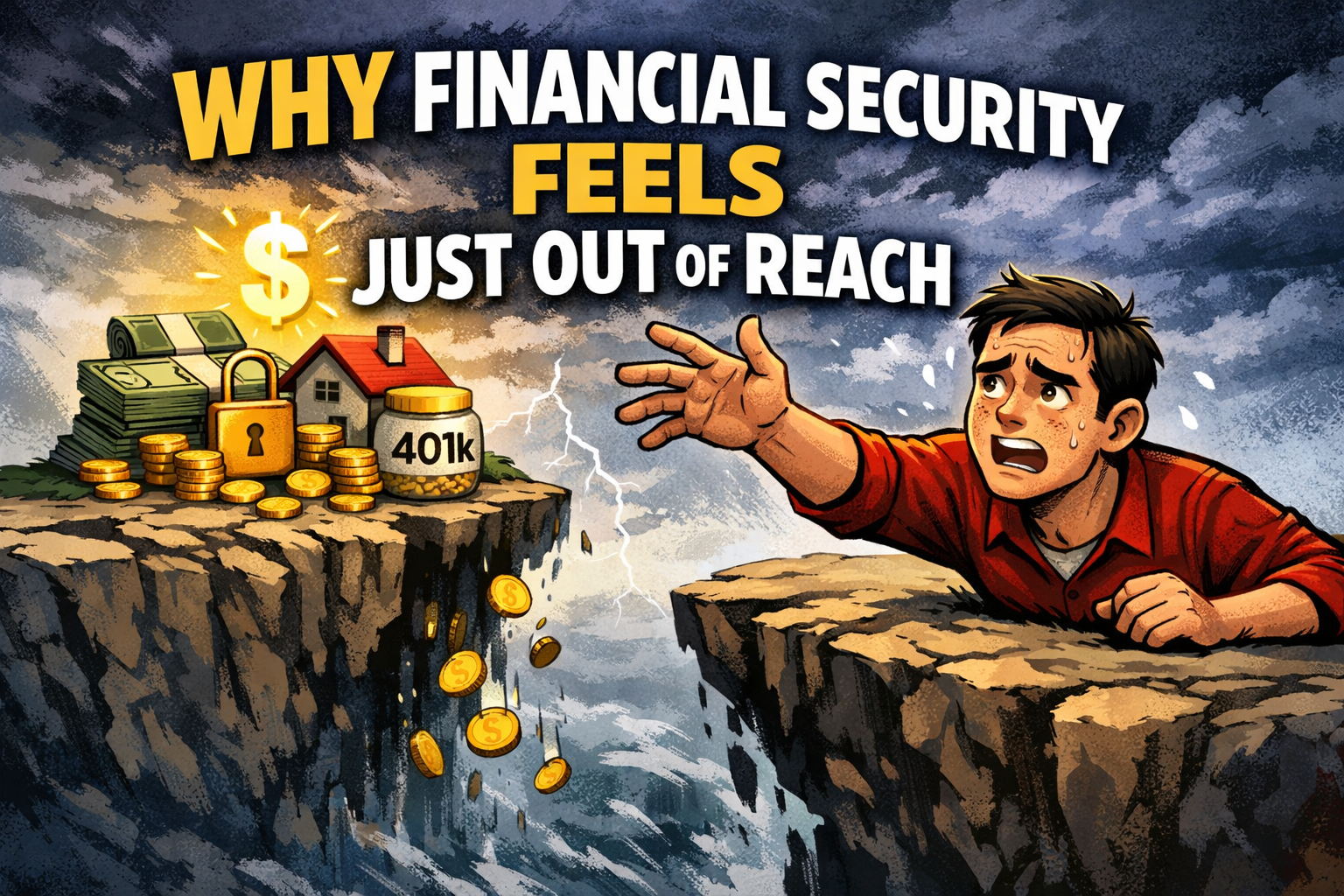
You finally pay off that lingering credit card debt. You get the raise you’ve been working toward. You hit the savings goal for your emergency fund. In that moment, there’s a wave of relief, a sense of accomplishment. You’ve solved a money problem. Yet, within days, weeks, or months, a new anxiety creeps in. The finish line seems to have moved. The feeling of being truly, completely “solved” financially remains perpetually over the horizon.
This isn’t a personal failing or a lack of discipline. It’s the product of a powerful confluence of psychology, evolving life stages, economic reality, and the very nature of modern money. The pursuit of financial peace often feels like running on a treadmill that gradually increases its speed—just as you match the pace, it accelerates again. Understanding why this happens is the first step to changing your relationship with money from one of endless problem-solving to one of sustainable navigation.
Part 1: The Shifting Goalposts of “Enough”
The most fundamental reason money problems feel unsolvable is that the definition of “solved” is a moving target, dictated by both our internal wiring and external circumstances.
1. Hedonic Adaptation: The Financial Treadmill
Humans are remarkably adept at getting used to things. This phenomenon, hedonic adaptation, means we quickly acclimate to a new level of income or wealth, and it soon becomes our new normal. The thrill of a $10,000 raise fades as new expenses or desires emerge. The car that once felt like a luxury becomes mere transportation. Our desires escalate in lockstep with our means. We move from “I need to be debt-free” to “I need a down payment” to “I need to save for my kids’ college” to “I need a secure retirement.” Each achievement is satisfying, but it merely unlocks the next level of financial concern. The goal isn’t to reach a plateau of contentment; it’s to climb an endless mountain where the summit is always shrouded in clouds.
2. Life’s Relentless Timeline
Financial needs are intrinsically tied to life stages, each with its own expensive portfolio of “problems” to solve.
- Your 20s & 30s: The problems are foundational: student loan debt, establishing credit, affording rent, saving for a first home, perhaps starting a family. Solving one (e.g., paying off loans) simply frees up resources to tackle the next colossal expense (e.g., a mortgage).
- Your 40s & 50s: The problems shift to amplification and pressure: funding retirement aggressively, paying for children’s education, caring for aging parents, navigating potential career plateaus or shifts. The stakes feel higher; the consequences of missteps are more severe.
- Your 60s and Beyond: The problems transform again: transitioning from accumulation to decumulation, managing healthcare costs, ensuring savings last 30+ years, legacy planning. The “problem” of retirement isn’t solved by retiring; it’s replaced by the problem of staying retired.
There is no natural pause button. Solving the money problem of one stage simply grants you admission to the next, more complex level.
3. The Myth of the Static Number
We love the idea of a magic number: “If I just had $X in the bank, I’d be set.” This number is often a snapshot of current anxieties projected onto the future. But the future is dynamic. Inflation silently erodes purchasing power, making today’s comfortable number tomorrow’s insufficiency. Personal circumstances change—a health diagnosis, a divorce, a new child, a desire to change careers. The economy shifts, impacting investment returns and job security. The static number you aimed for is a photograph in a world that is constantly moving. By the time you get there, the landscape has changed, requiring a new number.
Part 2: Psychological Traps That Perpetuate The Feeling
Our brains are not optimized for long-term financial serenity. They are built for immediate survival, which creates cognitive biases that make us feel perpetually behind.
1. Loss Aversion and Scarcity Mindset
The pain of losing $100 is psychologically about twice as powerful as the pleasure of gaining $100. This “loss aversion” makes us hyper-vigilant about potential financial threats, even when we’re objectively secure. It fuels a scarcity mindset, where we focus on what we might lose rather than what we have. This mindset, once established, is hard to shake. Even after building a safety net, the brain remains primed to scan for danger, interpreting normal market fluctuations or unexpected bills as existential threats, reinforcing the feeling that things are never truly safe.
2. Social Comparison: The Neighbor’s Lawn
Our reference for “normal” or “successful” is rarely our own past self; it’s our peers, our community, and the curated highlight reels on social media. This constant comparison creates a phenomenon known as “lifestyle inflation by proxy.” When you see others with newer cars, bigger homes, or fancier vacations, your own achievements can feel diminished. Your adequately funded retirement account feels paltry against someone’s boast about a hot stock tip. This robs you of the satisfaction of solving your own problems, because the goalpost is no longer your security, but keeping up with an ever-accelerating social standard that is often an illusion of debt and leverage.
3. The Planning Fallacy and Unknown Unknowns
We are terrible at predicting the future, especially the cost and complexity of future problems. We budget for known expenses but consistently underestimate them (the planning fallacy). More profoundly, we cannot budget for “unknown unknowns”—the black swan events like a pandemic, a sudden industry collapse, or a family crisis. Because these events are, by definition, unforeseen, we can never feel fully “solved.” There is always the lurking awareness that something from left field could unravel our best-laid plans. Financial planning thus becomes less about building an impenetrable fortress and more about building a resilient system that can withstand shocks—but the potential for shocks never disappears.
Part 3: The Systemic Reality of Modern Economics
The feeling of being unsolved isn’t just in our heads; it’s woven into the fabric of the contemporary economic system.
1. The Transformation from Ownership to Subscription
Past generations often measured stability through ownership: a paid-off home, a car owned outright, furniture that lasted decades. Today, the economy increasingly pushes us toward subscription and leasing models: software, vehicles, entertainment, even clothing. This creates perpetual monthly obligations. Where once solving a problem meant eliminating a payment (paying off a loan), now “solutions” often involve adding another ongoing fee for convenience or access. Financial life becomes a juggling act of recurring charges, never feeling the concrete finality of outright ownership.
2. The Erosion of Traditional Safety Nets
The responsibility for financial security has shifted dramatically from institutions to individuals. Pensions have given way to 401(k)s, placing the burden and risk of investment and longevity on the employee. Healthcare costs are increasingly borne by individuals through high-deductible plans. Job tenure has shortened. This massive transfer of risk means that individuals are now managing a complex portfolio of risks (market risk, longevity risk, health risk, employment risk) that were once pooled and managed by companies or the state. The job of managing this risk is endless and inherently anxiety-provoking; you can never fully “solve” for every potential outcome.
3. Inflation: The Silent Thief of Solutions
Inflation is the background radiation of financial planning. A “solved” budget from 2019 is broken in 2024 simply due to the rising cost of groceries, utilities, and housing. Even with wage growth, inflation creates a constant, low-grade pressure that requires continual adjustment. You don’t just solve your housing cost; you have to solve it again next year when property taxes and insurance rise. The victory of reaching an income goal is diluted if that income buys less than you anticipated. It’s a race where the track itself is lengthening as you run.
Part 4: The Problem of “Enough” in a Culture of More
Our societal narrative is fundamentally at odds with the concept of “enough.”
1. Consumerism as Identity
We live in an engine of consumption where buying is tied to identity, belonging, and even self-worth. To stop striving for more—a bigger house, a more prestigious brand, a more exotic experience—can feel like social or personal stagnation. The economy is predicated on continuous growth and desire. Choosing to be content with “enough” runs counter to the cultural current. Therefore, feeling financially “solved” can feel oddly like giving up, or settling, rather than achieving a wise and sustainable peace.
2. The Blurred Line Between Want and Need
Marketing and technology have masterfully blurred the line between luxuries and necessities. A smartphone was a luxury 15 years ago; today, it’s often essential for work, school, and basic communication. High-speed internet, multiple streaming services, premium healthcare options—all are framed as parts of a standard, expected life. This constantly expanding basket of “needs” makes it incredibly difficult to feel you’ve met them all. What you considered a solved, comfortable life a decade ago might look deprived by today’s standards, not because your core needs have changed, but because the definition of normal has been artificially inflated.
Navigating the Unsolvable: From Destination to Journey
If financial problems are never truly solved in a permanent sense, what is the path forward? The answer lies in shifting your mindset from seeking a final destination to mastering the skill of navigation.
1. Redefine “Solved” as “Secure and Adaptive.”
Stop thinking of being solved as a state where no financial concerns exist. Instead, define it as having resilience and options. Resilience is your emergency fund, your insurance, your diverse skills. Options are your savings, your investments, your debt-free status that give you choices. The goal isn’t to eliminate all problems, but to have the tools and capacity to handle them without crisis. This is a state you can achieve and maintain, even as specific problems change.
2. Practice Intentional Gratitude and Comparison.
Actively combat hedonic adaptation and social comparison by ritualizing gratitude for your financial progress. Regularly review how far you’ve come. Compare yourself to your past self, not to your neighbor’s curated present. This isn’t about complacency, but about acknowledging victories to fuel sustainable effort, rather than feeling perpetually behind.
3. Embrace “Enough” as a Radical Act.
Consciously define what “enough” means for you, based on your values, not your feed. Is it debt-free living? Is it the ability to work less and live more? Is it funding your children’s education? Write it down. Once you hit a milestone that satisfies your definition of “enough,” have the courage to redirect energy from endless accumulation to other sources of fulfillment—relationships, hobbies, health, community. This breaks the treadmill cycle.
4. Focus on Systems, Not Just Goals.
Goals are checkpoints (pay off debt, save $X). Systems are the ongoing processes that get you there and beyond (automated savings, monthly budgeting reviews, continuous learning). By building robust financial systems—automated investing, a clear spending plan, regular check-ins—you manage the endless series of “problems” on autopilot. The feeling of control comes from maintaining the system, not from reaching a single point.
5. Accept Uncertainty as a Non-Negotiable.
Make peace with the fact that you cannot predict or prevent all financial shocks. The goal is not a risk-free life, which is impossible, but a shock-absorbent one. Build a buffer, diversify your income, stay insured. Then, acknowledge that some anxiety is rational—it’s a signal that you’re aware of your responsibilities, not a sign that you’re failing.
Conclusion: The Peace is in the Process
The persistent feeling that money problems are never solved is not a sign that you’re bad with money. It is a logical reflection of human psychology, a dynamic life, and a complex economic world. The quest for a finish line is a mirage.
True financial peace, therefore, is found not in the elusive state of being “done,” but in the confidence of your ability to handle what comes. It’s the peace of the sailor who doesn’t expect a flat, calm ocean, but who trusts their skill, their boat, and their navigational tools to weather storms and adjust course. It comes from knowing you have built resilience, that you are living in alignment with your values, and that you are actively steering your financial life, rather than being passively tossed by its waves.
Release the burden of solving money forever. Instead, cultivate the skill of managing it wisely, continuously. That is where stability—not as a static condition, but as a durable, adaptable state of being—truly resides.
Money Habits That Quietly Destroy Financial Stability 3000 word no ai no duplicate seo optimize or non plag
Why Money Problems Never Feel “Solved” 3000 word no ai no duplicate seo optimize or non plag