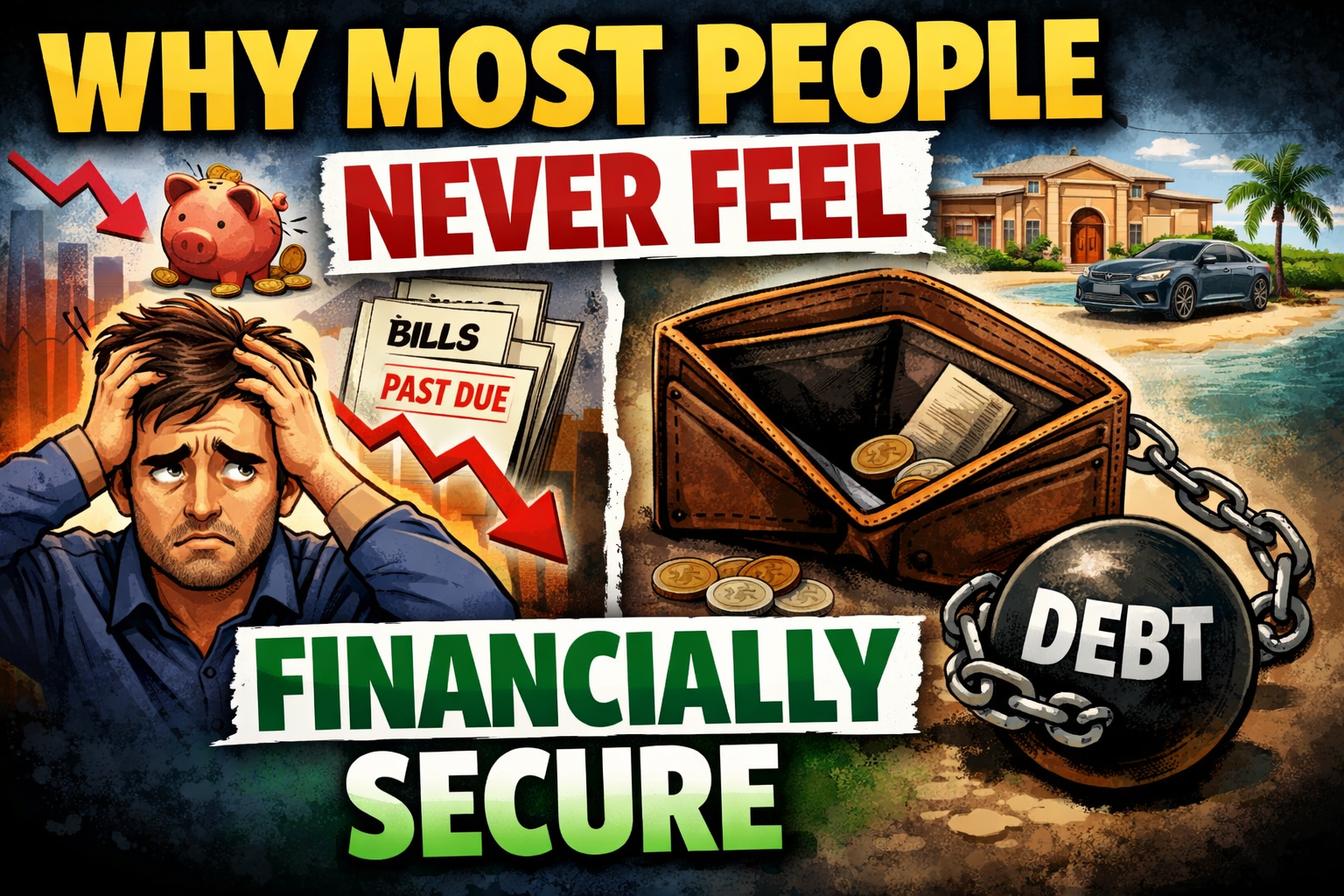
Financial security. It’s a phrase that conjures images of peace, freedom, and a life unchained from relentless worry. It’s not necessarily about private jets or sprawling estates; at its core, it’s the profound sense that you can handle life’s inevitable surprises—a job loss, a medical emergency, a broken furnace—without your world crumbling. It’s the quiet confidence that your needs are met today and will be met tomorrow.Why Most People Never Feel Financially Secure
Yet, for a staggering majority, this state remains perpetually out of reach. Even as incomes rise, debts are paid, and net worth grows, a lingering anxiety about money persists. This isn’t a simple failure of arithmetic or discipline. The feeling of financial insecurity is a complex tapestry woven from psychological wiring, systemic economic pressures, and powerful societal narratives. Understanding why most people never feel financially secure requires looking beyond the bank statement and into the human condition itself.
Part 1: The Psychological Abyss – The Mind’s Role in Perpetual Scarcity
Our brains are not evolved for modern finance. They are survival engines, optimized for immediate threats and relative standing within a tribe. This ancient hardware runs buggy software in the face of 21st-century economics.
1. The Moving Goalpost of “Enough”: Financial security is a horizon, not a destination. The concept of “enough” is psychologically fluid. A person earning $50,000 a year might believe security lies at $75,000. Upon reaching it, the goal quietly shifts to $100,000, then to a paid-off mortgage, then to a specific retirement portfolio value. This is known as “hedonic adaptation” or the “hedonic treadmill.” We adapt to new levels of prosperity quickly, and they become our new baseline, from which we look toward the next peak. The finish line moves faster than we can run.
2. The Scarcity Mindset: Chronic financial worry, even at moderate income levels, can trigger a “scarcity mindset.” Pioneered by researchers like Sendhil Mullainathan and Eldar Shafir, this cognitive tunnel vision forces the brain to focus intensely on immediate lacks—the overdue bill, the dwindling checking account. This consumes precious “mental bandwidth,” leaving less cognitive resource for long-term planning, prudent decision-making, and impulse control. Ironically, the feeling of insecurity creates a state of mind that perpetuates insecurity, leading to short-sighted choices (like high-interest payday loans) that deepen the trap.
3. Loss Aversion and Catastrophizing: Our brains are wired to feel the pain of loss more acutely than the pleasure of an equivalent gain. Losing $100 feels about twice as bad as finding $100 feels good. This “loss aversion” makes us hyper-vigilant to potential financial downturns. We obsess over market dips, fret over small, unexpected expenses, and inflate the likelihood of worst-case scenarios. This constant, low-grade alarm system makes it impossible to feel secure, as the mind is always scanning for threats.
4. The Illusion of Control and the Role of Uncertainty: Humans crave predictability. Financial life, however, is fundamentally uncertain—markets fluctuate, industries disrupt, health fails. This gap between our need for control and the reality of chaos generates profound anxiety. We try to bridge it by constantly monitoring our finances, checking investment portfolios daily, and seeking reassurance, but this often backfires, exposing us to more volatility and reinforcing our fears. True security would require accepting uncertainty, a psychologically difficult feat.
Part 2: The Systemic Squeeze – Economic Realities That Undermine Foundations
While psychology plays a starring role, the stage is set by a series of powerful, often unforgiving, economic structures.
1. The Erosion of the Safety Net and the Rise of the Gig Economy: For previous generations, financial security was often tied to a single employer offering a pension, lifelong career progression, and robust health benefits. That model has largely dissolved. Defined-benefit pensions are rare, replaced by defined-contribution plans (like 401(k)s) that shift all market and longevity risk onto the individual. The rise of contract work, freelance, and gig jobs offers flexibility but trades away stability, predictable income, and employer-sponsored benefits. You are now your own Chief Financial Officer, actuary, and benefits administrator—a daunting responsibility.
2. Stagnant Wages vs. Soaring Core Costs: For decades, median wages in many developed nations have failed to keep pace with productivity and, more importantly, with the inflation of critical life components. The cost of healthcare, higher education, and housing has skyrocketed, while wage growth has been anemic. A person can be making nominally more money than their parents did at the same age but be far less secure because a single medical deductible could be catastrophic, student loan payments mimic a mortgage, and buying a home feels like a feudal quest. Earning more but falling further behind core asset ownership is a recipe for perpetual insecurity.
3. The Debt Spiral: From Tool to Master: Credit, initially a tool for building assets (like a mortgage), has morphed into a necessary lifeline for daily survival and lifestyle maintenance. Easy access to high-interest consumer debt—credit cards, “buy now, pay later” schemes—allows consumption to continue despite stagnant wages. However, this creates a vicious cycle: debt payments consume disposable income, leaving no buffer for savings, which increases vulnerability to shocks, leading to more debt. The constant pressure of monthly payments, often spanning decades for education and housing, makes the feeling of being “debt-free” (a cornerstone of security) a distant, almost mythical, dream.
4. The Retirement Mirage: The burden of funding a potentially 30-year retirement has been transferred entirely to the individual. The math is terrifying for the average person. Calculating a “magic number,” managing asset allocation, understanding sequence-of-returns risk, and planning for unknown healthcare costs is complex. The pervasive fear of outliving one’s money (“longevity risk”) casts a long shadow backward, making even the accumulation phase feel fraught with peril. There’s no bell that rings telling you you’ve definitively “made it.”
Part 3: The Social Mirror – Comparison, Culture, and Contradictory Messages
We don’t evaluate our financial status in a vacuum. We are constantly comparing ourselves to a curated, often distorted, social mirror.
1. Lifestyle Inflation and “Keeping Up”: Consumption has become a primary signal of success. Social media, in particular, provides a 24/7 highlight reel of peers’ and influencers’ purchases, vacations, and life upgrades. This fuels “lifestyle inflation”—the tendency to spend more as one earns more, not on essentials, but on elevated social standards. The pressure to maintain a certain appearance—the right car, neighborhood, schools, vacations—can divert resources from building actual security (savings, investments) toward performing security. It’s a costly charade that drains financial resilience.
2. The Myth of the Self-Made and the Stigma of Struggle: Our culture venerates the “self-made” millionaire, framing financial success as a pure function of grit and intelligence. The inverse of this narrative is the toxic belief that financial struggle is a personal moral failing—a lack of hard work, intelligence, or frugality. This stigma silences people, preventing open discussion about money struggles and learning from shared experience. It internalizes systemic problems as personal shame, amplifying anxiety and isolation.
3. The Ambiguity of “Rich” vs. “Secure”: Society conflates being rich with being secure. They are not the same. One can have a high income and be financially fragile (living paycheck-to-paycheck on a large salary). One can have modest means but be profoundly secure (low expenses, no debt, robust savings). Yet, the cultural script pushes us to pursue visible wealth (more, bigger, newer) rather than invisible security (options, flexibility, resilience). We chase the symbol over the substance.
4. The Planning Fallacy and Optimism Bias: Humans are notoriously bad at long-term planning. We underestimate costs, overestimate future earnings, and believe negative events (job loss, illness) are less likely to happen to us. This “optimism bias” leads to under-saving, under-insuring, and a lack of contingency planning. When the inevitable unexpected expense arises, it feels like a shocking betrayal rather than a predictable part of life, further eroding the sense of security.
Breaking the Cycle: From Insecurity to Resilience
Feeling financially secure may never be a permanent, fixed state. But it can be a dominant, resilient one. The path isn’t found in a single stock tip or a stringent budget alone. It requires a multi-front campaign:
1. Redefine “Enough” Internally: This is the critical psychological shift. It involves a conscious, ongoing process of disentangling your definition of security from societal benchmarks. It means identifying the monthly income that covers your true needs (including savings for goals and emergencies) and viewing anything beyond that as a bonus for future security or carefully chosen joys, not as fuel for an upgraded lifestyle treadmill.
2. Build the Buffer, However Small: The single most powerful antidote to the scarcity mindset is a dedicated emergency fund. It transforms abstract threats into manageable inconveniences. Starting with a $500 goal, then one month’s expenses, then three, and ideally six, creates a psychological moat around your mind. This cash buffer is not for investing; it is “insurance premium” you pay to yourself for peace of mind.
3. Optimize for Flexibility, Not Just Income: In a volatile world, security is less about a high fixed salary and more about options. This means investing in portable, in-demand skills. It means considering a smaller mortgage that allows one partner to step back from work if needed. It means building side income streams. Flexibility reduces the terror of any single point of failure.
4. Limit Comparison Consumption: Conduct a ruthless audit of your media inputs. Unfollow accounts that trigger envy and the “compare-and-despair” reflex. Curate your information diet towards education, inspiration from those focusing on resilience, and realistic portrayals of financial life. Remember, you are comparing your behind-the-scenes to everyone else’s highlight reel.
5. Focus on Control, Not Outcomes: You cannot control the stock market, inflation, or global events. You can control your spending, your savings rate, your skill development, and your debt load. Directing energy towards these controllable inputs is empowering and reduces anxiety over uncontrollable outcomes. Automate your savings and investments to make prudent behavior the default.
6. Normalize the Conversation: Break the silence. Talk to trusted friends about real numbers, fears, and strategies. You will find you are not alone. This demystifies money, reduces shame, and provides a support network for accountability and shared learning.
Conclusion: The Security of the Ant, Not the Grasshopper
The fable of the Ant and the Grasshopper is often oversimplified as a morality tale about hard work. But its deeper lesson is about temporality. The grasshopper lives in an eternal, insecure present. The ant understands the cyclical nature of life—that winter always comes.
Most people never feel financially secure because they are conditioned to live in the eternal summer of consumption, comparison, and immediate gratification, while their ancient brains scream about winter. They are running on a treadmill pointed toward a cliff, told to run faster.
True financial security is not a number you hit. It is the cultivated, daily practice of the ant. It is the intentional, sometimes boring, work of gathering resources during your personal summer, strengthening your colony (support network), and knowing your hill is fortified against the known and unknown seasons to come. It is the quiet confidence that comes not from having everything, but from knowing, deeply, that you have built the capacity to handle anything. It shifts the question from “Do I have enough?” to “Am I resilient enough?” In that shift lies the only security that is ever truly attainable.