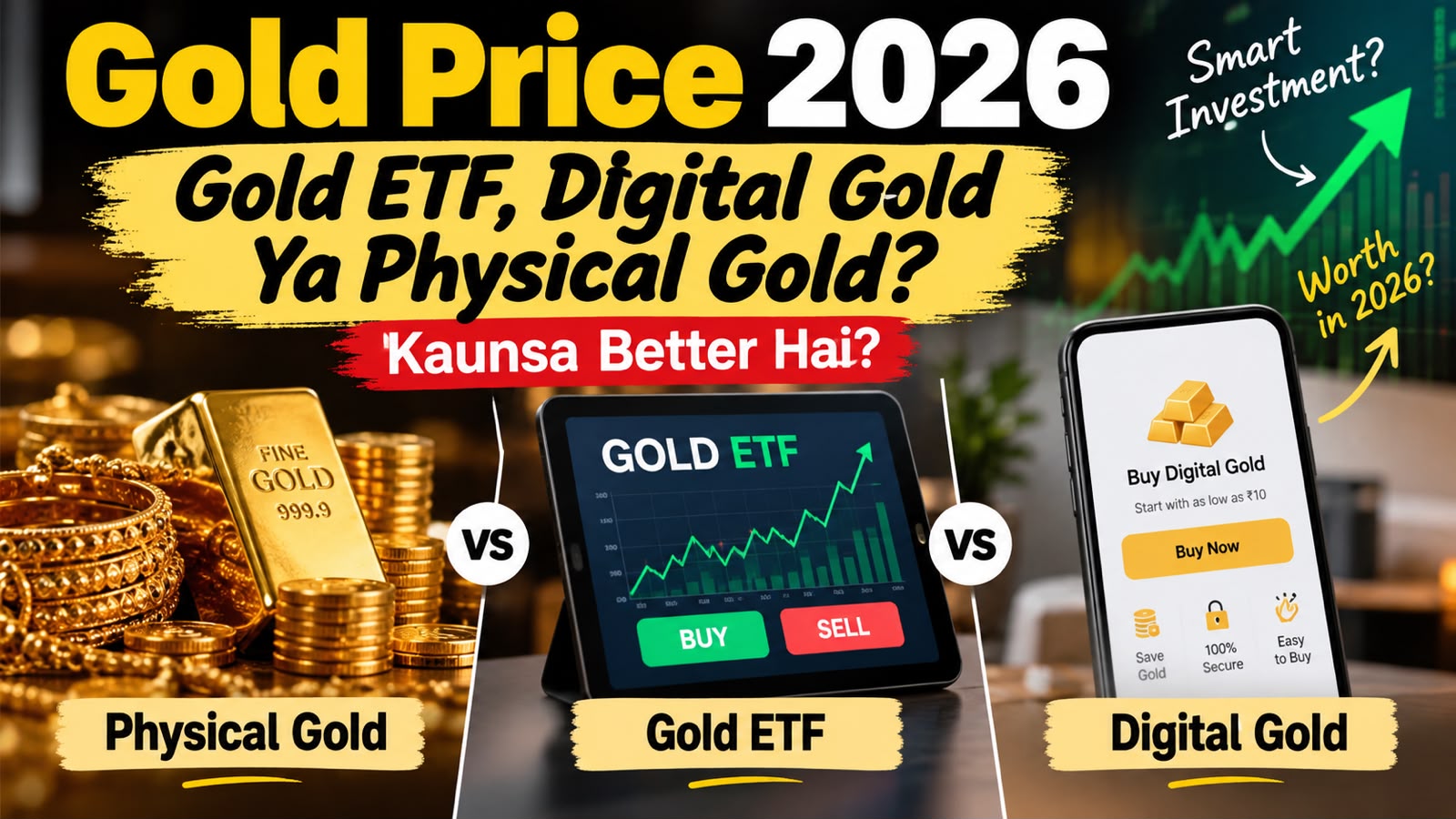
Whenever gold is mentioned in India, the first things that come to mind are jewellery, weddings, and festivals. However, gold is no longer limited to jewellery. Many people also include gold in their investment portfolios.
Gold prices have seen significant movement in 2026. Prices are currently at high levels, which has led to a common question among investors: If you want to invest in gold now, should you choose Gold ETF, Digital Gold, or Physical Gold?
The simple answer is that no single option is suitable for every investor. Some people want physical gold, some only want investment exposure, while others find it convenient to buy small amounts of gold regularly.
That is why it is important to understand all three options before making a decision.
Why Is Gold Demand in Discussion in 2026?
Gold has traditionally been considered an important asset during uncertain times. Factors such as the global economy, interest rates, inflation, currency movements, and geopolitical developments influence gold prices.
Gold has continued to attract strong interest in 2026. According to the World Gold Council’s September 2026 update, demand for Gold ETFs in India remained positive, while digital gold buying also maintained momentum. Indian Gold ETFs recorded an inflow of ₹2,597 crore in August, which was 67% higher than in July.
However, this does not mean that gold prices will always move upward. In September, gold faced short-term pressure in international markets due to a stronger US dollar and higher Treasury yields.
In other words, gold is also a market asset, and its price can rise and fall.
Now let us understand the actual difference between Physical Gold, Gold ETF, and Digital Gold.
⸻
Physical Gold: The Oldest and Most Familiar Option
Physical gold is the most traditional form of gold investment in India. Jewellery, coins, and bars fall under this category.
Many Indian families have been buying gold for generations. One reason is that physical gold has personal and emotional value in addition to its investment value.
Whether it is a wedding, festival, or gift for someone, physical gold can be used easily.
What Are the Benefits of Physical Gold?
The most obvious benefit is that you physically own the gold.
You can wear jewellery, gift it to someone, or sell it in the future. You do not need a demat or trading account for this.
However, there is one important point to remember.
If you are buying jewellery, you do not pay only the market price of gold. Making charges and applicable taxes also affect the final bill.
For example, if the actual value of the gold is ₹1 lakh, the final jewellery bill may be noticeably higher because of making charges and taxes.
That is why jewellery needs to be viewed differently when the objective is purely investment.
Problems with Physical Gold
Keeping physical gold also involves security and storage concerns.
If you own a large quantity, you may need a locker or secure storage.
At the time of selling, purity, the jeweller’s buyback policy, and the prevailing market price also become important.
Who Should Consider Physical Gold?
If you actually need jewellery or prefer to personally hold physical gold, it can be a practical option.
However, if your only objective is to earn returns from gold price movements, you should also compare other options.
⸻
Gold ETF: A Market-Based Way to Invest in Gold
Gold ETF stands for Gold Exchange Traded Fund.
In simple terms, a Gold ETF gives you exposure to gold prices without requiring you to store physical gold at home.
Gold ETFs are traded on stock exchanges. Therefore, investors generally need a demat and trading account.
One major difference is that a Gold ETF is a SEBI-regulated financial product.
The Biggest Advantage of Gold ETFs
Gold ETFs do not involve making charges like jewellery.
You also do not need to store gold physically. Concerns related to lockers, theft, and physical storage are comparatively lower.
Since ETFs are traded on stock exchanges, investors can buy or sell units during market hours.
Investor interest in Gold ETFs remained strong in 2026. According to World Gold Council data, Indian Gold ETFs received an inflow of ₹2,597 crore in August 2026.
This shows that investors are increasingly viewing gold as a financial asset.
What Costs Are Involved in Gold ETFs?
Gold ETFs are not completely cost-free.
They may involve an expense ratio and transaction-related costs. Brokerage may also depend on the investor’s trading setup.
Therefore, before investing, it is useful to check the ETF’s expense ratio and tracking performance.
Who Should Consider Gold ETFs?
Gold ETFs may be relevant for investors who want to add gold to their portfolio but do not want to store physical gold.
If your objective is investment rather than jewellery, it is useful to compare Gold ETFs with Physical Gold.
⸻
Digital Gold: An Easy Way to Buy Gold Through Your Mobile
Digital Gold has made buying gold much simpler.
Today, users can purchase small amounts of gold through several online platforms and apps. This can be convenient for people who do not want to invest a large amount at one time.
You make the purchase through your phone, and your gold quantity is displayed on the app.
You do not need to keep physical gold at home.
This convenience is the biggest attraction of Digital Gold.
However, Digital Gold Should Not Be Confused with Gold ETFs
This is a very important point.
Digital Gold and Gold ETFs may both appear to be online investment options, but their regulatory structures are not the same.
In November 2025, SEBI specifically cautioned investors that Digital Gold products offered on online platforms are not equivalent to SEBI-regulated Gold ETFs or securities.
According to SEBI, such digital gold products were not regulated as securities or commodity derivatives, and the investor protection framework applicable to the securities market did not apply to them.
In 2026, discussions about stronger regulatory oversight for Digital Gold were also reported. However, investors should understand the difference between proposed changes and final government or regulatory notifications.
Therefore, before buying Digital Gold, it is important to check the platform’s terms, charges, storage arrangements, redemption process, and regulatory status.
⸻
Gold ETF vs Digital Gold: What Is the Difference?
This comparison has become especially important in 2026.
A Gold ETF is a regulated financial product traded on a stock exchange.
Digital Gold is generally purchased through an online platform, and its regulatory framework is different from that of a Gold ETF.
If you use a demat account and want gold exposure in your investment portfolio, it is useful to understand how Gold ETFs work.
If you want to accumulate gold in small amounts and app-based convenience is important to you, Digital Gold may seem convenient. However, regulatory protection and platform-related risks should not be ignored.
⸻
Gold Price 2026: Should You Buy Gold Now?
This is a question almost every investor has in mind.
When gold prices are high, it is natural to feel that entering the market now may be risky.
However, it is not possible to accurately predict the future price of any asset.
Gold prices may move because of interest rates, the dollar, and global events. They may also be influenced by investor demand and central-bank buying.
In 2026, gold has experienced periods of strong gains as well as volatility.
Therefore, investing only because “gold will rise further” or avoiding it because “gold is already too expensive” can both be oversimplifications.
Investors should also consider their financial goals and investment horizon.
⸻
Physical Gold, Gold ETF, and Digital Gold: Quick Comparison
Feature Physical Gold Gold ETF Digital Gold
Physical possession Yes No Generally no
Demat account No Usually required No
Storage required Yes No Generally no
Jewellery use Yes No No
Buying with a small amount Relatively difficult Possible Easy
Trading on an exchange No Yes No
SEBI-regulated Physical commodity Yes Not equivalent to a Gold ETF
Making charges May apply to jewellery No No
Convenience Medium High High
Main use Jewellery and physical ownership Investment Convenient gold accumulation
⸻
Check These 5 Points Before Buying Gold
- Why Are You Buying Gold?
First, be clear about your purpose.
If you need jewellery, Physical Gold is the logical choice.
If you only want to invest, it may be useful to compare financial products such as Gold ETFs.
If you want to accumulate gold regularly in small amounts, the convenience of Digital Gold may seem attractive.
- Look at the Total Cost
Do not look only at the headline gold price.
Physical Gold may involve making charges and taxes.
Gold ETFs may involve an expense ratio and transaction costs.
Digital Gold may involve a buy-sell spread, platform charges, or delivery-related charges.
It is important to understand the total cost before making a final decision.
- Understand Liquidity
If you may need to convert your investment into cash quickly in the future, understand the exit process in advance.
Gold ETFs provide exchange-based trading.
Selling Physical Gold depends on the jeweller and market conditions.
For Digital Gold, the platform’s redemption and selling rules are important.
- Check the Regulation
This is especially important in the case of Digital Gold.
SEBI has clarified that Digital Gold products should not be considered equivalent to SEBI-regulated Gold ETFs.
Therefore, do not automatically assume that every product described as “online gold” has the same investor protection framework.
- Maintain Portfolio Balance
Gold can be considered one part of an investment portfolio.
Investing all your savings only in gold would generally be the opposite of diversification.
The allocation between equity, debt, cash, and gold depends on an individual investor’s goals, time horizon, and risk tolerance.
⸻
Is Jewellery the Best Option for Investment?
In India, it is common to view jewellery as an investment. However, jewellery serves both an investment and a consumption purpose.
Making charges can increase the purchase cost. When you sell the jewellery, you may not necessarily recover all the charges paid at the time of purchase.
Therefore, if your objective is purely investment, you should compare jewellery with other forms of gold investment.
If you actually need jewellery, the calculation will be different.
⸻
What Should You Check Before Buying Digital Gold?
Before buying Digital Gold, do not look only at the app interface or promotional offer.
Make sure you check the following:
- Through which entity is the gold stored?
- What is the purity of the gold?
- What is the difference between the buying and selling price?
- Is physical delivery available?
- How much are the delivery charges?
- What is the redemption process?
- What do the platform’s terms and conditions say?
- What is the current regulatory status of the product?
These small details can become very important in the future.
⸻
Which Gold Option Should You Choose in 2026?
The answer depends on your purpose.
Physical Gold is practical for people who want to own actual gold or use it as jewellery.
Gold ETFs are relevant for investors who want to add gold to their financial portfolio and prefer an exchange-traded, regulated product.
Digital Gold may be convenient for people who want to accumulate gold in small amounts through an app. However, it is important to understand that its regulatory structure is different from that of a Gold ETF.
Despite gold prices being at high levels in 2026, investment demand has remained strong. However, strong past performance does not guarantee future returns.
When investing in gold, the most important factor is not just the price. The product structure, total cost, liquidity, regulation, and your investment objective are equally important.
Final Words
The excitement around gold is understandable, especially when prices are making headlines. However, making an investment decision based only on recent price movements is not the right approach.
If you need jewellery, the purpose of Physical Gold is clear. If you want gold exposure for portfolio diversification, it may be useful to understand regulated products such as Gold ETFs. If you want to accumulate gold in small amounts through a digital platform, carefully check the risks and terms of Digital Gold.
The simple rule is: decide your purpose first, and then choose the product.
No one can guarantee what the price of gold will be tomorrow. However, you can clearly understand the form in which you are buying gold, the costs involved, and the risks associated with it.
Disclaimer: This article is for general educational purposes only and does not constitute personalised investment advice. Gold prices, taxation, regulations, and financial product terms may change over time. Check the latest official information and product documents before investing.