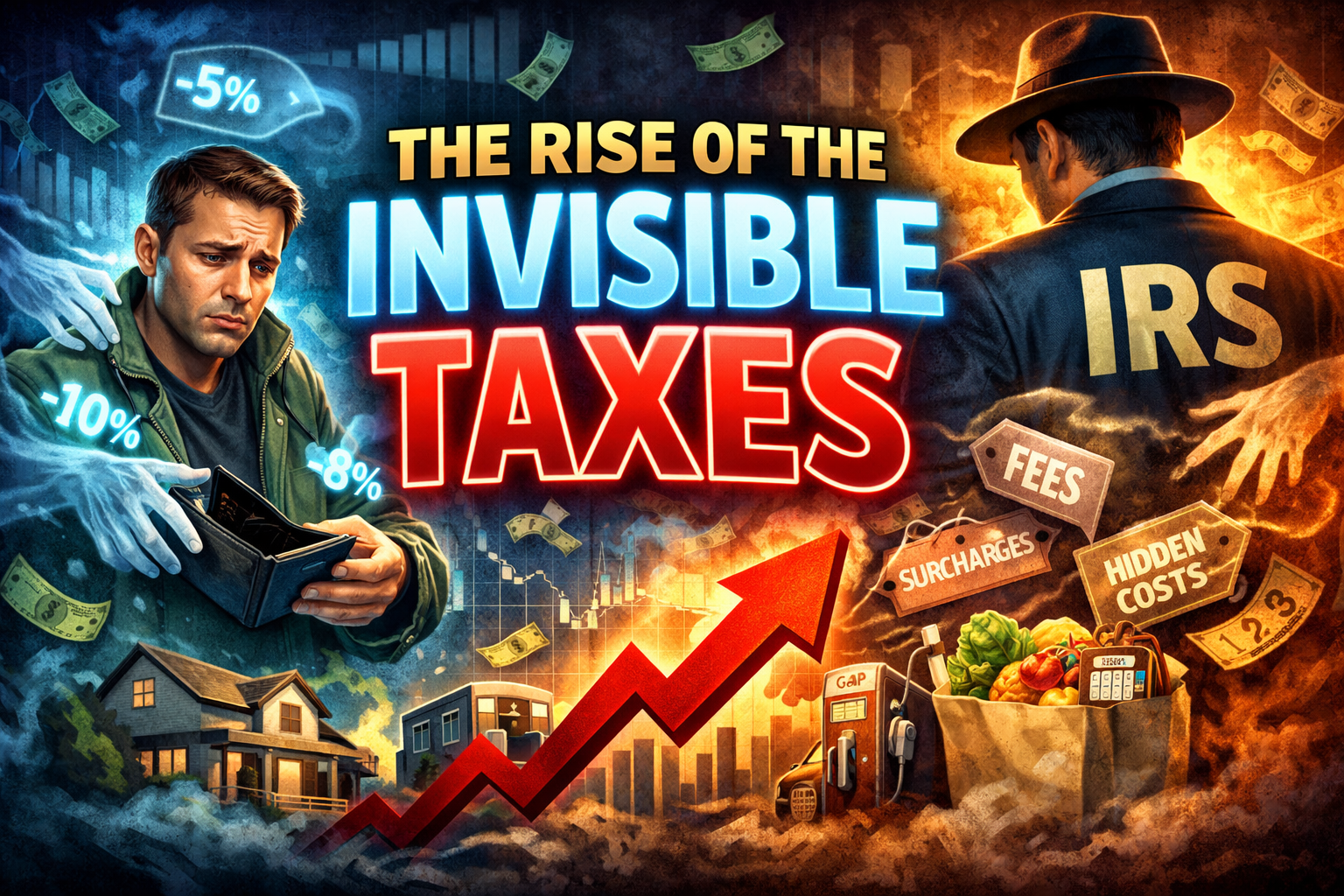
We live in an age of unparalleled abundance and technological marvel. At our fingertips, we command goods, services, information, and social connections that were unimaginable a generation ago. The conveniences are so deeply woven into the fabric of daily life that we rarely stop to consider their true cost. For while the era of visible, state-mandated taxation continues, a new and more pervasive system of extraction has emerged. This system does not demand a portion of our income through bureaucratic forms; instead, it levies a toll on our most intangible yet vital resources: our convenience, our demand for speed, our desire for status, and our finite attention. These are the Invisible Taxes of the 21st century, and their cumulative burden is reshaping our economies, our psyches, and our societies in profound and often unsettling ways.The Rise of the Invisible Taxes
This essay will explore the architecture of these four dominant Invisible Taxes, examining how they are levied, who benefits, and the price we pay beyond the dollar amount. It will argue that while often presented as choices within a free market, they function as coercive, systemic forces that extract value from individuals in ways that are opaque, psychologically manipulative, and ultimately corrosive to genuine human flourishing.
The Convenience Tax: The Premium on Effortlessness
The most readily apparent of the invisible levies is the Convenience Tax. It is the delta between the base cost of a good or service and the price we pay to avoid friction, physical effort, or mental labor.
How It Is Levied: The mechanism is straightforward. A company identifies a point of friction in daily life—grocery shopping, meal preparation, transportation, home cleaning—and offers a solution that minimizes personal effort. The premium is embedded in delivery fees, service charges, and marked-up prices on platforms that promise “just one click.” Think of the $3 delivery fee plus a service charge plus a driver tip on a $15 meal, effectively doubling its cost. Or the “subscription model” for razors, socks, or underwear that trades the “hassle” of remembering to buy essentials for a recurring, often higher, lifetime cost. The “one-click buy” button is perhaps the ultimate symbol, divorcing the act of purchase from any moment of financial reflection.
Who Benefits: A vast ecosystem of platform companies (Amazon, Uber Eats, DoorDash, Instacart), subscription services, and “time-saving” product manufacturers are the primary beneficiaries. Their entire valuation is often predicated on our willingness to pay this tax consistently.
The Hidden Price: The cost extends far beyond money. First, it fosters a loss of basic competencies and disconnects us from the tangible world. We forget how to cook, navigate without GPS, or repair basic items. Second, it creates a dependency loop: the more we rely on convenience, the more inconvenient and unbearable ordinary tasks seem, locking us into the cycle. Third, it erodes local economies and community interactions. The walk to the local store, with its chance encounters and personalized service, is replaced by a silent transaction with an algorithm and a gig worker under pressure. We pay to eliminate minor hassles, only to find ourselves more isolated and less resilient.
The Speed Tax: The Toll on Patience and Presence
Closely linked to convenience is the Speed Tax, a levy on our patience. In a culture that venerates “disruption” and “instant gratification,” slowness has become a luxury few can afford, and expediency is sold at a premium.
How It Is Levied: This tax manifests in express shipping fees, priority boarding passes, “skip-the-line” tickets at theme parks or government offices, and premium subscriptions that remove ads or accelerate downloads. It’s the fee for next-day, same-day, or two-hour delivery. In the digital realm, it’s the paid version of a service that processes data faster or grants immediate access, while the free version forces a wait. Even in finance, high-frequency trading is the ultimate Speed Tax, where milliseconds of advantage are worth billions, a game far removed from the average investor.
Who Benefits: Logistics giants (Amazon, FedEx), software companies, ticketing platforms, and any service that can create a tiered system based on time privilege profit directly. The entire “on-demand” economy is built on monetizing impatience.
The Hidden Price: The psychological cost is staggering. The constant conditioning for speed rewires our brains for impatience, shortening our attention spans and fueling anxiety when instant results aren’t met. It devalues the processes that require time and maturation: deep learning, skilled craftsmanship, building trust, and forming meaningful relationships. By constantly paying to “save time,” we often end up feeling more time-poor, as the saved moments are instantly filled with more accelerated demands. We sacrifice presence and deliberation at the altar of haste, becoming shallower in our engagements with the world and with each other.
The Status Tax: The Cost of Social Signaling
Perhaps the oldest yet now most democratized invisible tax is the Status Tax. It is the premium paid for goods, services, or experiences that confer perceived social capital, identity, or belonging.
How It Is Levied: Traditional luxury goods (designer handbags, luxury cars) have always operated on this principle, where the price is far detached from functional cost. The modern evolution is subtler and more pervasive. It is the “premium” coffee shop where the coffee is $7, but the ambiance and the logo on the cup signal a certain aesthetic. It’s the cost of attending the “right” conference, living in the “trendy” neighborhood with inflated rents, or using the latest wellness app favored by influencers. Subscription boxes for artisanal goods or niche hobbies often carry a heavy Status Tax, signaling cultural discernment. In the digital world, it’s the paid “verified” checkmark on social media platforms—a direct monetization of perceived credibility and status.
Who Benefits: Luxury conglomerates (LVMH, Kering), aspirational lifestyle brands, exclusive clubs, and social media platforms that sell validation. The rise of “influencer marketing” has turned everyday consumption into a potential status play, with brands leveraging social proof to justify higher margins.
The Hidden Price: This tax fuels relentless social comparison and financial anxiety. It drives consumer debt, as individuals stretch to afford signals of a success they may not yet have achieved. More insidiously, it commodifies identity itself. Our tastes, hobbies, and even our political or wellness choices can become curated performances funded by this tax. It fractures communities along lines of consumption rather than connection, creating “in-groups” and “out-groups” based on purchased aesthetics. The pursuit of status through consumption is a hedonic treadmill, offering fleeting hits of validation that quickly fade, demanding the next purchase to maintain the same social standing.
The Attention Tax: The Most Precious Currency of All
The most invasive and arguably most valuable of all is the Attention Tax. In an information-saturated world, human attention is the scarcest resource. This tax is levied by capturing and monetizing our focus, often without our conscious consent or for a paltry return in “free” services.
How It Is Levied: The business model of much of the internet—social media, “free” news sites, search engines, and many mobile apps—is the attention economy. We “pay” for access not with money, but with our focus, our data, and our psychological vulnerability. Every notification, infinite scroll, autoplay video, and clickbait headline is a mechanism for extracting more attention. This attention is then sold to advertisers in granular detail. Even when we pay for ad-free versions, we are often still paying with our data and behavioral patterns. The tax is the constant, low-grade cognitive drain of being always “on,” the fragmentation of our concentration, and the surrender of our mental sovereignty.
Who Benefits: Big Tech conglomerates (Meta, Google, TikTok, X) are the quintessential tax collectors. Media companies, app developers, and any platform that relies on advertising revenue also participate. Their entire empires are built on aggregated human attention.
The Hidden Price: This is the most profound tax of all. It degrades our capacity for deep thought, reflection, and creativity. It fuels epidemic levels of distraction, anxiety, and shortened attention spans. The algorithmic curation of content to maximize engagement often promotes outrage, polarization, and misinformation, because these capture attention most effectively. By surrendering our attention, we allow our worldviews, desires, and even our democracies to be shaped by platforms optimized for engagement, not truth or well-being. We pay with our peace of mind, our political cohesion, and our very sense of an autonomous self.
The Synergy of Extraction: A Self-Reinforcing System
These four Invisible Taxes rarely operate in isolation. They form a synergistic system of extraction. The Convenience Tax saves us time, but that saved time is often instantly captured by the Attention Tax on our smartphones. The Speed Tax conditions our impatience, making us more willing to pay the Convenience Tax to avoid waiting. The Status Tax drives us to purchase premium conveniences at high speed to project an image of effortless success, a performance we then document and seek validation for online—paying further Attention Taxes.
This system is powered by sophisticated technology, behavioral psychology, and vast data collection. It creates a feedback loop where our taxed behaviors generate data, which is used to refine the algorithms that make the taxes more irresistible, trapping us in a cycle of perceived need and instant, costly gratification.
Resisting the Invisible Levy: Towards Conscious Sovereignty
If these forces are so pervasive and powerful, is resistance possible? The first and most crucial step is recognition. We must learn to see the tax being levied in each transaction, digital interaction, and consumer choice. This requires cultivating a mindset of conscious inquiry: “What am I truly paying here? Is it just money, or is it my time, my focus, my autonomy, or my self-worth?”
Practical resistance involves:
- Auditing Friction: Deliberately reintroducing benign friction. Cook a meal. Visit a library. Walk to a store. Reclaim the small competences and satisfactions that convenience sells back to you.
- Cultivating Patience: Practice delayed gratification. Choose the standard shipping. Stand in the line. Allow processes to unfold. Recalibrate your nervous system’s expectation of instant response.
- De-commodifying Identity: Seek status through creation, contribution, and connection, not consumption. Question whether a purchase is for function or for signal. Invest in experiences and skills that build intrinsic, not extrinsic, worth.
- Guarding Attention Aggressively: Use ad-blockers, turn off non-essential notifications, schedule digital fasts, and curate your information diet. Treat your attention as the sacred, finite resource it is.
The rise of the Invisible Taxes represents a fundamental shift in how value is extracted in a late-capitalist, hyper-connected world. We have moved from a model of taxing tangible wealth to one of monetizing human experience itself—our desire for ease, our hurry, our social anxiety, and our very capacity to notice. While offering real short-term benefits, this system, in the aggregate, threatens to impoverish us in more meaningful ways: eroding our skills, fragmenting our focus, alienating us from community, and commodifying our identities.
The path forward is not a Luddite rejection of technology or modern comforts, but the cultivation of a new form of literacy—a literacy of cost. We must become adept at calculating the full price, visible and invisible, of the lives we are sold. Only then can we make choices that truly serve our long-term well-being, reclaiming our convenience, our time, our status, and, above all, our attention, from the silent tax collectors of the digital age. Our sovereignty over our own lives depends on it.