
Last year, a friend of mine in Pune got a call that changed his month completely. His father had to be admitted to hospital for a sudden surgery, and the bill came to a little over Rs 1.8 lakh. He had health insurance, but the hospital asked for an advance, some medicines were not covered, and the claim took weeks to settle. He ended up putting a large part of it on his credit card, and then spent the next eight months paying interest on a bill that was never part of his plan.
Nothing about that story is unusual. A job loss, a medical emergency, a car that breaks down at the worst possible time, a sudden repair at home — these things do not wait for a good month. They arrive when they want to, and they usually cost more than we expect. That is exactly why an emergency fund in India matters so much, and why it should come before fancy investments, stock tips, or trying to beat the market.
An emergency fund is not money for a sale on an shopping app, a holiday, or a new phone. It is money kept aside for the kind of trouble you cannot predict but know, deep down, will happen at some point. If you have it, a bad month stays a bad month. If you do not, a bad month can turn into debt that follows you for a year.
What Is an Emergency Fund, Really?
In simple words, an emergency fund is a separate pool of money that you touch only when something urgent and unexpected happens. It is not your daily spending money, and it is not your long-term investment money either. Its job is different. It is supposed to be safe, and it is supposed to be available quickly.
Think of it like the spare tyre in your car. You hope you never need it, you rarely think about it, but when a tyre bursts on a highway at night, you are very glad it is there. You do not use the spare tyre for a regular drive, and you do not expect it to make you money. You expect it to get you home safely.
The tricky part is that many of us confuse having money in the bank with having an emergency fund. If your salary comes in and your regular savings account slowly grows, that feels safe. But if that same account is also paying for groceries, EMIs, and weekend spending, the money is not really protected. One busy month, and it is gone. An emergency fund works only when it is kept apart, in a place you do not dip into for normal life.
How Much Emergency Fund Do You Actually Need in India?
You will hear one rule again and again: keep three to six months of expenses. It is a good starting point, but it is not a perfect answer for everyone, because our lives are very different. A single person living in a rented flat in Indore does not have the same risk as a family of four in Mumbai with a home loan and one earning member.
A better way to think about it is to start with your essential monthly expenses, not your salary. Add up what you must pay even if your income stops for a while: rent or EMI, groceries, electricity and water, phone and internet, school fees, insurance premiums, transport, and basic medicines. Leave out eating out, streaming subscriptions you can pause, shopping, and holidays. That essential number is your base.
If your essential expenses are Rs 40,000 a month, three months means Rs 1.2 lakh, and six months means Rs 2.4 lakh. That is a big range, so how do you choose where you fall inside it?
If you have a stable government or large-company job, both partners in the family earn, and you have good health insurance, three to four months may be enough. Your risk is lower, and you can rebuild the fund faster if you use it. If only one person earns in the family, if you have a home loan or large EMIs, or if you have young children or ageing parents depending on you, aim for six months or even a little more. The fewer safety nets you have, the bigger your fund should be.
Freelancers, gig workers, and small business owners need a different approach. Your income already goes up and down, so a single bad quarter can hurt twice as much. For you, six to nine months of essential expenses is a safer target. It sounds like a lot, and it is, but it is also what lets you say no to bad clients, wait for the right work, or survive a slow season without borrowing.
One more thing that people often forget in India is medical costs. Even with insurance, there are room rent limits, consumables, and waiting periods. Keeping a small extra buffer for health-related costs, over and above your regular fund, can save a lot of stress. You do not need to be perfect about this. You need a number that lets you sleep better at night.

Where Should You Keep Your Emergency Fund?
This is where many people make a costly mistake. They either keep the whole fund in a regular savings account earning very little, or they put it into stocks and mutual funds hoping it will grow fast. Both approaches miss the point.
An emergency fund has three jobs, in this order: it must be safe, it must be easy to withdraw, and only then, it should earn a reasonable return. If any investment can fall sharply just when you need the money, it is not the right place for this fund.
A regular savings account is safe and instant, and that is why a part of your fund should stay there. Keep at least one month of expenses in your main savings account, or in a separate savings account that you can access through UPI or net banking at any hour. If you need money at 2 am for a hospital admission, you do not want to wait for a fund to be redeemed.
For the rest, a liquid mutual fund or a sweep-in fixed deposit can work well for many people. A liquid fund usually lets you redeem money within a day, and in many cases a portion is available instantly, up to a limit. A sweep-in FD, offered by several banks, automatically moves extra money above a threshold into a fixed deposit, and breaks it when you need it, while still giving you better interest than a plain savings account. Both are less exciting than stocks, and that is exactly the point.
What you should avoid is putting emergency money into equity mutual funds, direct stocks, or long lock-in products like PPF or a five-year FD that charges a penalty for early withdrawal. Those are good tools for long-term goals, but they are terrible for emergencies. Imagine needing Rs 80,000 urgently and finding that the market is down 20 percent that week. You would be forced to sell at a loss, or wait, and neither is helpful.
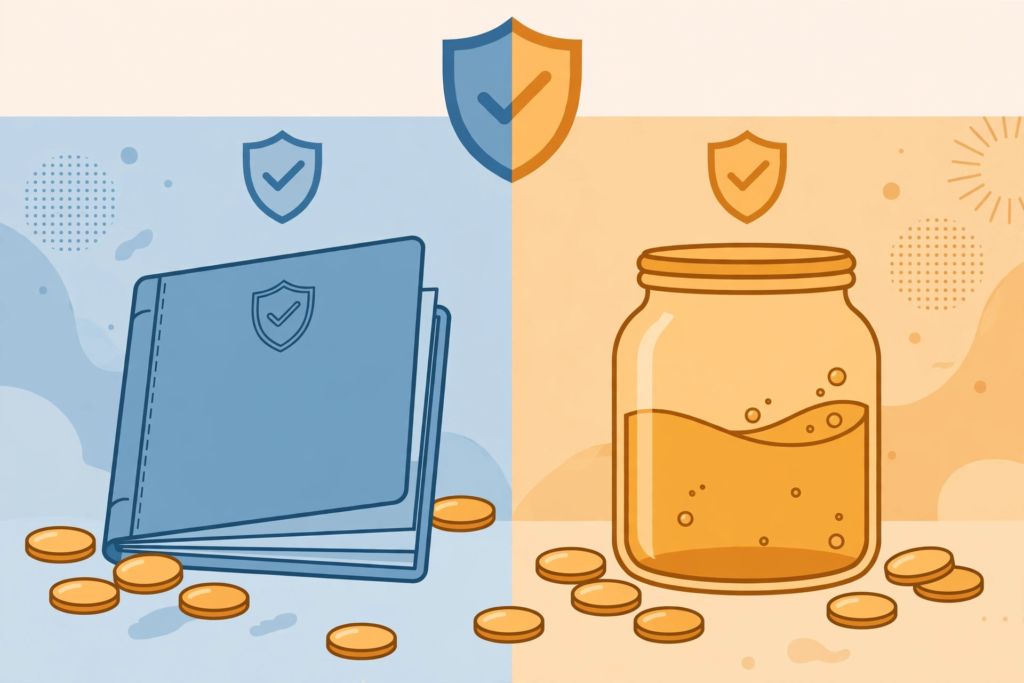
How to Build an Emergency Fund on a Regular Salary
Most people do not fail at building an emergency fund because they do not know about it. They fail because the target looks too big, so they never start. The trick is to start small and make it automatic, so willpower is not involved every month.
Begin with a starter goal of Rs 25,000 or one month of essential expenses, whichever feels more doable. That first chunk already covers many small emergencies: a phone repair, a minor medical bill, a sudden travel need. Once you reach it, you will feel the difference, and the next target will feel less impossible.
Then set up an automatic transfer on the day your salary comes in. If you earn Rs 60,000 a month and can set aside Rs 5,000, that is Rs 60,000 in a year, without thinking about it each month. If Rs 5,000 feels tight, start with Rs 2,000 or Rs 3,000. A smaller amount that actually happens every month is far better than a big plan that stops after two months.
Keep this money in a separate account, not the one linked to your everyday UPI spending. When the money is slightly out of sight, you are less likely to borrow from it for a sale or a dinner out. You can still reach it in an emergency, but you have to make a deliberate decision to move it, and that small friction helps.
For freelancers, the rule is a little different. Instead of a fixed monthly amount, try to save a percentage of every payment you receive. If you get Rs 40,000 from a client, moving Rs 4,000 or Rs 6,000 straight into your emergency account keeps the habit alive even when income is uneven. In good months, you save more. In slow months, you at least save something.
Common Mistakes That Quietly Break an Emergency Fund
The first mistake is using a credit card as an emergency fund. A credit card can help you pay a hospital or a repair shop today, but it is not your money. It is a loan at a very high interest rate, often 36 to 42 percent a year if you do not pay the full bill. If you cannot clear it next month, the emergency does not end. It just changes shape and becomes debt.
The second mistake is keeping the fund in the same account as your spending money and hoping you will not touch it. Most of us are not that disciplined, especially when a good offer appears. Separate it. Give it its own account, and if possible, do not link that account to your main UPI app for daily payments.
The third mistake is stopping once you have saved a little. A fund of Rs 20,000 is a great start, but it will not cover a job loss or a major medical bill. Celebrate the first milestone, but keep going until you reach your full target. And if you do use the fund, rebuilding it becomes your first financial priority again, before new investments or upgrades.
When Should You Actually Use It, and How Do You Rebuild It?
Use your emergency fund only for something that is urgent, unexpected, and necessary. A job loss, a medical emergency, an essential car or home repair, or a sudden need to support a family member all qualify. A discounted flight, a new television, or a loan to a friend, even a close one, do not. If you are not sure, wait a day and ask yourself a simple question: what happens if I do not pay for this today or this week? If the answer is serious harm, a health risk, or losing your home or job, it is likely a real emergency.
After you use it, do not feel guilty. That is what the money was for. But do make a plan to refill it. Go back to your automatic transfer, cut back on non-essential spending for a few months if you can, and direct bonuses or extra income towards it until you are back to your target. Many people find that rebuilding is faster the second time, because the habit is already there.
A Final Thought, Not a Formula
There is no single perfect number for an emergency fund in India, because there is no single Indian household. Your number depends on your job, your family, your loans, your health cover, and how much risk you can actually live with. What matters is that you have a number, that you are moving towards it, and that the money is kept safe and separate.
If you start today with a small automatic transfer, you are already ahead of where most people are. You do not need to build the whole fund this month. You need to build the habit this month, and let the fund grow month after month. One day, when life throws something unexpected at you, you will not have to reach for a credit card or borrow from family in a panic. You will have your own money, waiting quietly, ready to help.
That peace of mind is the real return on an emergency fund. It does not show up in a portfolio statement, but you feel it every time a bad month arrives and you can handle it without turning it into a long-term debt.
DISCLAIMER: This article is for general educational purposes only and is not personalized financial advice. Tax rules, interest rates, and fund features can change, so check current details with your bank or a qualified financial adviser before making a decision.
2 thoughts on “Emergency Fund in India: How Much You Really Need and Where to Keep It”