
Index funds vs active mutual funds in India is one of those questions that sounds technical, but the answer affects a very ordinary decision: where should your monthly SIP actually go? If you are putting aside ₹5,000 or ₹10,000 a month, you want to know what you are paying for, and what you are likely to get back. This article works through that question in plain language, with numbers you can check, so you can make sense of the choice yourself.
Both types of funds collect money from many investors and put it into shares and other securities. The difference is who decides what to buy, and how much that decision costs you.
What an Index Fund Actually Does
An index fund follows a market index, usually the Nifty 50 or the Sensex in India. It does not try to pick winners. It simply buys the same shares, in roughly the same proportion, as the index itself. If Reliance or HDFC Bank makes up a large part of the Nifty 50, the fund holds a large part in those shares too. If a company drops out of the index, the fund drops it as well.
Because there is no team trying to outsmart the market, the fund is cheap to run. Most index funds in India charge an expense ratio of around 0.1% to 0.3% a year. On a ₹1 lakh investment, that is roughly ₹100 to ₹300 a year in fund charges. The fund will not beat the index by much, because it is designed to match it, minus those small costs and minor tracking differences.
That simplicity is the whole point. You are not betting on one fund manager’s judgement. You are buying a broad slice of the market, and you are accepting whatever return that broad market gives over time.
What an Active Fund Tries to Do Differently
An active mutual fund has a fund manager and a research team. They study companies, read results, meet managements, and decide which shares to buy, which to avoid, and when to sell. The aim is to beat the benchmark index, not just match it. A large-cap active fund, for example, is usually compared with the Nifty 100 or a similar index. A flexi-cap fund has more freedom to move between large, mid, and small companies.
That work costs money. Active equity funds in India commonly charge around 1% to 2% a year, and sometimes a little more for smaller or more specialised funds. On that same ₹1 lakh, that is roughly ₹1,000 to ₹2,000 a year. The gap looks small in one year. Over twenty years, with compounding, it becomes much larger, which is why cost keeps coming up in this debate.
Active funds also change their holdings more often. That can help when a manager spots trouble early, or finds a company the market has overlooked. It can also hurt when a good-sounding call goes wrong. The fund’s return depends, in a real way, on human decisions made year after year.
The Cost Gap, in Real Numbers
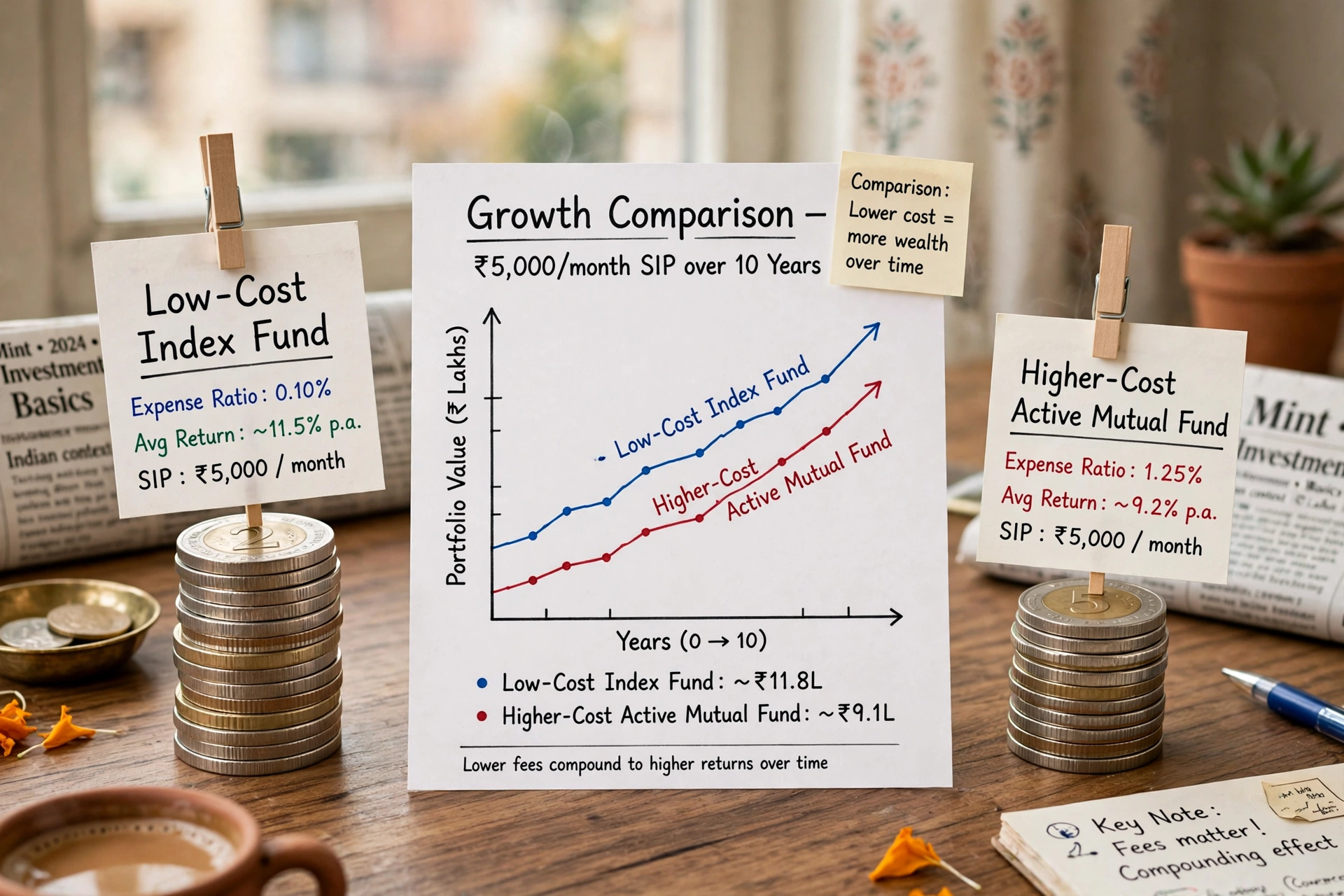
Take two investors, Priya and Rohan, who each start a SIP of ₹10,000 a month. Priya picks an index fund charging 0.2% a year. Rohan picks an active fund charging 1.5% a year. Suppose, for illustration only, that both funds earn 12% a year before charges. These are not promised returns, and actual market returns will vary a lot from year to year.
After charges, Priya’s fund would earn roughly 11.8% a year, while Rohan’s would earn roughly 10.5% a year. That 1.3 percentage point gap does not sound dramatic. But over 20 years, Priya’s total investment of ₹24 lakh could grow to roughly ₹98 lakh at 11.8%, while Rohan’s could grow to roughly ₹82 lakh at 10.5%, using the same illustrative assumptions. The difference, about ₹16 lakh, is mostly the cost of active management, not a difference in the market itself.
This is why index-fund supporters keep returning to cost. An active fund does not just have to match the index. It has to beat the index by more than its extra charges, year after year, just to leave the investor ahead. That is a high bar, and it gets higher the longer you invest.
Do Active Funds Actually Beat the Index?
Sometimes, yes. In some years, a good number of active funds do beat their benchmark. In other years, fewer do. Over longer periods, the record in India, as in most markets, is mixed. Large-cap active funds have found it harder to beat the Nifty 50 consistently, partly because the biggest Indian companies are widely researched and hard to outguess. Mid-cap and small-cap funds have had more room to find less-followed companies, so their record against benchmarks has looked better in some periods, though with much sharper ups and downs.
The trouble for an investor is that past outperformance does not guarantee future outperformance. A fund that beat the index for three years may not do so for the next three. Managers change, market conditions change, and a strategy that worked when interest rates were falling may struggle when they rise. Picking the fund that will win next is itself a difficult decision, and many investors end up switching funds after a bad year, which often means selling low and buying high.
Risk Looks Different in Each Case
It is a mistake to think of an index fund as safe and an active fund as risky, or the other way round. Both invest in shares, so both will fall when the market falls. In March 2020, for example, broad Indian indices fell sharply in a matter of weeks, and index funds fell with them. An active manager could, in theory, hold more cash or avoid the worst-hit shares, but many did not, and some fell just as much.
Where risk does differ is in concentration and surprise. An index fund’s holdings are public and predictable. You can look up the Nifty 50 list and know, more or less, what you own. An active fund can hold shares you would not expect, or take a large position in one company or sector. If that call works, returns jump. If it fails, the fund can lag badly, and you may only understand why after the fact.
For a beginner, that predictability matters. It is easier to stay invested through a rough year when you understand what you own and why it fell. It is much harder to stay calm when a fund you chose for its star manager suddenly underperforms and you have no clear way to judge whether the manager is wrong or just early.
| Feature | Index fund | Active mutual fund |
|---|---|---|
| How it invests | Copies a market index like Nifty 50 or Sensex | Manager picks shares to try to beat the index |
| Typical yearly cost | About 0.1% to 0.3% | About 1% to 2% |
| What you can expect | Close to the market return, minus small costs | Could beat or lag the index, depending on the manager |
| Effort for the investor | Very little ongoing judgement needed | Needs regular review of the fund and manager |
| Best suited to | Beginners and investors who want simplicity | Investors willing to research and monitor funds |
Where Active Funds Still Make a Case
None of this means active funds are pointless. There are parts of the market where a skilled manager may add more value. Smaller companies are covered by fewer analysts, company accounts can be harder to read, and prices can move a long way on limited information. A careful manager may avoid weak companies that an index is forced to hold, or spot a growing business before it enters a major index.
Active funds can also manage risk in ways an index cannot. A manager worried about valuations can hold cash, reduce exposure to an overheated sector, or shift towards steadier companies. An index fund has no such discretion. It stays fully invested in the index, even when parts of that index look expensive.
What About SIPs, Taxes, and Exit Loads?
Both index and active funds can be bought through a SIP, and the SIP mechanics are the same. You invest a fixed amount each month, you get units at that month’s price, and over time you buy more units when prices are low and fewer when prices are high. If you are just starting out, this guide on how to start a SIP with just ₹500 a month walks through the practical setup, from choosing a fund to setting up the monthly payment.
Tax treatment for equity funds is also broadly the same for both types. Gains on units held for more than a year are treated as long-term capital gains, with tax above the annual exemption limit, while gains on units sold within a year are taxed as short-term gains at a higher rate. Exit loads, if any, depend on the individual scheme, so check the scheme document before investing rather than assuming one type is always cheaper to exit.

A Sensible Way to Choose as a Beginner
If you are investing for the first time, a broad index fund is often the calmer starting point. Pick a well-known Nifty 50 or Sensex index fund with a low expense ratio and a reasonable tracking error, which measures how closely the fund actually follows its index. Set up a SIP you can afford every month, even in a tight month, and let it run. You do not need to check it daily, and you do not need to worry about whether your manager had a good quarter.
Once you have that base in place, and once you understand how market falls feel in real life, you can decide whether to add an active fund. Some investors keep most of their money in index funds and put a smaller part into one or two active funds they have researched properly. That way, even if the active bet disappoints, the core of the portfolio still tracks the market.
Mistakes to Avoid on Either Side
First, do not pick a fund only because it topped a one-year return chart. One year is too short to judge a manager, and the top fund in one year is often nowhere near the top the next. Look at longer periods, at least three to five years, and check whether the fund beat its benchmark after costs, not just before them.
Second, do not hold too many funds that do the same thing. Five large-cap funds, index or active, will mostly hold the same big companies, so you are paying multiple fees for the same portfolio. One or two broad funds usually cover the large-cap part of a portfolio well enough.
Third, do not ignore the expense ratio in an active fund, and do not ignore tracking error in an index fund. A cheap index fund that tracks its index poorly can cost you almost as much as a pricier one that tracks it well. Both numbers are in the scheme documents, and both are worth a minute of your time.
Finally, keep your emergency fund separate from this decision. Money you might need in the next few months does not belong in shares at all, index or active. This guide on how much emergency fund you really need and where to keep it is a useful check before you raise your SIP, because an SIP you have to stop in a crisis helps nobody.
So, Index or Active?
For most beginners in India, an index fund is the simpler, cheaper, and easier-to-stick-with choice. You get the market’s return, you pay very little for it, and you do not have to bet on picking the right manager. Active funds can still earn their place, especially in mid-cap and small-cap segments or for a specific goal, but they need to clear a higher hurdle: beating the index by more than their extra cost, consistently, over years.
Whichever route you take, the decision that matters most is not made once, on the day you pick a fund. It is made every month, when you keep the SIP going, leave the money alone during a fall, and resist the urge to chase last year’s winner. Get that habit right, keep costs low, and check your portfolio once or twice a year rather than once a day. That is how most ordinary investors in India actually build wealth over time, whether they hold an index fund, an active fund, or a mix of both. This is general educational information, not advice for your personal situation, so consider your own goals, time horizon, and risk comfort, and talk to a qualified professional if you need help applying it to your own finances.