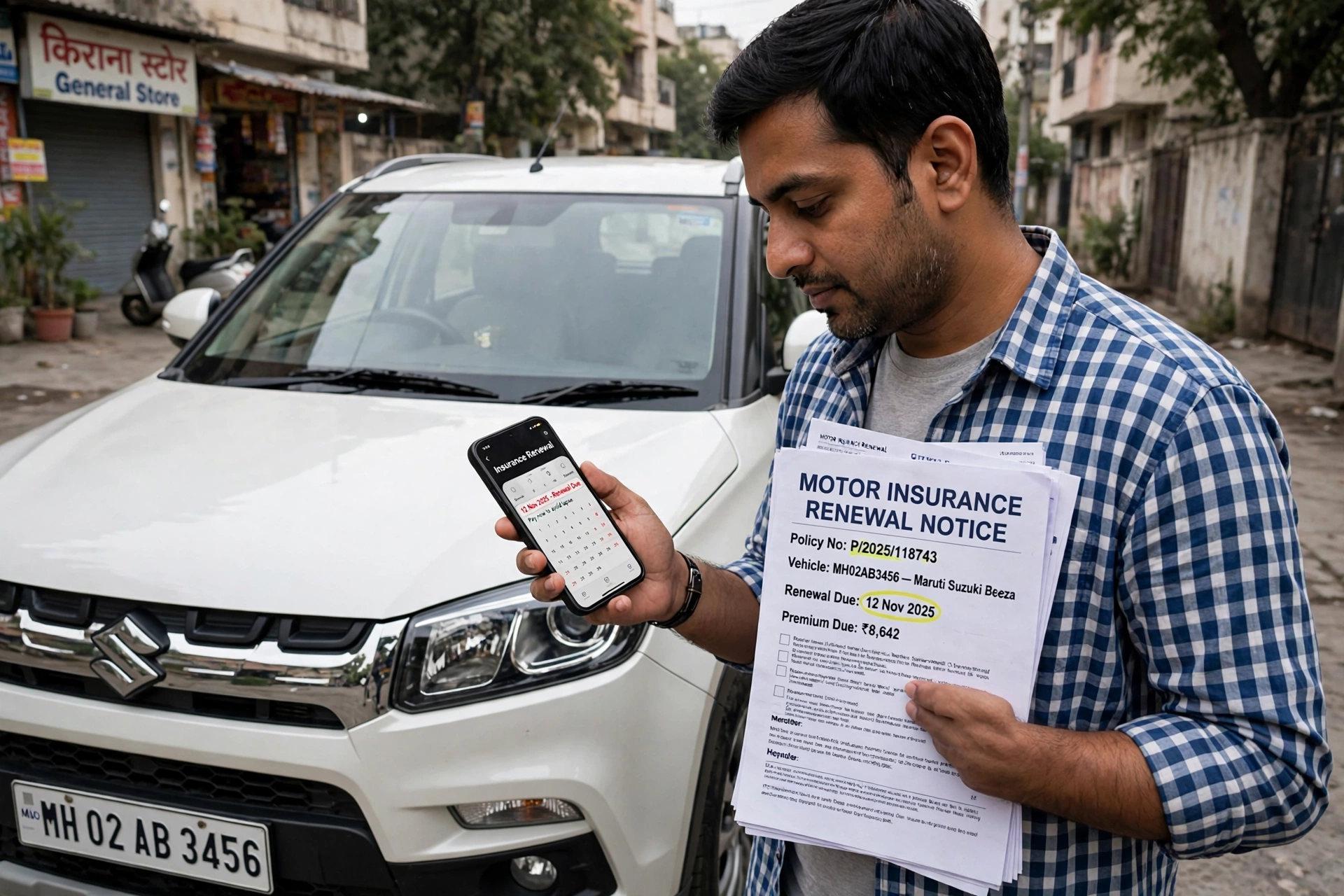
Car insurance renewal is one of those tasks that arrives every year by SMS, gets postponed for a week, and then gets done in a hurry on the last day. That hurry is expensive. The renewal notice shows a premium, you pay it, and you move on, without noticing that the insured value has dropped, that a no claim bonus has quietly disappeared, or that you are paying for add-ons you never needed while missing the one add-on that would have saved you thousands after an accident.
Renewal is actually the one moment in the year when you have real power over your car insurance. You can change insurers, adjust the insured value, add or drop covers, and protect a discount you have spent years earning. This article covers what to check before you pay, in the order that matters, so the renewal takes twenty careful minutes instead of one careless click.
First, Never Let the Policy Lapse
The single most important rule of car insurance renewal is simple: renew before the expiry date. In India, third-party car insurance is legally mandatory, and driving without it can mean a fine and legal trouble. But the practical risk is bigger than the fine. If the policy lapses and you have an accident the next day, there is no cover at all, and the repair bill comes entirely out of your pocket.
A lapse also costs you money in a less obvious way. If the policy has been expired for more than 90 days, insurers will usually insist on an inspection of the vehicle before renewing, and your no claim bonus, the discount earned for claim-free years, can be lost. Even a short gap can complicate renewal, because some insurers treat a break in cover as a reason to re-inspect or re-price. Set a reminder a week before expiry, not on the day itself, and renew early. Most insurers allow renewal up to 60 days before expiry, and early renewal does not waste any days: the new policy simply starts when the old one ends.
If your policy has already lapsed, do not drive the car until it is renewed, and renew it as soon as possible. A short lapse with an inspection is an inconvenience. A long lapse with a lost no claim bonus is a real financial loss, as the next section explains.
Protect Your No Claim Bonus Like It Is Cash
The no claim bonus, or NCB, is a discount on the own-damage premium that grows with every claim-free year, from 20% after one year up to 50% after five claim-free years. On a car with an own-damage premium of ₹15,000, a 50% NCB saves ₹7,500 a year, every year. That is real money, and it is surprisingly easy to lose.
The NCB belongs to you, not to the car, and not to the insurer. If you sell your car and buy a new one, you can transfer the NCB to the new car’s policy by getting an NCB certificate from your old insurer. If you switch insurers at renewal, the new insurer will honour the NCB, but they will verify it with the old insurer, so declare it honestly. Inflating your NCB to get a cheaper quote is a mistake that surfaces at claim time, when the insurer checks and reduces or rejects the claim.
The most common way people lose NCB is by claiming for small damage. A bumper scratch that costs ₹4,000 to repair is not worth a claim if it wipes out a 50% discount worth ₹7,500 a year for the next several years. As a rough rule, if the repair cost is only slightly above your deductible, the amount you pay out of pocket before insurance kicks in, pay it yourself and keep the NCB intact. This is a judgement call, not a fixed rule, but it is worth making deliberately rather than filing a claim in the heat of the moment at the service centre.
There is also an add-on worth knowing about: NCB protection. It lets you make one or two small claims in a year without losing your bonus. It costs a little extra, usually a few hundred rupees, and for drivers with a high NCB it often pays for itself the first time it is used.
Check the IDV: The Number That Decides Your Payout
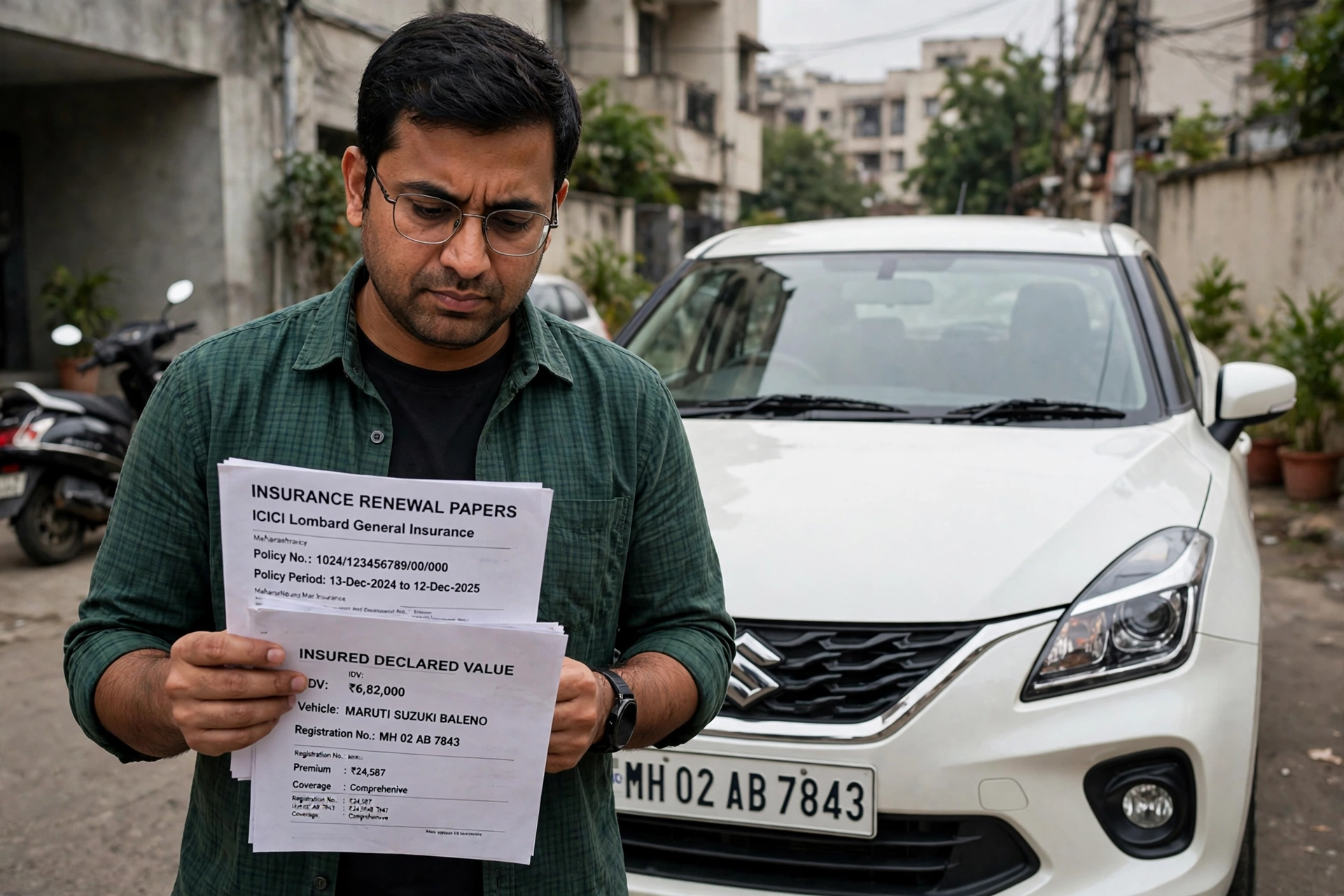
IDV stands for Insured Declared Value, and it is the maximum amount the insurer will pay if your car is stolen or completely damaged. It is roughly the car’s current market value, minus depreciation. Insurers calculate it from the car’s age and original price, and at renewal they will suggest a value. Do not accept it blindly.
A low IDV means a lower premium, which looks attractive, but it also means a lower payout when you need it most. If your car’s market value is ₹6 lakh and the IDV is set at ₹4.5 lakh, a total-loss settlement will be based on ₹4.5 lakh, and you absorb the difference. On the other hand, an inflated IDV raises your premium without raising your payout, because the insurer will still settle based on the actual market value at the time of loss. The right IDV is close to what your car would actually sell for today. Check used-car listings for your model and year before renewal, and if the insurer’s suggested IDV is far off in either direction, ask for it to be corrected.
Depreciation works on a fixed schedule, so the IDV will fall every year, roughly 10% in the first year, then 15%, 20%, and so on up to 50% after five years, after which it is based on the car’s condition and market value. Understanding this schedule stops two surprises: the premium falling more slowly than you expected, and the payout being smaller than you remembered.
Add-Ons: The Few That Are Worth It, and the Rest
Renewal is when insurers sell add-ons, and the list can be long. Most drivers need only a few, but those few make a genuine difference. Zero depreciation cover, also called bumper-to-bumper, is the most valuable for cars under five years old. Without it, the insurer deducts depreciation on parts, plastic, rubber, and fibreglass, and you pay a large share of every repair. With it, the insurer pays the full cost of replaced parts, minus your deductible. For a new or nearly new car, this single add-on changes the experience of a claim completely.
Engine protection is worth considering if you live in a city that floods during the monsoon or if you regularly drive through waterlogged roads. A standard policy does not cover engine damage from water ingression, and an engine repair can cost ₹50,000 or more. Roadside assistance is cheap, often a few hundred rupees, and genuinely useful if you travel on highways or drive at night. Return to invoice cover, which pays the car’s original purchase price in case of total loss instead of the depreciated IDV, makes sense for a new car in its first two or three years.
Other add-ons deserve a harder look. Consumables cover pays for engine oil, nuts, bolts, and similar small items during a repair, which is nice but usually small money. Key replacement cover matters only if losing keys is a real risk for you. Personal accident cover for passengers is worth having if you regularly carry family members, but check whether your existing personal accident policy already covers you. The test for every add-on is the same: does it cover a loss that would actually hurt, at a price that is small compared with that loss? If not, skip it, however persuasively it is described.
Compare Before You Renew With the Same Insurer
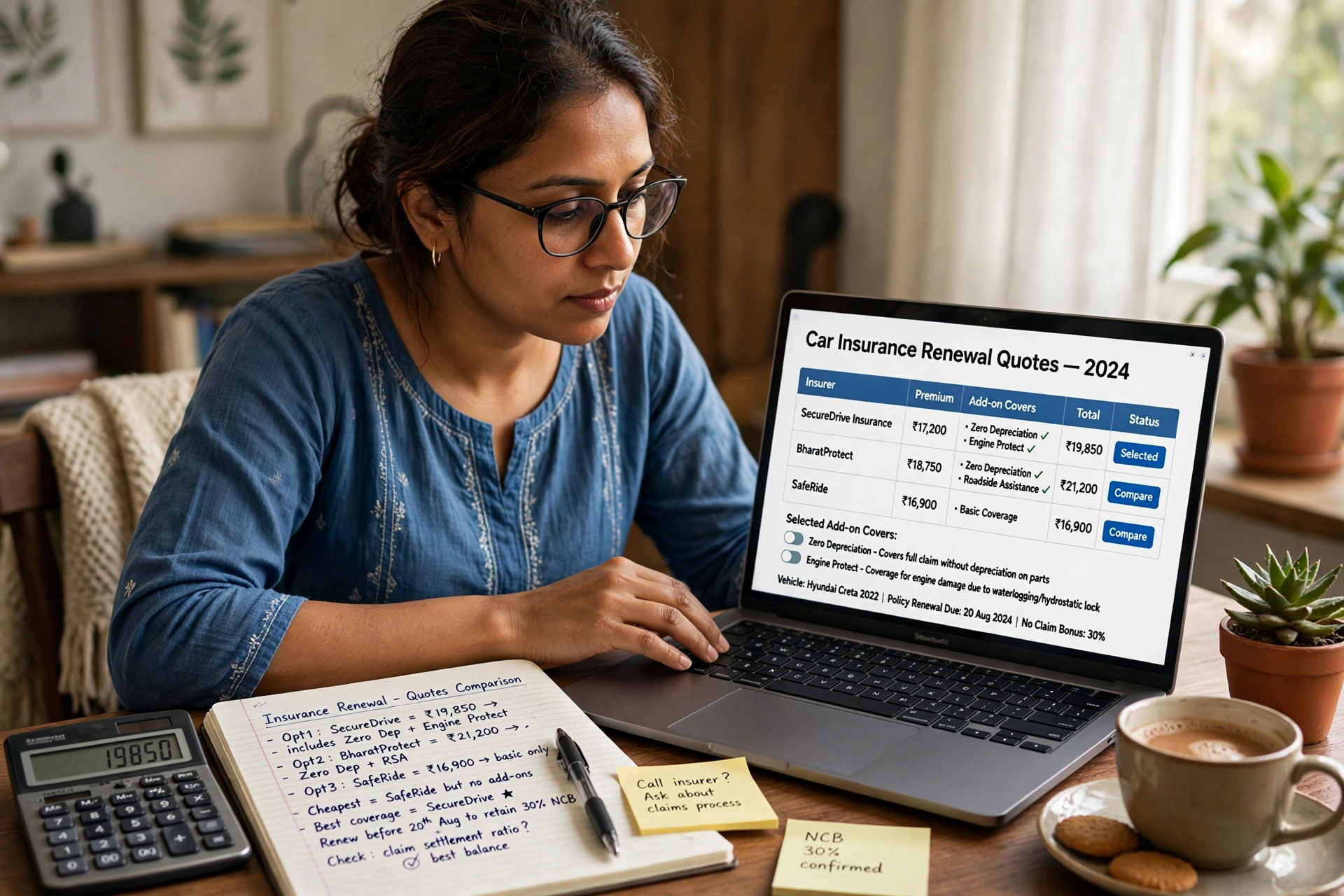
Loyalty to an insurer is not rewarded in car insurance the way it is in some other products. Premiums for the same car, same IDV, and same add-ons can differ by thousands of rupees between insurers, because each company prices risk differently and runs different discounts at different times. At renewal, get at least two or three quotes for an identical set of covers, so the comparison is honest. A cheaper quote that quietly drops zero depreciation cover is not cheaper at all.
When comparing, check three things beyond the premium. First, the claim settlement ratio, which tells you what share of claims the insurer actually settled, and the speed of settlement, which matters when your car is sitting in a garage. Second, the network of cashless garages near you. A cashless claim at a garage five minutes from home is worth more than a slightly cheaper policy whose nearest network garage is across town. Third, the deductible. A policy with a lower premium but a higher voluntary deductible can cost you more at claim time, so compare like with like.
Switching insurers at renewal is straightforward. Your NCB transfers, your policy history is visible to the new insurer, and the new policy starts when the old one ends, so there is no gap. The only paperwork to watch is the NCB declaration and, for older cars, a possible inspection. Do not let the fear of paperwork keep you paying a higher premium year after year.
Common Renewal Mistakes That Cost Real Money
The most expensive mistake is renewing only third-party cover to save money when your car still has significant value. Third-party insurance covers damage to other people and their property, which is the legal minimum, but it pays nothing for damage to your own car. For a car worth several lakhs, the saving of a few thousand rupees on premium is a poor trade against a repair bill of ₹50,000 or more. Comprehensive cover, which adds own-damage protection, is the sensible default until the car’s value falls so low that the premium is a large fraction of what the car is worth.
The second mistake is ignoring the policy details after payment. Check the renewed policy document when it arrives, not months later at claim time. Confirm the registration number, the engine and chassis numbers, the IDV, the NCB percentage, and the add-ons you chose. Errors in these details are common, and they are easy to fix within days of renewal but painful to fix after a claim has been filed.
The third mistake is paying for covers you already have elsewhere. Personal accident cover, for example, may already exist in a standalone policy or through your employer. Duplicate cover is wasted premium, and it does not double your payout, because insurers coordinate and settle based on actual loss.
The fourth mistake is forgetting that a claim affects more than this year’s premium. A claim reduces or resets your NCB, and a history of claims can raise your premium at the next renewal. This does not mean never claim. It means claiming deliberately, for losses that are genuinely large, and paying small repairs yourself.
A Renewal Checklist You Can Use Every Year
Two weeks before expiry, note the date and set a reminder. Check your current IDV against your car’s market value and your NCB percentage against your claim history. Decide which add-ons you actually want, and drop the ones you have never used. Get two or three quotes for the same cover, compare the premium, the deductible, the cashless garage network, and the claim settlement record, and renew before the expiry date so there is no gap. When the new policy arrives, verify the details immediately and keep a digital copy with your other important documents.
Done this way, renewal stops being an annual chore and becomes a small financial review. The same discipline applies to the rest of your money: a budget that actually reflects your spending, an emergency fund that covers real emergencies, and insurance that pays when it is needed. Our guide to managing a household budget covers the monthly side of that discipline, and car insurance renewal is the yearly version of the same habit: check the numbers, keep what protects you, and drop what does not.
Twenty minutes of attention once a year is a small price for a policy that actually works when your car is damaged, your NCB intact, and your premium fair. The renewal notice will keep arriving by SMS either way. The difference is whether you read it carefully or just pay it.