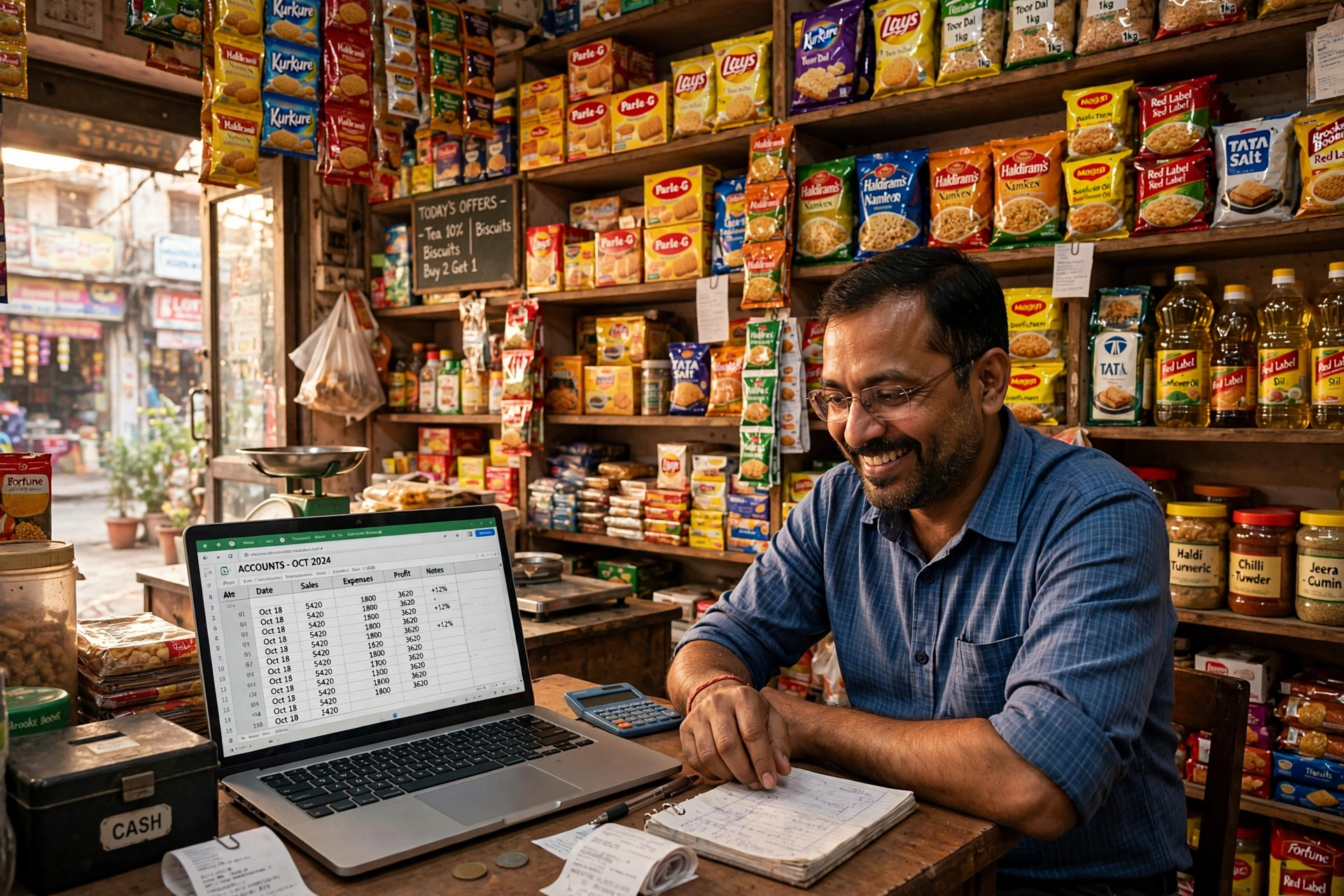
Every small business reaches a point where its own cash isn’t enough. A kirana store owner wants to stock up before Diwali. A small manufacturer gets a big order and needs raw material first. A boutique owner finds a better location but the deposit is ₹3 lakh. The business is doing fine — it just needs money a little before the money comes in.
That is exactly what a business loan is for. But in India, business loans are a maze: banks, NBFCs, Mudra, CGTMSE, overdrafts, term loans, rates anywhere from 10% to over 30%. Many small business owners either borrow far too expensively or don’t borrow at all, and both mistakes cost them growth.
This guide walks through the real options, what they cost, what lenders actually ask for, and how to apply without wasting weeks on rejections.
First, know what kind of money you need
Lenders offer different products for different needs, and picking the wrong one is the most common expensive mistake.
A term loan is a lump sum you repay in fixed monthly instalments over one to five years. It suits one-time spending: buying machinery, renovating a shop, opening a second outlet. You borrow once, you pay it back on schedule.
A working capital loan, overdraft (OD) or cash credit (CC) is a flexible limit you draw from as needed and pay interest only on what you use. It suits the everyday gap between paying suppliers and getting paid by customers. A shop that pays its supplier in 15 days but gets paid by customers over 60 days lives on this kind of facility.
A loan against property lets you borrow a larger amount at a lower rate by pledging a shop, office or house. Rates start around 10–11% at many banks, and tenures can stretch to 15 years. The trade-off is obvious: your property is at stake if the business struggles.
A gold loan is the cheapest money available to many small businesses — SBI’s gold loan rates run roughly 8.65% to 9.95% — but the amount depends on the gold you own, and it’s short-term by nature.
Then there are the government-backed schemes, which exist precisely because small businesses often have no collateral. These deserve their own section, because for a first-time borrower they are usually the best starting point.
Mudra, CGTMSE and the schemes that actually help
The Pradhan Mantri Mudra Yojana (PMMY) is the most widely used small business loan scheme in India. It now runs in four categories: Shishu, up to ₹50,000; Kishore, above ₹50,000 up to ₹5 lakh; Tarun, above ₹5 lakh up to ₹10 lakh; and the newer Tarun Plus, ₹10 lakh to ₹20 lakh. These are collateral-free loans given through banks, NBFCs and micro-finance institutions, and Mudra loans often carry lower rates than a regular unsecured business loan — indicative rates start around 10–11% at many banks. There is also a 2% interest subvention on prompt repayment of Shishu loans, which makes the smallest loans genuinely cheap.
The CGTMSE scheme is the reason banks can lend to you without collateral at all. The Credit Guarantee Fund Trust for Micro and Small Enterprises guarantees the loan — the cover now goes up to ₹10 crore — so the bank’s risk is lower. Ask your bank to route your loan under CGTMSE by name; a guarantee fee applies, usually under 1% a year, but it is often the difference between approval and rejection.
Stand-Up India offers loans of ₹10 lakh to ₹1 crore for SC/ST and women entrepreneurs setting up a greenfield enterprise. And the 59-minutes loan portal (psbloansin59minutes) gives in-principle approval for MSME loans up to ₹1 crore, with rates starting around 8% for strong profiles.
One document unlocks several of these benefits: Udyam registration. It is free, takes minutes online, and it is the cheapest thing you can do before applying. Some banks waive processing fees entirely on loans up to ₹5 lakh for Udyam-registered micro and small enterprises, and it strengthens your case for CGTMSE cover.
What a business loan actually costs
Rates vary far more than most borrowers expect. For the same ₹10 lakh, the difference between a good rate and a bad one is lakhs of rupees.
| Lender / product | Indicative rate | Notes |
|---|---|---|
| HDFC Bank business loan | 10.75% – 22.50% | Processing up to 2%; waived up to ₹5 lakh for Udyam-registered MSMEs |
| ICICI Bank business loan | ~10.25% – 19% | Processing up to 2% |
| Bajaj Finance MSME loan | 14% – 23.50% | ₹2 lakh – ₹80 lakh; processing up to 4.72% incl. taxes |
| Public sector bank MSME loan | ~9.75% – 14% | Often CGTMSE-backed; lower for micro enterprises |
| Mudra (Shishu/Kishore/Tarun) | ~10% – 13% | Collateral-free; subvention on Shishu |
| Gold loan (SBI) | ~8.65% – 9.95% | Cheapest, but needs gold as security |
To see what the rate actually means, take a ₹10 lakh loan over five years:
| Rate | EMI | Total interest |
|---|---|---|
| 11% | ₹21,742 | ₹3.05 lakh |
| 14% | ₹23,268 | ₹3.96 lakh |
| 18% | ₹25,393 | ₹5.24 lakh |
The gap between 11% and 18% is about ₹2.2 lakh of extra interest on the same ₹10 lakh. That is why it pays to apply to two or three lenders and compare, rather than taking the first offer from whoever calls you. Also watch the costs that don’t show up in the rate: processing fees of 1–3% (sometimes up to 4.72%), prepayment charges on fixed-rate loans, and penal charges on late payment that can run as high as 36% a year at some NBFCs. Always ask for the total cost, not just the rate.
And since January 2026, RBI rules mean no prepayment charges on floating-rate loans to MSMEs — one more reason to prefer a floating-rate loan if you expect to repay early.

Who can get one, and what lenders ask for
You don’t need to be a big company. Lenders generally look for:
- A business vintage of 1–3 years. Most banks want at least two or three years of operation; some NBFCs and Mudra lenders will consider one year. A brand-new business with no track record will usually only qualify for a Mudra Shishu loan.
- Turnover to support the EMI. As a rough rule, lenders like your annual turnover to be at least 4–5 times the loan amount. For a ₹10 lakh loan, that means turnover of ₹40–50 lakh a year. It varies, but if the business can’t show the cash flow, the application stalls.
- A decent credit history. Your personal CIBIL score matters a lot for small businesses, because the business and the owner are often the same credit risk in the lender’s eyes. A score of 700-plus opens doors; below 650, expect higher rates or rejection. If you have existing loans, a clean repayment record is the best argument you can make.
- Documents that prove the business is real. The usual list: PAN and Aadhaar, business address proof, 6–12 months of bank statements, GST returns or ITRs for the last two years, a Udyam registration certificate if you have one, and a short note on what the money is for. For loans above ₹10 lakh, lenders often ask for a project report or a CA-certified financial statement.
The single most common reason for rejection is not a bad business — it’s a thin file. Bank statements that show all receipts in cash, no ITR filed, no GST registration where it applies. If you run a cash-heavy business, route as much as possible through the bank account for a few months before applying. Lenders can only judge what they can see.
How to apply, step by step
Start by deciding the amount and the purpose, precisely. “₹8 lakh for a packaging machine and three months of raw material” gets a better response than “₹10 lakh for business”. Lenders fund purposes, not vague needs.
Then check your own position: pull your CIBIL report (free once a year), look at your last 12 months of bank statements, and confirm your Udyam registration. Fix anything obvious — a wrong address, an old loan showing as active — before you apply, because every application leaves a footprint on your credit report.
Apply to two or three lenders in the same short window — a bank where you already hold the business account, plus one more bank or NBFC. Comparing offers is your strongest negotiating tool, and applications made within a couple of weeks count as a single enquiry for credit scoring purposes.
When the sanction letter arrives, read it fully before signing: the rate, whether it is fixed or floating, the processing fee, the prepayment terms, and any insurance bundled into the loan. Some lenders add a loan insurance premium to the amount without explaining it. Ask, and get it removed if you don’t want it.
After disbursal, keep the money in the business. The fastest way to ruin a good loan is to use it to pay off a personal expense or to fund a different venture. The EMI doesn’t care where the money went.

Term loan vs overdraft: a worked example
The choice between a term loan and a working capital facility is easier with numbers. Suppose your shop needs ₹6 lakh to stock up for the festive season, and the stock will sell over four months.
With a term loan of ₹6 lakh at 13% for two years, your EMI is about ₹28,500 and you pay it every month whether the stock has sold or not. Total interest comes to roughly ₹84,000. With a cash credit limit of ₹6 lakh at 12%, you draw the money, pay interest only on the amount used, and repay as the stock sells. If you use the full ₹6 lakh for four months and then clear it, the interest is about ₹24,000.
The overdraft wins for short, revolving needs. The term loan wins when the money goes into something that lasts — a machine, a renovation, a vehicle — because you want the repayment spread over the life of the asset, not crammed into the next quarter. Many growing businesses end up with both: a term loan for assets and a working capital limit for the day-to-day cycle. Lenders like that structure too, because it shows you understand the difference.
How to get a better rate
A few things genuinely move the rate you are offered:
- Register on Udyam if you haven’t. It’s free and it unlocks fee waivers and scheme benefits.
- Ask for CGTMSE cover. Collateral-free loans priced without a guarantee are more expensive; the guarantee lowers the lender’s risk and often the rate.
- Bring a co-applicant or collateral if you can. A loan against property is usually 3–5 percentage points cheaper than an unsecured business loan. Even a small FD lien can help.
- Keep your credit score healthy. Pay every EMI and credit card bill on time for six months before applying. A 50-point improvement in your score can be worth a full percentage point on the rate.
- Show growth, not just survival. Bank statements with rising credits over six months tell a lender the business is growing. Flat or falling credits tell the opposite story.
- Negotiate. If one lender offers 13% and another offers 15%, show the first offer to the second. Rates on business loans are often negotiable, especially if you are an existing customer.
What to do if your application is rejected
Rejection is common, especially for first-time borrowers, and it is not the end of the road. Ask the lender for the reason in writing — they are obliged to tell you. The usual causes are a low credit score, insufficient turnover on paper, or missing documents.
If the score is the problem, spend three to six months fixing it: clear any overdue amounts, keep credit card utilisation below 30%, and avoid applying to five lenders at once. If turnover on paper is the problem, give it a few months of routing more receipts through the bank account and filing your GST returns on time. Then reapply — ideally to the bank where your business account already sits, since they can see your cash flow directly.
If the amount is the problem, start smaller. A ₹2 lakh Mudra Kishore loan repaid cleanly over two years is the best possible foundation for a ₹10 lakh loan later. Lenders trust a borrower with a finished loan far more than one with only a plan. And if a bank says no, an NBFC may say yes at a higher rate — take it only if the maths still works, and only for a short tenure while you build the track record to move to a bank.
Mistakes that cost small businesses dearly
Borrowing for the wrong reason tops the list. A loan to buy stock that will sell in three months is good debt. A loan to cover losses from a business model that isn’t working is not — it just delays the reckoning and adds interest to it. Before borrowing, be honest about whether the problem is timing or viability.
Borrowing too much is the second mistake. Lenders will sometimes approve more than you asked for. Taking it feels like a cushion; in practice it becomes an EMI your cash flow can’t support. Borrow what the purpose needs, not what the bank offers.
The third is mixing personal and business money. When the loan EMI and the household expenses come from the same account, nobody knows whether the business can actually afford the loan. Keep a separate business account, pay yourself a fixed monthly amount from it, and let the EMI come out of the business.
And finally, ignoring the fine print: a low headline rate with a 3% processing fee and a foreclosure charge can cost more than a slightly higher rate with no fees. Compare the total cost over the full tenure, not the rate alone.
The bottom line
A business loan is a tool, not a trophy. Used well, ₹10 lakh borrowed at a fair rate can turn into stock that sells, an order that gets delivered, or a shop that finally opens in the right location. Used carelessly, the same ₹10 lakh becomes an EMI that eats the business it was meant to grow.
Start with the cheapest money available to you — a Mudra loan if you are small, a CGTMSE-backed bank loan if you have some track record, a gold loan or loan against property if you have the security. Register on Udyam, keep your books clean, apply to more than one lender, and read the sanction letter before you sign it. The best business loan is rarely the first one offered to you. It is the one you chose after comparing.
Related reading: Personal Loan in India: When It Makes Sense and What It Really Costs and Gold Loan in India: How It Works, Interest Rates and Hidden Costs