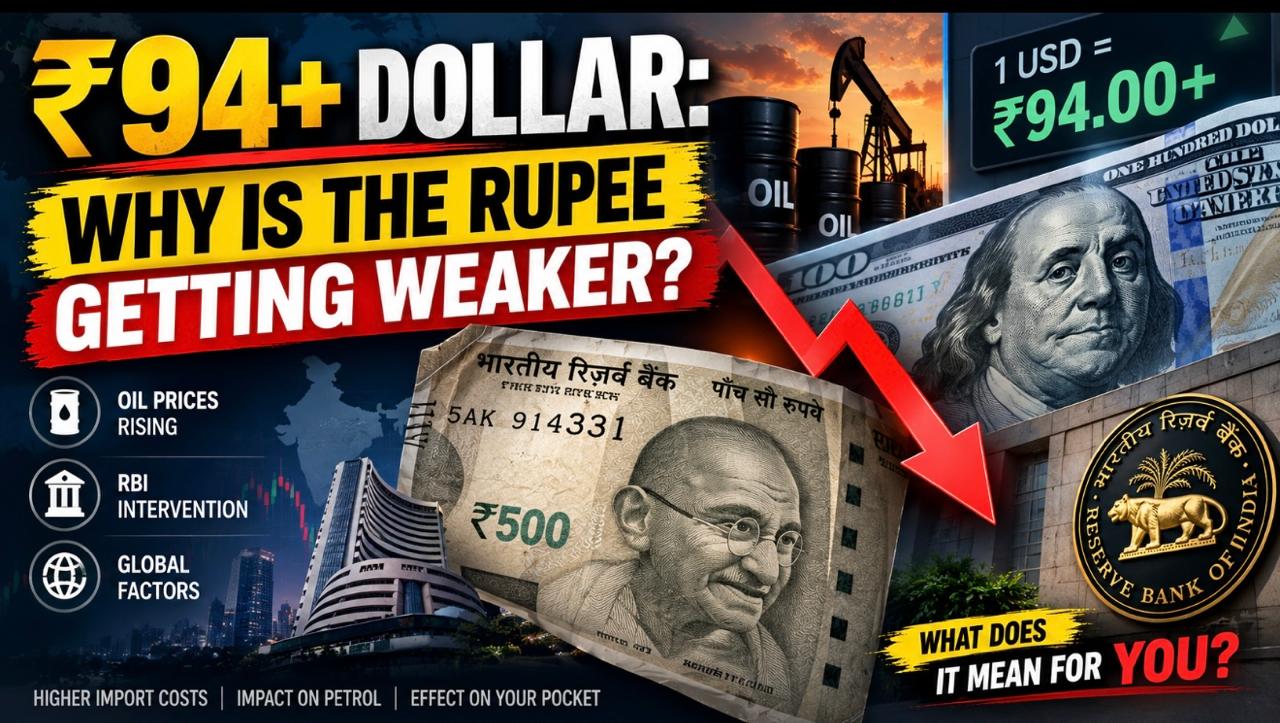
The Indian rupee is once again under pressure against the US dollar. The dollar has crossed the ₹94 mark, and this has raised a lot of questions about where the rupee is heading next.
At first, a dollar at ₹94 may look like just another currency-market number. But it can actually affect many things in our daily lives.
From foreign travel and education to imported products, fuel costs and inflation, the value of the rupee has an impact on several parts of the economy.
So, why is the rupee getting weaker?
The answer is not just one thing. Rising crude oil prices, tensions in the Middle East, strong demand for dollars, global interest rates and overall market uncertainty are all playing a role.
Let’s understand it in simple words.
What Does a ₹94 Dollar Actually Mean?
When we say that the dollar is at ₹94, it simply means you need around ₹94 to buy one US dollar.
Suppose a dollar was worth ₹90 earlier. If it moves to ₹94, you now need more rupees to buy the same one dollar.
In simple terms, the dollar has become more expensive and the rupee has become weaker against it.
This matters because India imports many important things from other countries, and a large part of international trade is settled in US dollars.
The biggest example is crude oil.
Why Is Crude Oil So Important?
India imports a large part of the crude oil it needs.
And crude oil is generally bought in US dollars.
This creates a direct connection between oil prices and the rupee.
For example, imagine India needs to pay $100 million for an import.
If the dollar is at ₹90, the cost would be around ₹9 billion.
But if the dollar rises to ₹95, the same $100 million would cost around ₹9.5 billion.
That means India has to spend more rupees even though the dollar amount has not changed.
Now imagine this happening with oil imports worth billions of dollars.
The difference can become very large.
That is why a weak rupee can be a problem for a country like India, especially when crude oil prices are also high.
Why Is the Middle East Situation Important?
Another major factor right now is the situation in the Middle East.
The region is extremely important for the global oil market. A large amount of the world’s oil passes through the region, including important shipping routes.
Whenever there is a conflict or the possibility of disruption to oil supplies, global markets become nervous.
Traders start worrying that oil supplies could be affected.
When there is fear of lower supply, oil prices can rise.
Brent crude has recently been trading around the $97-per-barrel level.
For India, higher oil prices are not good news because the country needs to spend more money on oil imports.
Higher oil prices mean a higher import bill.
And a higher import bill can mean stronger demand for dollars.
That can put more pressure on the rupee.
What Is the RBI Doing?
This is where the Reserve Bank of India, or RBI, comes in.
The RBI keeps a close watch on the currency market.
When the rupee comes under heavy pressure, the central bank can step in by selling dollars from its foreign exchange reserves.
The basic idea is quite simple.
If there is a shortage of dollars and demand for them is high, selling more dollars into the market can increase dollar supply.
This can help slow down the rise in the dollar and reduce pressure on the rupee.
The RBI has been active in the currency market recently, and traders have reported dollar selling by state-run banks, which is widely seen as part of the central bank’s intervention.
But there is an important point to understand.
The RBI cannot control the currency market forever.
Its job is not necessarily to keep the dollar at one particular level every single day.
Currency values naturally move up and down.
The RBI mainly tries to prevent sudden and excessive movements.
If global factors continue to push the rupee down, the central bank can reduce the pressure, but it cannot completely remove those global forces.
Oil Is Not the Only Reason
It would be wrong to say that crude oil is the only reason behind the rupee’s weakness.
Several other factors are also involved.
Global interest rates, foreign investment, demand for dollars and the overall strength of the US dollar can all affect the rupee.
For example, investors around the world constantly decide where to put their money.
If US investments become more attractive because of higher interest rates or better returns, some investors may move their money towards US assets.
That can increase demand for dollars.
When demand for dollars rises, emerging-market currencies such as the Indian rupee can come under pressure.
This is one reason why decisions by the US Federal Reserve are closely watched in India as well.
How Does a Weak Rupee Affect Ordinary People?
This is probably the most important question.
A weaker rupee does not mean that everything becomes expensive immediately.
But if the rupee stays weak for a long period, its effects can slowly reach consumers.
- Foreign Travel Can Become More Expensive
If you are planning a trip to the US or another country, the exchange rate matters.
Suppose you need $2,000 for your trip.
At ₹90 per dollar, you would need around ₹1.80 lakh.
At ₹95 per dollar, you would need around ₹1.90 lakh.
That is a difference of ₹10,000 just because of the exchange rate.
Of course, your actual travel cost will depend on many other things as well, but the example shows why the dollar rate matters.
- Studying Abroad Can Cost More
Students studying abroad can also feel the impact.
College fees, rent and other expenses are often paid in dollars or another foreign currency.
If the rupee becomes weaker, families in India need more rupees to arrange the same amount of foreign currency.
For families already dealing with high education costs, even a small change in the exchange rate can make a noticeable difference.
- Imported Products May Become More Expensive
India imports many products and raw materials.
Companies also import parts and components used to manufacture products in India.
When the dollar becomes more expensive, these imports can cost more in rupee terms.
Companies may absorb the additional cost for some time, especially if they have already purchased inventory or have currency hedges.
But if the rupee remains weak for a long period, some of the higher costs may eventually reach consumers.
This does not mean your phone or laptop will suddenly become more expensive tomorrow.
The impact usually takes time.
What About Petrol and Diesel?
Whenever the rupee and crude oil are discussed, petrol and diesel naturally become part of the conversation.
India imports crude oil from international markets, and these purchases are made in dollars.
So, if crude oil becomes expensive while the rupee is also weak, India’s cost of importing oil can increase.
However, petrol and diesel prices do not depend only on the dollar and crude oil.
Taxes, refining costs and pricing decisions by oil companies also play a role.
So, it would be wrong to say that petrol prices will automatically rise just because the dollar crosses ₹94.
But if expensive crude oil and a weak rupee continue for a long time, they can create additional pressure on fuel prices and inflation.
Is a Weak Rupee Always Bad?
Not necessarily.
A weak rupee can create problems for importers, but it can also benefit some exporters.
Think about Indian IT and service companies that earn money from customers abroad.
Suppose a company earns $1 million.
If the dollar is worth ₹90, that income is worth around ₹9 crore in rupee terms.
If the dollar rises to ₹95, the same $1 million becomes worth around ₹9.5 crore.
So companies that earn a significant part of their revenue in foreign currencies can benefit from a weaker rupee.
This is why currency movements do not affect every business in the same way.
Import-heavy companies may face higher costs, while exporters may get a boost from foreign-currency earnings.
Could the Dollar Reach ₹100?
This is probably the question many people are asking right now.
The honest answer is that nobody can predict the exact future exchange rate with certainty.
The dollar could move higher if crude oil stays expensive, tensions in the Middle East increase, global demand for dollars remains strong and other factors continue to work against the rupee.
But the opposite is also possible.
If oil prices come down, geopolitical tensions ease, foreign investment improves and the dollar weakens globally, the rupee could get some relief.
So, just because the dollar is above ₹94 today does not mean it will automatically reach ₹100.
Currency markets can change very quickly.
What Should We Watch Next?
If you want to understand where the rupee could go from here, there are a few things worth watching.
Crude Oil Prices
This is one of the biggest factors for India.
If oil prices continue to rise, India’s import bill could increase and put more pressure on the rupee.
RBI Intervention
The RBI’s actions will also be important.
If the central bank continues selling dollars when necessary, it can help reduce sudden movements in the rupee.
US Interest Rates
The US Federal Reserve’s decisions are another major factor.
If US interest rates remain high for longer, the dollar could stay strong.
That could make things more difficult for emerging-market currencies.
Middle East Tensions
Any major change in the Middle East could quickly affect oil prices and, in turn, the Indian currency.
The Bigger Picture
The rupee falling below or above a particular number is not the whole story.
What really matters is why the rupee is moving and how long the pressure lasts.
Right now, several factors are coming together.
Oil prices are high. The Middle East situation is creating uncertainty. The demand for dollars remains strong, and global interest-rate expectations are affecting investor decisions.
At the same time, the RBI is stepping in to reduce excessive pressure on the rupee.
So, the currency market is currently caught between two sides.
On one side, global factors are putting pressure on the rupee.
On the other, the RBI is trying to keep the movement under control.
For ordinary Indians, a weak rupee could mean higher costs for foreign travel, overseas education and some imported products.
But it can also benefit exporters and companies that earn money in foreign currencies.
As for whether the dollar will move to ₹95, ₹100 or fall back from current levels, there is no guaranteed answer.
The next few weeks will depend heavily on oil prices, the RBI’s actions, US interest rates and developments in the Middle East.
So instead of looking at just one number, it is better to look at the bigger picture.
Because ₹94 for a dollar is not just a currency-market number. It is a reflection of what is happening in India and the global economy at the same time.