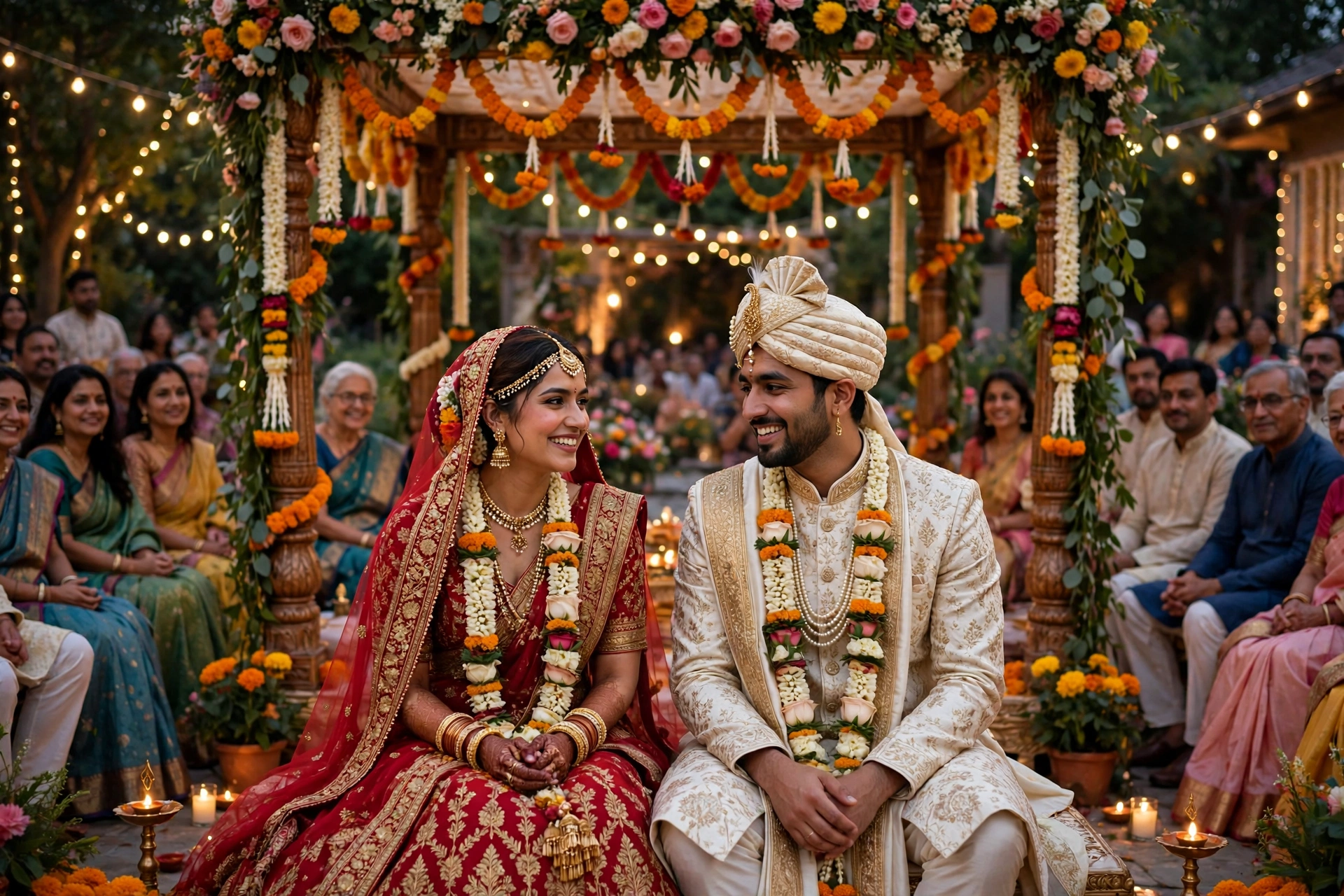
An Indian wedding is one of the happiest days of a family’s life, and also one of the most expensive. Ask any family that has done one recently and they will tell you the same thing: the number you start with is never the number you end with. A wedding planned at ₹10 lakh quietly becomes ₹15 lakh. A ₹25 lakh plan drifts towards ₹35 lakh. And in too many cases, the difference is borrowed — a personal loan, a loan against gold, or a credit card stretched across months of EMIs.
The good news is that a good wedding does not need a loan. It needs a budget made early, a few honest decisions, and the discipline to protect that budget from the three or four moments when it is most likely to break. This is a practical plan for doing exactly that.
Start with the number you actually have, not the number you wish you had
Most wedding budgets start backwards. The family decides what kind of wedding they want — the venue, the guest count, the food — and then works out how to pay for it. That order is the problem. When the dream comes first, the budget becomes whatever the dream costs, and borrowing fills the gap.
Flip the order. Start with the money that is actually available. Add up the savings set aside for the wedding, the contributions both families are genuinely comfortable making, and any gifts or support that are certain, not hoped for. That total is your budget. Everything else is a wish list.
Suppose the number is ₹12 lakh. That is a real, respectable wedding budget in most Indian cities. It will not buy a five-star hotel for 800 guests, but it can buy a genuinely good celebration for 200 to 300 people. The mistake is not having ₹12 lakh. The mistake is planning a ₹25 lakh wedding with ₹12 lakh in hand and borrowing the rest.
Be honest about one thing in particular: contributions from relatives. “Chacha will help” is not a budget line until the money is in your account. Count only what is confirmed. If extra help arrives later, it is a bonus, not a rescue.
Where the money actually goes
Before you can control a wedding budget, you need to know where the money goes. For a typical middle-class Indian wedding, the split looks roughly like this.
The venue is usually the biggest single cost, taking 20 to 30% of the budget. A banquet hall in a metro city can cost ₹2 to ₹5 lakh for a day, and a farmhouse or resort costs more. Food and catering is the next big block, usually 25 to 35%. At ₹800 to ₹1,500 per plate in a city, 300 guests means ₹2.4 to ₹4.5 lakh on food alone. Decoration runs 8 to 12%, photography and video another 8 to 10%, clothes and jewellery for the couple 10 to 15%, and guest travel and stay 5 to 10% if relatives are coming from other cities. Music, the baraat, makeup, invitations, and miscellaneous costs take the rest.
Add those up and the pattern is clear: venue, food, and guest count decide the budget. Everything else is smaller. That means the three biggest savings are also the three hardest decisions — and the ones most worth making carefully.
The guest list is the budget
Here is the single most powerful sentence in wedding budgeting: every guest costs money, and the cost is not just their plate.
Each guest means one more plate of food, one more chair, a bigger venue, more decoration, more return gifts, and more travel and stay if they are from out of town. At a typical city wedding, one extra guest costs roughly ₹1,500 to ₹2,500 all-in. Fifty extra guests is ₹75,000 to ₹1.25 lakh. A hundred extra guests can cost more than the entire decoration budget.
This is why the guest list is where budgets are really made or broken. Families feel pressure to invite everyone — distant relatives, parents’ colleagues, old neighbours, business contacts. The list grows from 200 to 400 to 600, and nobody says no to anyone because each addition feels small on its own.
The way to handle it is simple, even if it is not easy. Both families sit down with three lists: must invite, should invite, and nice to invite. Start with the must-invite list. That is usually 100 to 200 people — close family and close friends. Then add from the should-invite list only if the budget allows. The nice-to-invite list stays home, or gets a phone call and a photo after the wedding.
It also helps to remember something that every family discovers after the wedding: the couple remembers the people they are close to. Nobody remembers the 87th guest. A smaller wedding with people who matter is a better memory than a large one full of people you barely know.
Pick the date and the venue with the budget in mind
Wedding dates in India are not all priced the same. The most auspicious dates in the November-to-February season, and the peak dates in May and June, cost the most. Venues charge a premium on those days, and so do caterers, decorators, and photographers. A Saturday in peak season can cost 30 to 40% more than a weekday in the off-season.
If the budget is tight, two choices save the most money with the least pain. First, consider a weekday wedding, or a date in the shoulder season — March, July, August, or September. The venue and vendors are cheaper, and the good ones are actually available. Second, consider a daytime or lunch wedding instead of an evening one. Lunch receptions are often cheaper, guests leave earlier, and the whole event costs less in lighting, music, and overtime charges.
The venue itself deserves a careful look. A banquet hall with an in-house caterer can look cheaper but locks you into their food prices. A community hall, a temple hall, or a family-owned space with an outside caterer often costs less overall, even after decoration. And a home wedding, if space allows, can cut the venue cost almost entirely — though it adds work. Always visit the venue at the same time of day as your event, check the power backup, the parking, the toilets, and the kitchen. A cheap venue that cannot handle 300 guests is not cheap.
Food: spend where guests notice, save where they do not
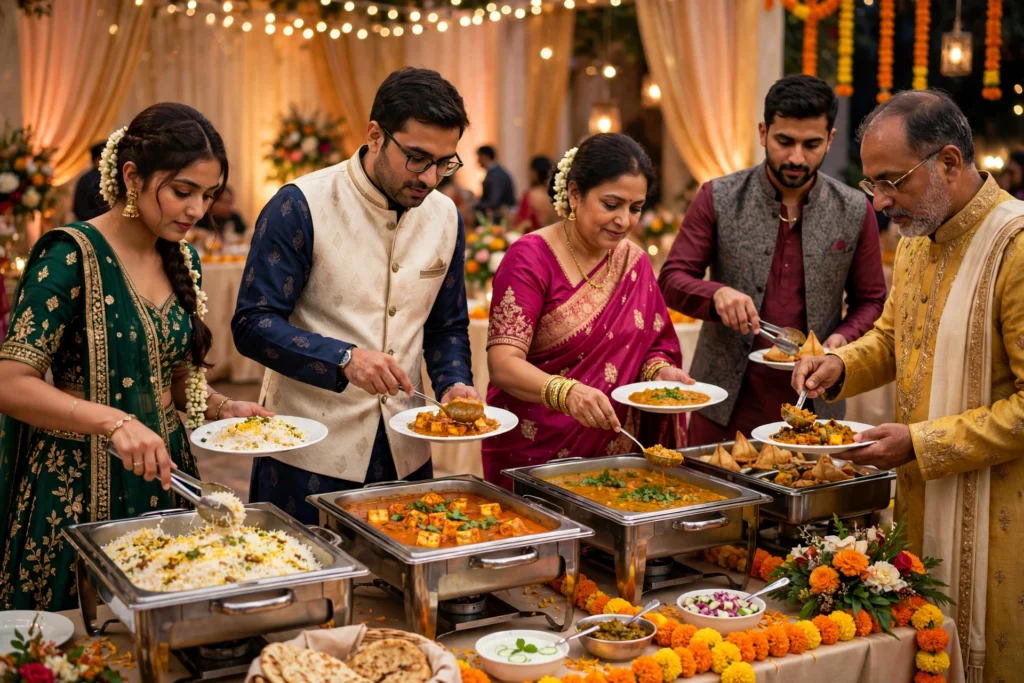
Food is where guests form their strongest memory of a wedding, so it deserves a real share of the budget. But it is also where families overspend most easily, because the temptation is to add one more dish, one more live counter, one more dessert.
A practical rule: a good menu has fewer excellent dishes rather than many average ones. Twelve dishes done well will be remembered better than twenty-five dishes that are lukewarm and half-finished. Guests remember the taste of the paneer and the dal, not the number of items on the menu card.
Live counters are popular and expensive. A chaat counter, a dosa counter, a pasta counter — each one adds ₹15,000 to ₹40,000. Pick one or two that your guests will actually enjoy, not five that look good in photos. The same goes for exotic desserts. A good gulab jamun and kulfi station beats an imported chocolate fountain that half the guests ignore.
Get the caterer to quote per plate and in writing, with the menu, the number of staff, and what is included — crockery, serving, water, and cleanup. And negotiate. Catering prices in India are almost always negotiable, especially if you are booking in the off-season or paying a large advance. A 10% negotiation on a ₹3 lakh catering bill is ₹30,000 saved.
Photography, decoration, and the things that feel mandatory but are not
Photography is worth paying for properly, because it is the one thing that lasts after the day ends. A good photographer and a good videographer will cost ₹75,000 to ₹1.5 lakh together in a city, and that is money well spent. But you do not need a drone, a pre-wedding shoot in three locations, a cinematic teaser, a same-day edit, and a 200-page album. Pick the package that covers the main day well, and skip the rest.
Decoration is similar. Flowers, lighting, and stage design can easily cross ₹1.5 lakh, and much of it is seen for a few hours and then dismantled. Focus the decoration on the places guests actually look — the entrance, the stage, and the dining area. Artificial flowers and rented props cost a fraction of fresh imported flowers and look nearly the same in photographs. And if the venue is already attractive, you need less decoration, not more.
Clothes are the third big emotional spend. A bridal lehenga can cost anywhere from ₹50,000 to ₹5 lakh, and the pressure to buy the most expensive one is real. But the dress is worn once. A beautiful outfit at ₹75,000 that fits well and photographs beautifully is a smarter choice than a ₹3 lakh one bought on EMI. The same applies to the groom’s sherwani and to jewellery — buy what you will wear again, and rent or borrow what you will not.
A simple timeline that keeps the budget safe
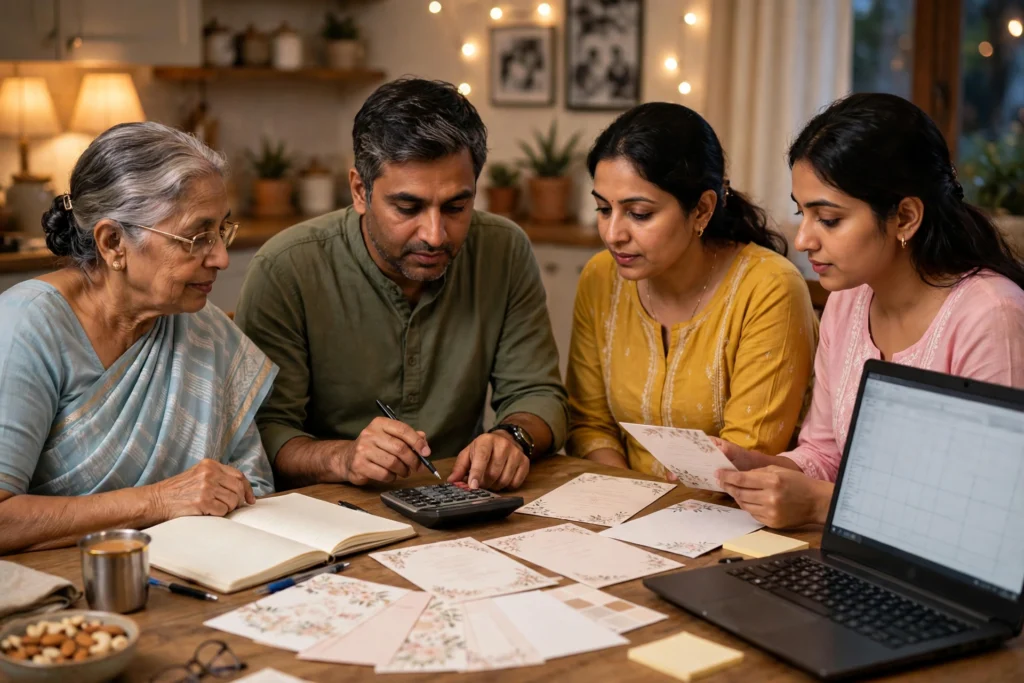
A wedding budget survives when the money is planned before the spending starts. A timeline helps.
Twelve months before, fix the total budget and the guest count, and open a separate savings account or a recurring deposit for wedding expenses. Every rupee meant for the wedding goes into that account, and every wedding payment comes out of it. When the account is empty, the spending stops. That one rule prevents more debt than any other.
Six to nine months before, book the venue and the caterer. These are the biggest costs, and booking early locks in prices and gives you time to negotiate. Nine months is also when you should start comparing photographers and decorators.
Three to six months before, book the remaining vendors, buy the clothes, and send the invitations. This is the danger zone for budget creep, because everything suddenly feels urgent. Stick to the list you made at the start.
One month before, do a final count. Confirm the guest numbers with the caterer, confirm the vendor payments, and keep 10% of the budget aside as a buffer for last-minute costs. There will always be last-minute costs — an extra table, a forgotten relative, a transport problem. A buffer absorbs them. Without one, they go on a credit card.
How to save for a wedding without stress
If the wedding is a year or more away, saving for it is straightforward. A recurring deposit or a short-term fixed deposit works well, because the money is safe and it is slightly inconvenient to withdraw — which is a feature, not a bug. A family saving ₹25,000 a month for two years builds ₹6 lakh, plus interest. A family saving ₹50,000 a month builds ₹12 lakh. Start early and the monthly number becomes manageable.
If the wedding is six months away, the options narrow. Cut discretionary spending sharply, postpone other big purchases, and consider whether any part of the celebration can be simplified. What you should not do is take a personal loan for a wedding. A ₹5 lakh personal loan at 12% over three years costs about ₹1.2 lakh in interest alone, and you will still be paying it long after the last guest has gone home. A wedding is one day. A loan is three years of monthly payments. The maths is not close.
If the money genuinely is not enough, the honest answer is a smaller wedding, not a bigger loan. A smaller guest list, a simpler venue, or a different date will always be kinder to the family than starting married life with debt. Nobody at the wedding will know what you did not spend. But you will feel every EMI for years.
The wedding is the start, not the finish
It is worth remembering why the budget matters. A wedding is the beginning of a shared financial life, not the end of one. The couple will need money after the wedding — for a home, for furniture, for emergencies, for the first year of living together. Every rupee borrowed for the wedding is a rupee that is not available for those things.
Families that plan a wedding within their means do something quietly important: they start the marriage without a debt hanging over it. The celebration is just as joyful, the photos look just as good, and the morning after, nobody owes anyone anything. That is the real gift a wedding budget gives — not a cheaper wedding, but a freer start.