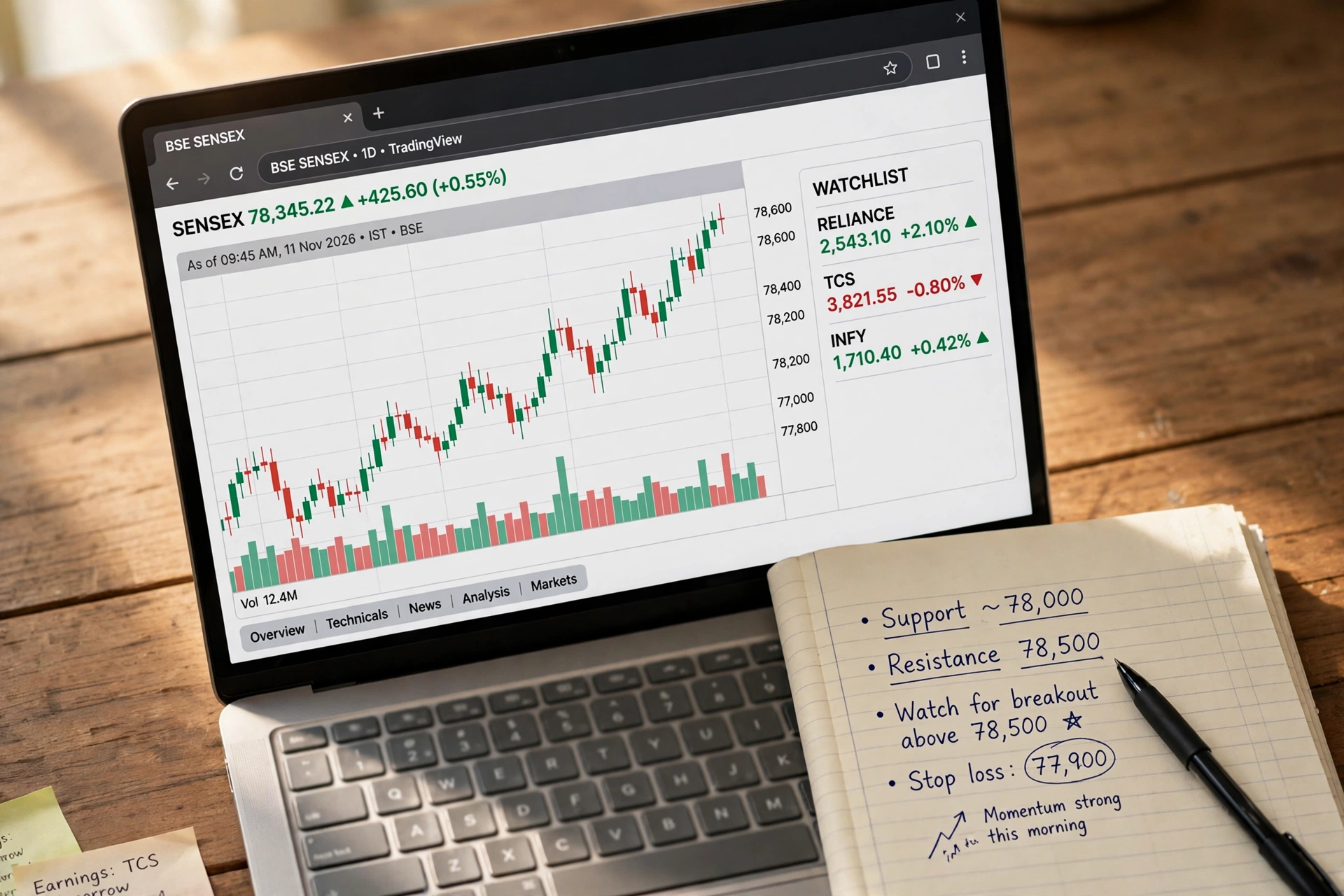
Every month, lakhs of Indians open a demat account for the first time. Some have watched a friend double their money on a stock. Others are simply tired of watching their savings earn 3% in a savings account while prices keep climbing. Whatever brings you here, the question is the same: how do you actually start investing in stocks in India without making expensive beginner mistakes?
The honest answer is that buying your first share is the easy part. It takes about ten minutes on a phone. The harder part — and the part that decides whether you make money over the years — is knowing what you are buying, why you are buying it, and what you will do when the price falls. This guide walks through all of it, step by step.
What does buying a stock actually mean?
When you buy a share of a company, you are buying a tiny piece of that business. If you own one share of a company that has a crore shares in circulation, you own a one-crore-th of it. That sounds abstract, but it has a very practical meaning: as the company earns profits and grows, your share of it becomes more valuable, and the market is usually willing to pay more for it.
This is also why a stock is not a lottery ticket. Its price moves up and down every day, sometimes for reasons that have nothing to do with the business — a global event, a rumour, a bad week for the whole market. But over years, the price of a good company’s shares tends to follow its profits. A company that keeps earning more usually ends up worth more. A company whose profits shrink usually ends up worth less. Keep that one idea in mind and most of the noise in the stock market becomes easier to ignore.
In India, shares trade mainly on two exchanges, the NSE and the BSE. You do not buy shares directly from the exchange. You buy them through a broker, and the shares sit in your demat account — short for dematerialised account — which is simply an electronic locker for the shares you own.
What you need before your first trade
Getting set up is mostly paperwork, and most of it can be done online in a day or two. Here is what you need:
- A PAN card. This is mandatory. Without it, you cannot open a trading or demat account in India.
- A bank account. Your money moves between your bank account and your trading account. Most brokers let you add money through UPI, net banking or a direct transfer.
- A demat account and a trading account. The trading account is what you use to place buy and sell orders; the demat account is where the shares you buy are held. Many brokers open both together. Popular discount brokers charge little or no account-opening fee, and annual maintenance charges are often between zero and ₹300 a year.
- A KYC-compliant identity. You will need an Aadhaar-linked mobile number for e-KYC, plus a cancelled cheque or bank statement and a photograph. The whole process is usually paperless now.
One thing worth checking before you pick a broker is the brokerage charge. Discount brokers typically charge a flat ₹20 per executed order for intraday and delivery trades, and many charge nothing at all for buying shares and holding them (delivery trades). Full-service brokers charge a percentage of the trade value, which can quietly eat into your returns if you trade often. For a beginner who plans to buy and hold, a low flat-fee broker is usually the sensible choice. Also check the charges for pledging, for selling, and for transferring shares, because those small fees add up over time.

How much money do you need to start?
Less than most people think. There is no minimum amount to open a demat account, and you can buy a single share of a company. If a company’s share costs ₹180, that is all you need to become a shareholder, plus a small brokerage fee.
That said, starting with a tiny amount has a practical problem: it limits what you can buy. With ₹1,000, you can buy a few shares of one or two companies. With ₹5,000 or ₹10,000, you can spread it across three or four. A reasonable way to begin is to set aside a fixed amount every month — say ₹2,000 or ₹5,000, whatever fits your budget — and invest it steadily. This is the same discipline that makes SIPs work in mutual funds, and it works just as well with stocks. You can read more about that habit in our guide to starting a SIP with just ₹500 a month.
What you should not do is invest money you will need in the next year or two. Stocks are for money you can leave alone for at least three to five years. If the money is for next year’s house deposit or your child’s school fees, it belongs in a fixed deposit or a savings account, not in the market.
How to pick your first stocks
This is where beginners usually get stuck, and it is also where most of the costly mistakes happen. A few ground rules help:
- Start with businesses you understand. If you use a bank, buy groceries from a supermarket chain, or recharge your phone through a telecom company, you already understand something about those businesses. You know what they sell, who their customers are, and whether they seem to be doing well. That is a better starting point than a stock tip from a stranger on social media.
- Look at the company’s track record, not just its price. A share that has fallen from ₹500 to ₹100 is not automatically cheap. It may have fallen because the business is in trouble. Before buying, check a few basics: has the company’s revenue and profit grown over the last five years? Does it carry heavy debt? Does it pay a dividend? Free tools on broker apps, exchange websites and financial portals show all of this in a couple of minutes.
- Think in terms of quality, then price. A well-run company bought at a fair price is a better investment than a shaky company bought cheap. As a beginner, large, established companies — the kind that show up in the Nifty 50 — are a safer place to start than small, unknown ones. They are less likely to collapse, their shares are easier to buy and sell, and there is plenty of public information about them.
- Diversify, even a little. Putting all your money into a single stock is a gamble, however good the company looks. Spread it across three or four companies in different sectors — say, a bank, a consumer goods company, an IT company and a pharma company. If one sector has a bad year, the others can cushion the blow.
- Ignore tips and “multibagger” promises. Nobody on the internet knows which stock will double next month. If they did, they would not be selling the tip. Hot tips are the single biggest reason beginners lose money in their first year.
The beginner mistakes that cost the most
Most new investors do not lose money because they picked terrible companies. They lose money because of behaviour. These are the mistakes to watch for in yourself:
- Trying to time the market. Waiting for the “perfect” moment to buy usually means waiting forever, or buying in a panic after prices have already risen. Nobody consistently buys at the bottom and sells at the top. Investing a fixed amount regularly matters far more than picking the right day.
- Buying penny stocks. Shares priced at ₹5 or ₹10 look cheap, and it is tempting to buy thousands of them. But these companies are often loss-making, thinly traded, or manipulated. A ₹10 share can fall to ₹2 just as easily as it can rise to ₹20 — and it is much harder to sell when you want out.
- Borrowing to invest, or trading on margin. Leverage magnifies losses exactly as much as it magnifies gains. A 20% fall wipes out your entire capital if you borrowed the same amount again. For your first few years, invest only money you actually own.
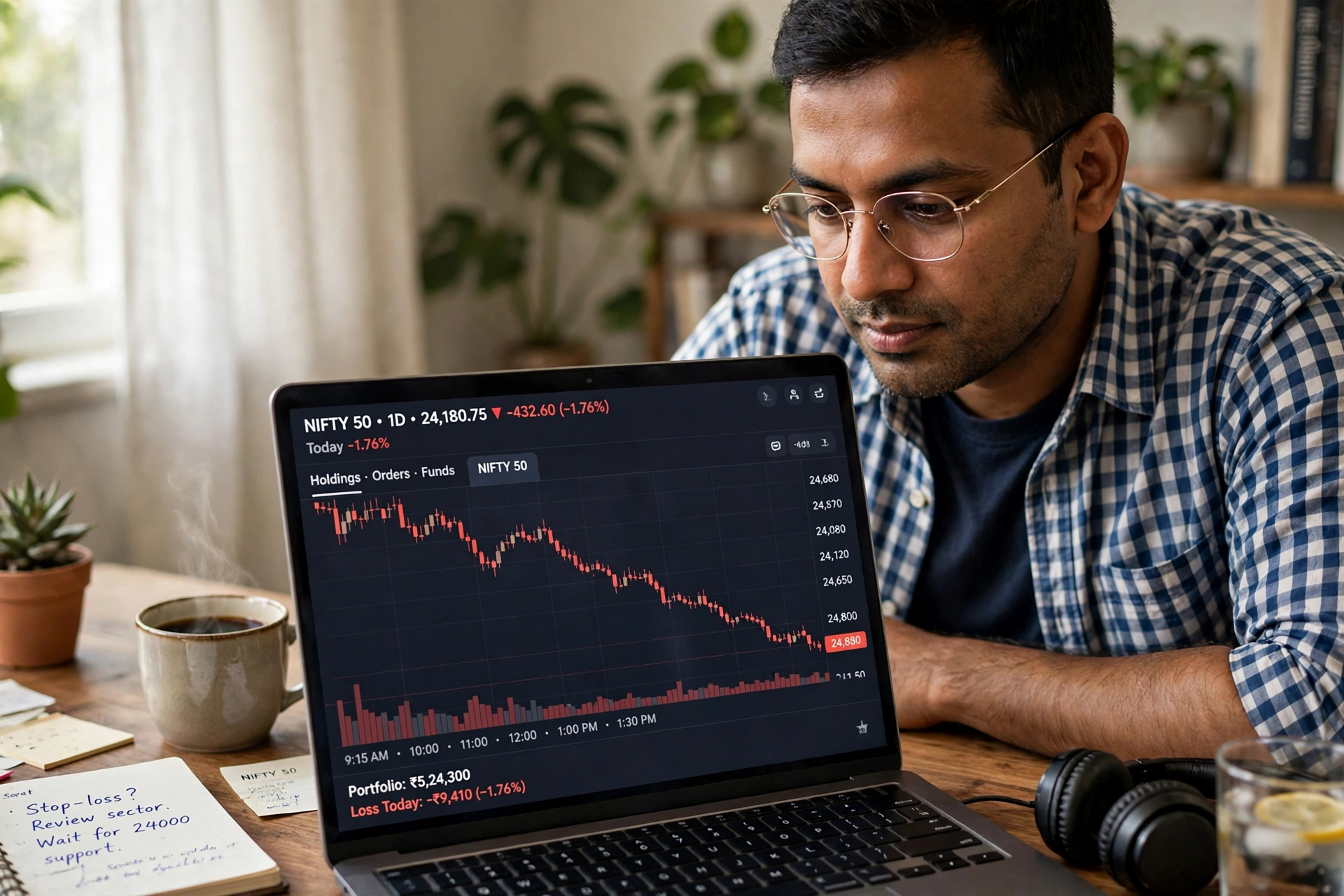
- Panic selling. The market will fall. It falls every year, sometimes by 10% or more, and it always feels terrible in the moment. Investors who sold in panic during the Covid crash of March 2020 locked in their losses; those who stayed invested saw their portfolios recover within months. If the companies you own are still fundamentally sound, a market fall is a buying opportunity, not a reason to exit.
- Checking prices every hour. Watching your portfolio all day does not make it grow faster. It makes you anxious, and anxious investors trade too much. Checking once a week — or even once a month — is plenty when you are investing for the long term.
Stocks vs mutual funds: which suits you?
This is a fair question, and the honest answer is that it depends on how much time and interest you have. Buying stocks directly gives you control and, if you choose well, potentially higher returns. But it also demands research, patience and the stomach to hold through bad years.
Mutual funds, especially index funds, do the stock-picking for you. An index fund simply buys all the companies in the Nifty 50 or Sensex, so you get the market’s average return without having to choose individual winners. For many beginners, that is the better first step — you can start with a small SIP, learn how the market behaves, and then add direct stocks as your confidence grows. Our comparison of index funds vs active mutual funds explains the difference in detail.
There is no rule that says you must choose one or the other. Many experienced investors hold both: index funds as the steady core of their portfolio, and a handful of individual stocks they have researched and believe in.
What about tax on stock gains?
Tax is part of the return, so it is worth knowing the basics. If you sell shares within a year of buying them, the profit is a short-term capital gain, taxed at 20%. If you hold for more than a year, the profit is a long-term capital gain, taxed at 12.5% — but only on gains above ₹1.25 lakh in a financial year. Gains below that threshold are exempt.
Two practical implications follow from this. First, holding for more than a year is usually more tax-efficient than frequent trading. Second, if your gains in a year are small, you may pay no tax at all. Your broker provides a tax statement, and the details also appear in your Annual Information Statement on the income tax portal, so filing is less painful than it sounds. Just remember that these rates apply to listed equity shares; the rules differ for unlisted shares and other assets.
A simple plan for your first year
If all of this feels like a lot, here is a plan you can actually follow:
- Month 1: Open your demat and trading account, and spend a few weeks reading about two or three companies you already know. Do not buy anything yet.
- Month 2: Invest your first amount — say ₹5,000 — split across two well-established companies. Watch how it feels when the price moves up and down.
- Months 3–12: Add a fixed amount every month, either to the same companies or to new ones you have researched. Read the quarterly results of the companies you own. Avoid tips, avoid leverage, avoid panic.
- End of year one: Review. Did your companies grow their profits? Did you stay disciplined? Most people who follow a plan like this end their first year with a portfolio they understand — and that understanding is worth more than any single stock pick.
Starting to invest in stocks in India is not about being clever or lucky. It is about buying pieces of good businesses, paying a fair price, and then giving them time. The investors who do well over decades are rarely the ones who made one brilliant trade. They are the ones who started, kept going through the bad years, and let compounding do the heavy lifting. Your first share is the hardest one to buy. After that, it is mostly a matter of not getting in your own way.