Most Indian parents will happily spend hours helping a child with maths homework, but money — the one subject that child will use every single day of adult life — rarely gets the same attention. We assume children will somehow pick it up. They do, but usually by watching us, and what they see is not always what we would want them to learn. They see us tapping a phone to pay and ordering things with a click. The thinking behind those actions stays invisible.
To teach kids about money, you do not need a finance degree or a long lecture every Sunday. You need small, regular moments where money becomes something they can touch, count, choose with, and sometimes get wrong while the stakes are still low. A child who loses ₹50 on a bad canteen choice at ten is far better off than an adult who loses ₹50,000 on a bad loan decision at twenty-five because nobody ever let them practise. The aim is not a child who obsesses over every rupee, but one who understands that money is a tool — useful, limited, and worth thinking about before it is spent.
Start Early, But Start Small
Children notice money long before they understand it. A four-year-old knows the coins in your wallet buy ice cream. A six-year-old knows the phone beep at the shop means something has been paid for. What they do not know is where that money comes from, or that it runs out. By five or six, a child can grasp that you work to earn money, that you spend some of it on things the family needs, and that you keep some aside for later. A simple sentence works: “Papa goes to office and earns money, and from that money we buy food, pay for your school, and save a little for later.”
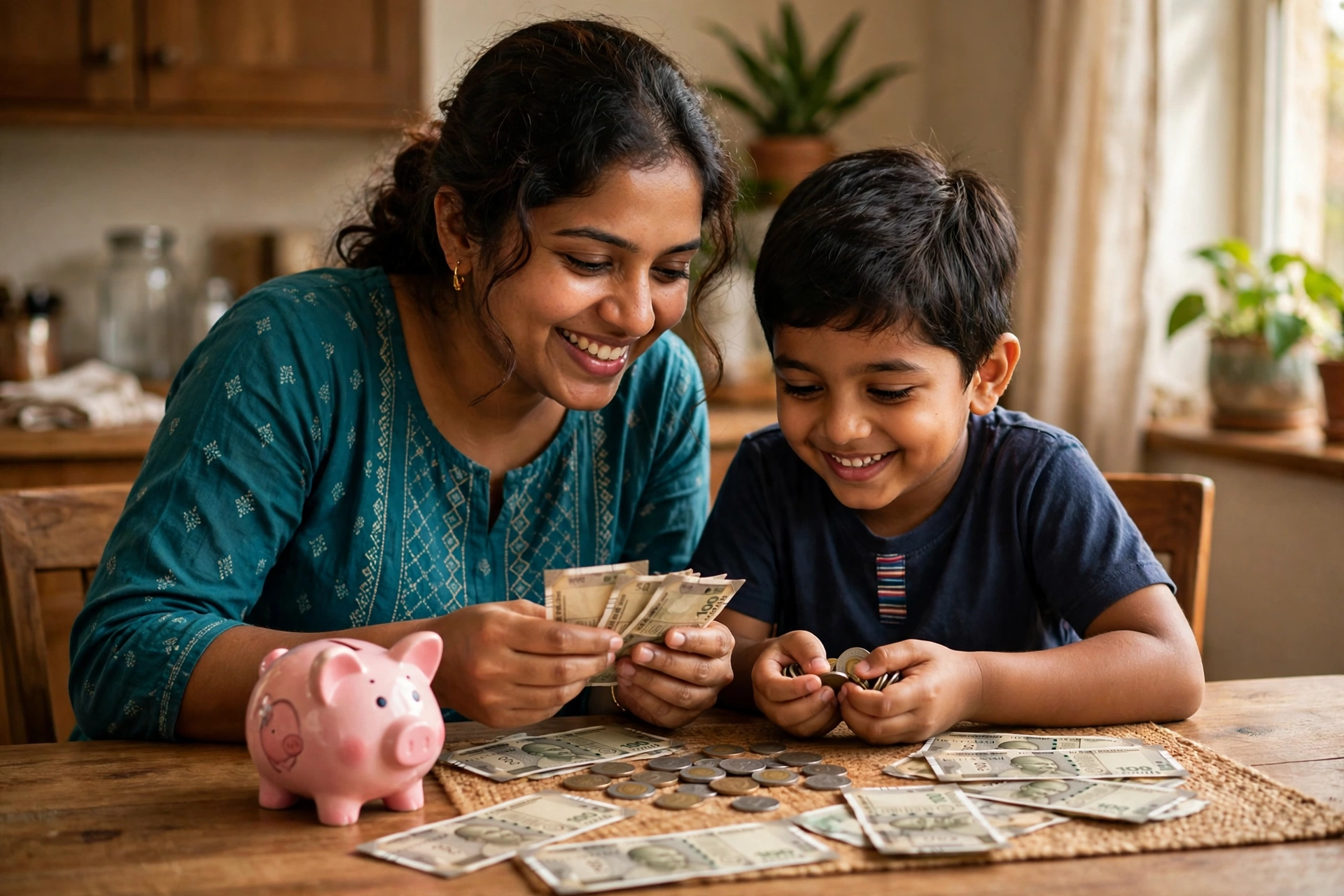
Let them handle real cash. Coins and notes make money concrete in a way a UPI screen never will. Give a young child a few coins to hold, count them together, and let them hand the money to the shopkeeper for a small purchase. That tiny act — counting, handing over, getting change back — teaches more than any explanation. A piggy bank, or even a steel dabba with a slit cut in the lid, is still one of the best teaching tools there is. Once a month, open it together and count. Celebrate the total, however small. The point is the habit, not the amount.
Pocket Money: The First Real Budget
Pocket money is where most families start, and it is also where most families get it slightly wrong — giving it irregularly, ₹20 here and ₹100 there whenever the child asks, and with no conversation at all. A fixed amount on a fixed day works better. For a child of six or seven, ₹50 a week is plenty. For a nine- or ten-year-old, ₹100 to ₹150 a week is realistic. For a teenager, ₹300 to ₹500 a week, or ₹1,000 to ₹2,000 a month, is enough to learn with — provided some of it has to cover real things, like canteen snacks or a bus pass top-up, rather than being pure fun money.
Agree together on what pocket money is for. Maybe ₹100 a week is for snacks and small treats, and anything bigger — a new cricket bat, a book — comes from saving up over a few weeks. When the money is gone, it is gone until next week. That is the hardest part for parents, and the most important part for children. Topping up mid-week teaches them that money always appears when you ask for it. It is kinder to let them learn otherwise with ₹100 than with a salary. Let them make small mistakes. If your daughter spends her whole week’s money on stickers on Monday and then has nothing for the school fete on Friday, resist the urge to rescue her. Ask afterwards, without scolding: “What would you do differently next week?” That one question does more than ten lectures.
Needs vs Wants: The Lesson That Never Gets Old
If there is one idea worth teaching early, it is the difference between a need and a want. To a nine-year-old, a new pair of shoes and the latest Beyblade feel equally urgent. Make it a game before it becomes a lecture. At the grocery store, point things out: “Rice and dal — need. That packet of chips — want. Both are fine, but we buy the needs first.” When they ask for something, ask them back: “Is this a need or a want?” A want is not a bad thing. The lesson is that wants come after needs, and that you sometimes wait for a want.
A simple way to make this stick is the three-box method: split pocket money into spend, save, and share. A child with ₹100 a week might keep ₹60 to spend, put ₹30 in savings, and keep ₹10 aside to give — to a temple donation box, a classmate’s birthday gift, or a charity collection at school. The share box teaches that money is not only for yourself, and children who give a little tend to value what they keep a little more.
Saving: From Piggy Bank to a Real Account
Once a child has saved a few hundred rupees in a piggy bank, the next step is a bank account. Most Indian banks offer a minor savings account that a parent operates jointly with the child. The exact product matters less than the experience: going to the bank together, seeing their name on a passbook, watching a deposit turn into a printed entry. When the first interest credit appears — even if it is just a few rupees — point it out. “See, the bank gave you ₹12 because you kept your money there.” That is a child’s first introduction to the idea that saved money can grow.
Set savings goals that a child can actually reach. “Save ₹5,000 for your future” means nothing to an eight-year-old. “Save ₹500 for that art set you want” means everything. Help them draw a simple chart — a row of boxes to tick off — and stick it on the fridge. Visible progress keeps them going in a way that abstract encouragement never does. Festivals are a natural saving lesson too. Diwali, Eid, or a birthday often brings cash gifts from grandparents and relatives. Instead of quietly absorbing that money into household expenses, decide together: some to spend, some to save. Even ₹200 saved from a ₹500 gift teaches the habit.
Involve Them in Real Family Spending
Children learn the most from watching real decisions, not from staged lessons. Let them see some of the family’s actual money life — in an age-appropriate way, without burdening them with adult worries. Take them grocery shopping and give them a small job. With a younger child, compare two packets of biscuits: “This one is ₹40, this one is ₹65. Which one should we buy?” With an older child, give them a budget for one part of the shop — “You have ₹300 for fruits today” — and let them choose. Once a month, have a short, calm family budget chat: “This month we spent more on electricity because of the AC, so we will eat out one less time.” Children who hear this grow up understanding that a household runs on choices, not on an endless tap. For a simple structure to explain to older children, try the 50/30/20 rule — half for needs, a third for wants, a fifth for saving. A clear explainer is here: https://smartfinanceindia.com/monthly-budget-india-50-30-20-rule/
UPI, Phones and Digital Money: Teach Safety Early
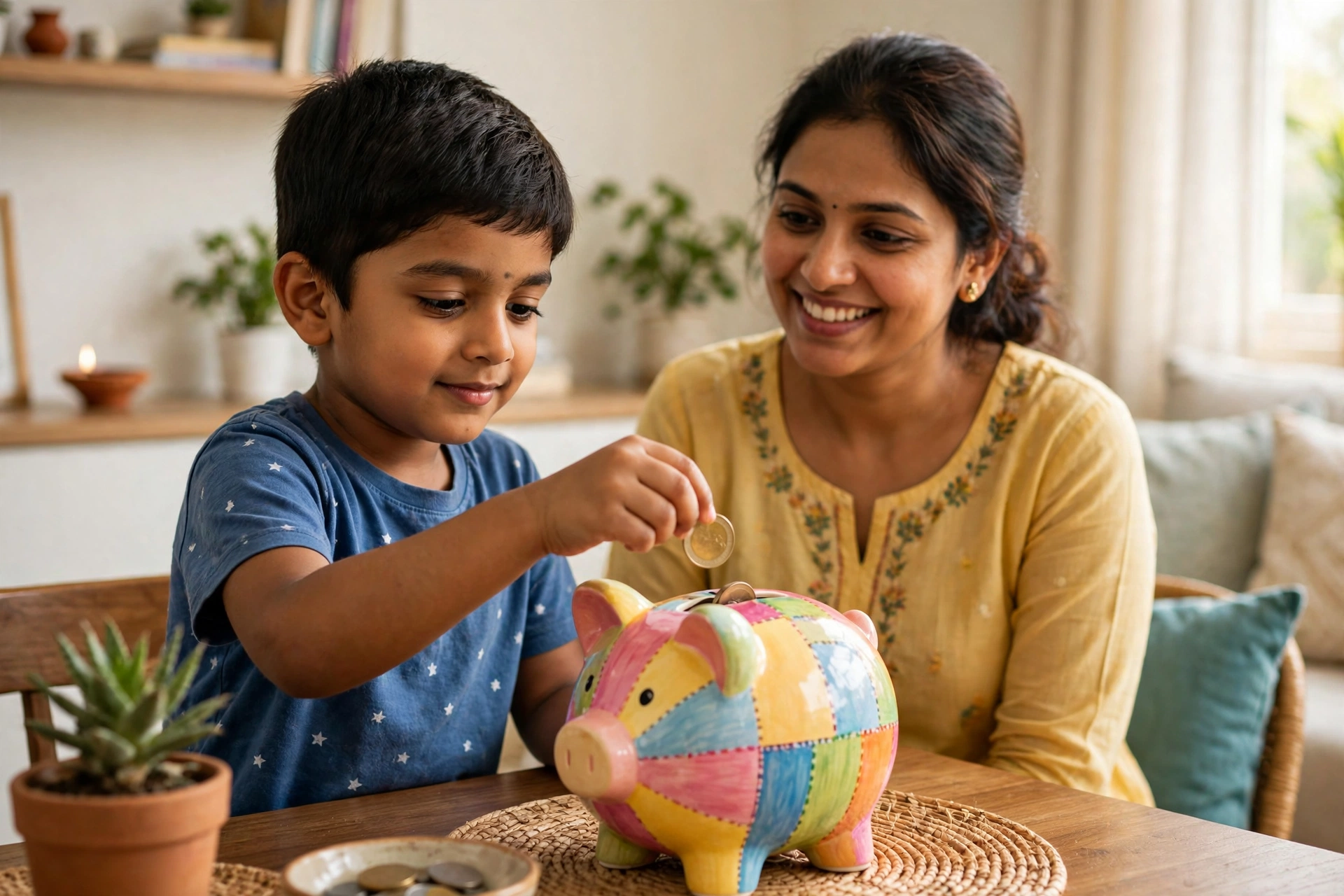
Here is the part our parents never had to teach, because it did not exist. A child today grows up watching money move without any physical sign of it. You tap, it beeps, it is done. To a child, that can look like magic — and magic never runs out. So do not hand a child your phone with UPI open and your PIN known, or let them memorise your PIN by watching you type it. If they need to pay for something small, do it together: “I am sending ₹150 to the shopkeeper from our bank account. See, the balance went down by ₹150.”
When they are old enough for their own phone — usually in their early teens — talk about digital payments before they start using them, not after a mistake. Never share a UPI PIN or OTP with anyone, not even a friend, and no real bank will ever ask for it on a call. Check the name of the person you are paying before you tap confirm. If a link promises free money or a prize, it is almost certainly a fraud. And if something goes wrong, tell a parent immediately, without fear of being scolded. The same rule applies to online games, where ₹49 here and ₹99 there can add up fast: no in-app purchases without asking, and any game spending comes out of their own pocket money.
Small Earning: The Other Half of the Lesson
Saving and spending are only half the picture. The other half is earning — understanding that money comes from doing something useful. A ten-year-old who helps a neighbour carry groceries and gets ₹50 for it learns something real. A twelve-year-old who makes handmade greeting cards and sells a few at a school fair learns that people will pay for something they made. Teenagers can tutor a younger child, help a relative with a computer problem, or do a small task for a family business. The amount matters less than the experience of being paid for work — and children are far more careful with money they earned themselves.
Age-Wise Ideas That Actually Work
Children of different ages need very different lessons. What works for a six-year-old will bore a fourteen-year-old, and what excites a teenager will confuse a seven-year-old.
Ages 5 to 8: Make It Touch and Count
At this age, everything should be physical and simple. Counting coins, sorting notes, a piggy bank they can shake. Let them pay at the shop. Play shopkeeper at home with real coins and toy groceries. Keep lessons to a minute or two, in the middle of everyday life. The goal is simple: money comes from work, it is limited, and saving means waiting for something good.
Ages 9 to 12: Give Them Real Choices
This is the pocket-money sweet spot. A weekly amount, a savings goal, a three-box split. Let them compare prices at the shop, plan a small birthday gift budget, and save for something they want over a month or two. Open a minor savings account together and let them watch the balance grow. Start talking about digital payments — what UPI is, in simple terms — and why you never share a PIN.
Ages 13 to 16: Trust Them With Bigger Decisions
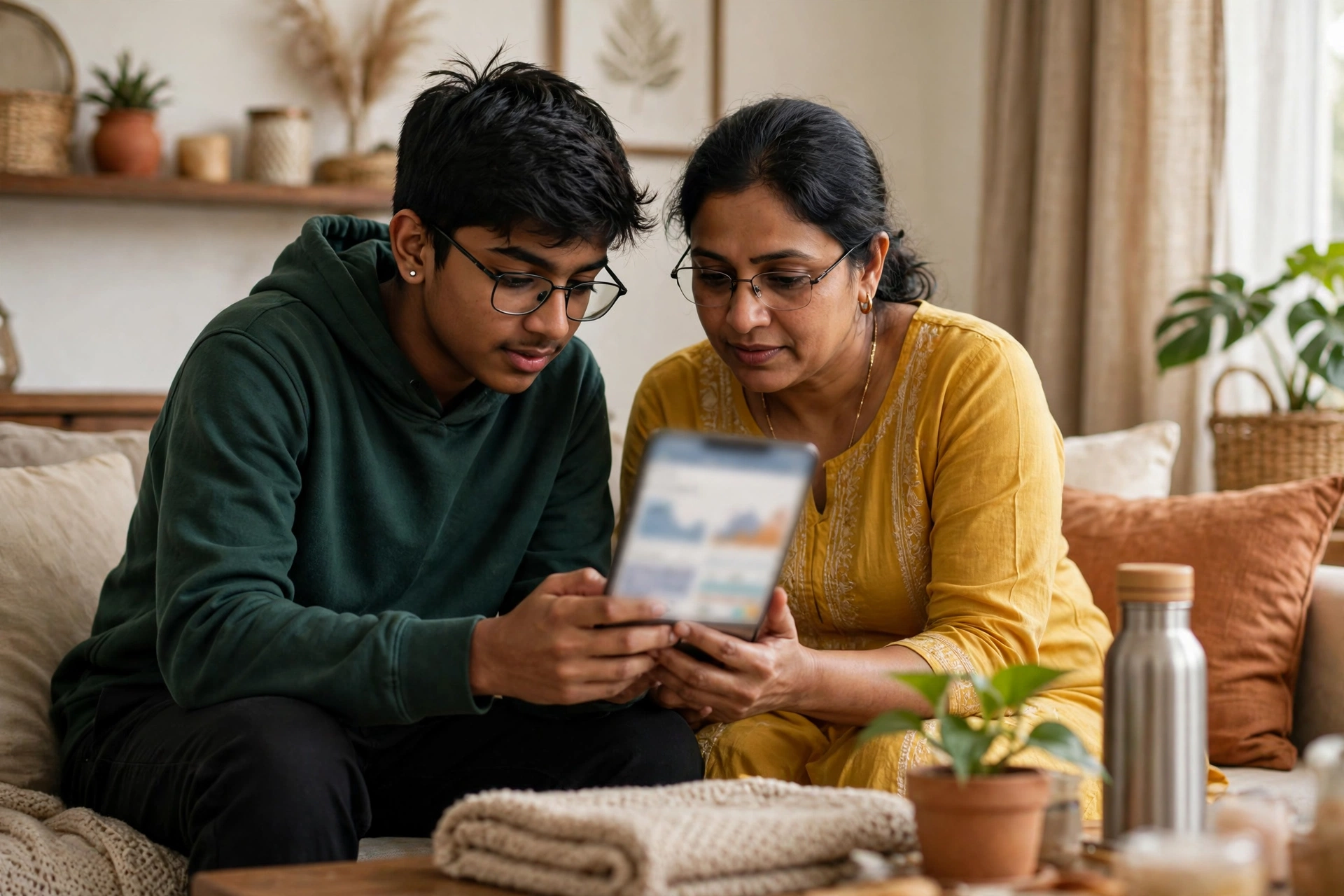
Teenagers can handle a monthly budget instead of a weekly one. Give them a fixed monthly amount that covers some real expenses — canteen, transport, a phone recharge — and let them manage it. If they blow it in the first week, that is the lesson, and it is still a cheap one. This is also the age to talk about bigger ideas in simple language: what is interest, why does a loan cost more than you borrow, why do adults keep an emergency fund? A ten-minute conversation while driving or cooking is enough. If you are saving for their higher education, tell them in broad terms that the family is planning for it — teenagers usually feel more secure knowing there is a plan. This guide is a useful starting point: https://smartfinanceindia.com/save-for-child-education-india/
Mistakes Parents Make
Most parents who want to teach kids about money go wrong in a handful of predictable ways, and all of them are easy to fix. First, using money as a reward or a punishment: paying a child for good marks, or cutting pocket money because they misbehaved, turns money into a control tool. Studying should be its own reward, and discipline should be about the behaviour, not the wallet. Second, never saying no. A child who gets everything they ask for learns that wanting is the same as getting. A calm, occasional no — “Not this month, we can put it on your birthday list” — is the most basic money lesson there is. Third, fighting about money in front of the children, which teaches them that money is a source of stress. Keep the difficult conversations private. Fourth, keeping children completely in the dark. “We can’t afford it” is not an explanation. A simple, honest sentence is better: “We are saving for your brother’s school fees right now, so we will wait a month for the new cycle.”
The Habit That Matters Most
Children learn about money the way they learn language — by hearing it spoken around them, every day, in ordinary moments. The family that talks about prices at the market, that plans a festival budget together, that counts piggy-bank savings on a Sunday evening, is teaching constantly, without ever calling it a lesson. You do not need to do all of this at once. Pick one thing this week. Start a piggy bank. Fix a pocket-money day. Take your child to the bank. Have one short conversation about a need and a want. Then do it again next week. Small habits, repeated, turn into a child’s common sense about money — and that common sense, learned young, will look after them long after you have stopped holding their hand at the shop counter. The goal is not a child who never spends, but one who spends thoughtfully, saves steadily, and grows into an adult who is not afraid of money.