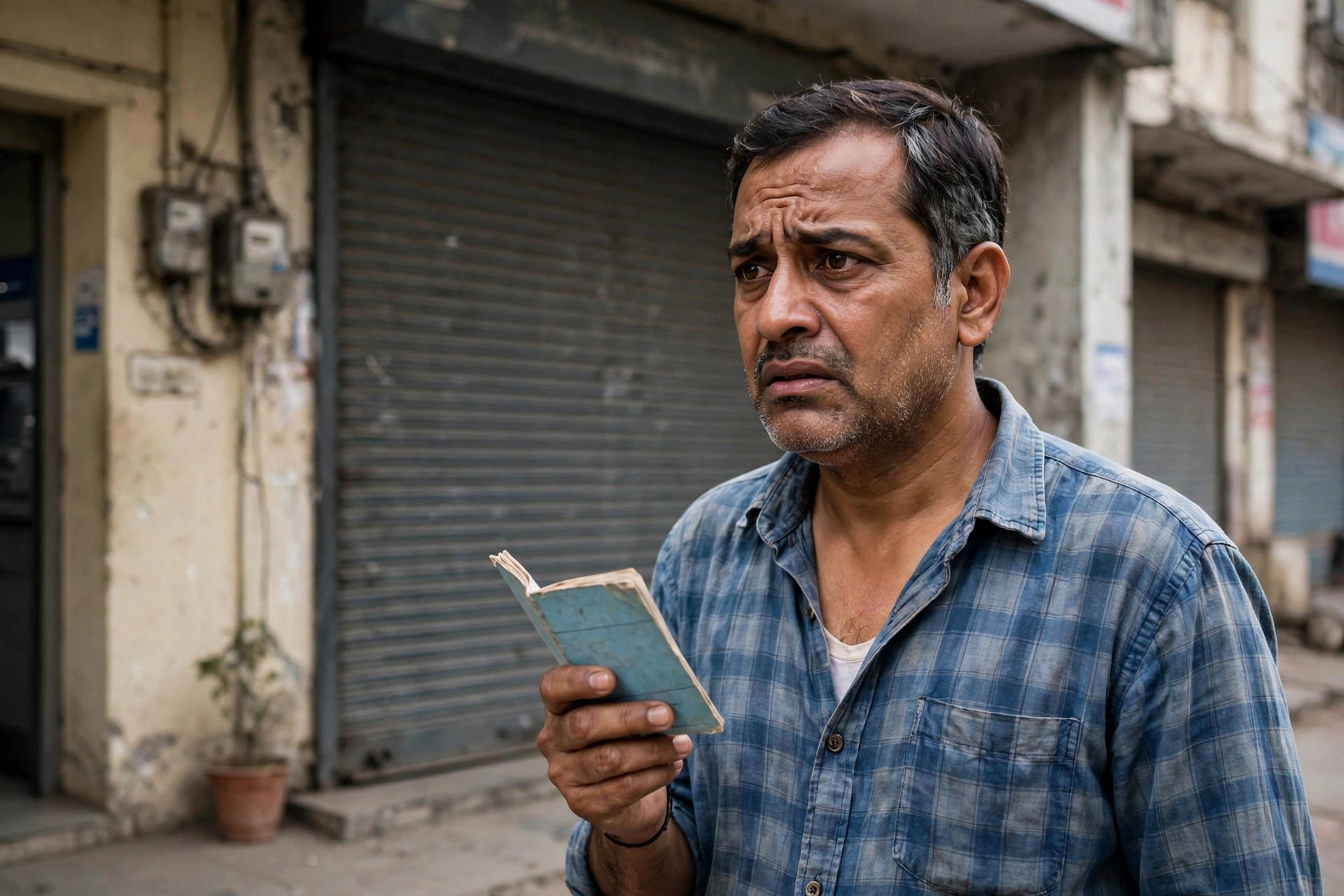
Most of us never think about it. Your salary lands in your account on the first of the month, you pay rent through UPI, a chunk sits in a fixed deposit, and life goes on. The bank feels permanent — a big building, a long queue, your money safe inside it.
But banks do fail. Not often, and not usually the big ones, but it happens, mostly with smaller co-operative banks. When it happens, every depositor asks the same question: is my money gone?
The short answer is: not all of it. India has a deposit insurance system that protects a good part of what ordinary savers keep in banks — but it has a limit, and that limit matters more than most people realise.
The ₹5 lakh safety net
Every bank deposit in India is insured by the Deposit Insurance and Credit Guarantee Corporation, or DICGC, a subsidiary of the Reserve Bank of India that has existed since 1961. The insurance is already there when you open an account or book a fixed deposit — you do not apply for it, and the bank pays the premium on your behalf.
The cover is ₹5 lakh per depositor, per bank. That is the maximum you can get back if your bank fails. It was ₹1 lakh for decades, and it was raised to ₹5 lakh in February 2020, after the Punjab and Maharashtra Co-operative Bank crisis left thousands of depositors unable to touch their money for months.
Five lakh rupees sounds like a lot until you add up what you actually have in one bank. A savings account with ₹1.5 lakh, a fixed deposit of ₹4 lakh, and a recurring deposit of ₹80,000 comes to ₹6.3 lakh in a single bank — and ₹1.3 lakh of it sits outside the insurance cover.
What exactly is covered?
The insurance covers the money you have parked with the bank in the usual ways. Your savings account balance counts, your current account counts, and fixed deposits and recurring deposits count too. If you hold several of these with the same bank, all of it is added together, and the total insured amount is still ₹5 lakh.
Interest counts as well, but only up to the same ceiling. A fixed deposit of ₹4.8 lakh that has earned ₹40,000 in interest gives you a total claim of ₹5.2 lakh, but the insurance will pay only ₹5 lakh.
One detail trips people up: the ₹5 lakh limit applies per depositor, per bank — not per account, and not per branch. Three accounts in three branches of the same bank give you ₹5 lakh of cover in total, not ₹15 lakh.
There is one useful exception. Deposits in different banks are insured separately. If you have ₹4 lakh in a fixed deposit with Bank A and ₹4 lakh with Bank B, both amounts are fully covered, because each bank gives you its own ₹5 lakh limit. This is the single most practical fact in the whole system, and we will come back to it.
What is NOT covered?
Not everything with a bank’s name on it is insured. Deposits of governments and other banks are excluded, as are deposits a bank received outside India.
For ordinary customers, the exclusion that matters most is this: the insurance covers deposits, not investments. Mutual funds, insurance policies, or bonds bought through your bank are not deposits. A mutual fund you bought through your bank’s app still belongs to you even if the bank goes under, because the money is held by the fund, not the bank. The contents of your bank locker are not covered either — a locker is a storage service, not a deposit.
There is one more quiet condition. A bank’s deposits are covered only if the bank is registered with DICGC and paying its premiums — almost all commercial and co-operative banks in India are. But if a tiny, unregistered entity calls itself a bank and takes your money, that money may have no cover at all, so check that any institution holding a large sum of yours is a real, licensed bank.
How do you get your money back?
When a bank fails, the RBI usually steps in first. It may place the bank under a moratorium — a temporary freeze on withdrawals — while it works out whether the bank can be rescued, merged with a stronger bank, or wound up. During a moratorium, withdrawals are typically capped at a small amount, often around ₹10,000, though the RBI has sometimes allowed more for medical emergencies. The freeze can last weeks or months, and this waiting period is genuinely hard for people who need the money for rent, school fees, or a hospital bill.
If the bank is merged with another bank, your deposits usually transfer to the new bank and life goes on — that is what happened with Yes Bank in 2020 and with Lakshmi Vilas Bank, merged into DBS Bank India. Depositors did not lose their money, though they went through a frightening few weeks.
If the bank is liquidated instead, DICGC steps in and pays depositors up to the ₹5 lakh limit, and the law now sets a clear deadline: payment within 90 days of the RBI imposing a moratorium or ordering liquidation. The first 45 days are for the bank to collect and verify depositor details, and the next 45 days are for DICGC to verify and pay. The money is credited directly to an account you nominate.
The paperwork is not complicated, but it exists. The failed bank’s liquidator collects identity proof, account details, and a claim form, though in practice the bank already has most depositors’ details on record. Delays usually come from messy records, incomplete KYC, or an old phone number or address on file — keeping your KYC and contact details current is one of those boring chores that suddenly matters enormously on the worst day of your financial life.
Why co-operative banks fail more often
The failures are rarely the big names. They are usually urban co-operative banks, small ones with a few branches in one city or district. The Punjab and Maharashtra Co-operative Bank crisis in 2019 is the best-known example: PMC had hidden bad loans worth thousands of crores, given to a single real estate group, and when the truth came out, the RBI froze withdrawals. Depositors who had kept their life savings there — many of them retirees — spent months protesting outside branches.
Co-operative banks are more vulnerable for a few reasons. They are smaller, so one big bad loan can sink them. Their governance has historically been weaker, sometimes controlled by local political interests. And until recently, their supervision was split between state governments and the RBI, which created gaps. The rules have tightened since 2020, with the RBI now having more direct power over co-operative banks, but the risk has not disappeared. That does not mean you should avoid them entirely — many are well-run. But think twice before keeping your entire savings in one small bank just because it offers 1% more interest. An extra ₹10,000 a year is a poor trade for risking your principal, and the same applies to small finance banks offering eye-catching rates.

The moratorium: what it feels like
A moratorium is the part of a bank failure that hurts most in the short term, because it freezes your money even though the bank has not formally died yet. You generally cannot withdraw more than the capped amount, and you cannot transfer money out through UPI or net banking beyond that limit. EMIs and SIPs linked to that account may bounce. It is a miserable experience, and no amount of insurance helps while it lasts, because the insurance pays out only after the final decision is made.
If you are building an emergency fund and wondering where to park it, the choice between account types matters too. Our earlier piece on fixed deposits versus savings accounts walks through the trade-offs — a savings account gives you instant access, while a fixed deposit pays more but locks the money up. And do not keep your emergency fund in the same bank as your long-term deposits: if one bank freezes, you still need to pay rent and buy groceries, so keep two or three months of expenses in a second bank.
Four habits that actually protect you
You do not need to become a banking expert. Four simple habits cover almost all of the risk.
Spread your deposits across banks. This is the most powerful move, and the cheapest. If you have ₹12 lakh in deposits, keep ₹4 lakh each in three different banks instead of all ₹12 lakh in one. Each bank gives you a separate ₹5 lakh of DICGC cover, so all ₹12 lakh is insured. Most people accumulate deposits in one bank out of habit — salary account, then FD, then RD, all in the same place. Break the habit on purpose.
Keep each bank’s total under ₹5 lakh where you can. A ₹10 lakh fixed deposit in one bank is only half insured. Split it into two ₹5 lakh deposits in two banks and the whole amount is covered. Note that branches of the same bank do not count as separate banks for insurance — it has to be a different bank.
Use joint accounts thoughtfully. If you and your spouse hold a joint account, the insured amount for that joint account is still capped at ₹5 lakh in total, not ₹5 lakh each. But if each of you also holds a separate individual account with the same bank, those are insured separately from the joint account. Worth working out once, especially for couples who keep most of their savings jointly.
Always add a nominee. A nominee does not affect deposit insurance, but it affects how fast your family can access your money if something happens to you. An account without a nominee can leave your family fighting paperwork for months. Adding one takes five minutes at the branch or through net banking, and it costs nothing. Do it for every account and every fixed deposit. While you are at it, check your other long-term savings too — our guide on checking your EPF balance and claiming online covers that step by step.
What about the big banks?
Could State Bank of India, HDFC Bank, or ICICI Bank actually fail? In theory, any bank can get into trouble. In practice, the RBI treats the largest banks as systemically important — a formal way of saying their failure would shake the whole financial system. They face stricter capital requirements and closer supervision, and the government has repeatedly stepped in when a large bank wobbled. Yes Bank was rescued in 2020 through a reconstruction scheme led by SBI, and no depositor lost money.
But “too big to fail” is a probability, not a guarantee. The ₹5 lakh insurance still applies to deposits in big banks, and the same logic about spreading deposits still holds — the risk in a large, well-capitalised bank is simply far lower than in a small co-operative bank with a concentrated loan book.
Check your own exposure in ten minutes
List every bank where you have money. For each one, add up everything — savings balance, fixed deposits, recurring deposits, current account if you have one. Any bank where the total is above ₹5 lakh is a bank where part of your money is uninsured, and any bank where the total is far above ₹5 lakh deserves a decision: move some of it, split it, or accept the risk knowingly.
Do the same check for your parents, if they will let you. Older savers are the most exposed, because they often keep large fixed deposits in a single bank they have trusted for thirty years — frequently a co-operative bank that offered a slightly higher rate for senior citizens.
What the ₹5 lakh limit does not solve
It is worth being honest about the gaps. The limit has not changed since 2020, and inflation eats away at it every year. Five lakh rupees in 2020 is worth noticeably less in 2026, and a middle-class family’s savings routinely exceed it. There have been demands to raise it to ₹10 lakh, but no change has been announced yet. Until it changes, the only way to get more cover is to use more banks.
The 90-day payout rule is also a best case, not a guarantee. The clock starts when the RBI imposes the moratorium or orders liquidation, and the process depends on the failed bank’s records being in order. In messy failures, depositors have waited longer. It is a big improvement on the old days, when payouts could drag on for years, but three months without your money is still three months.
And most depositors do not know the limit exists until their bank is in the news. Banks are required to tell depositors about DICGC cover, but the information sits in fine print. If you are reading this, you now know more than most depositors in the country.

The quiet lesson
A bank account feels like a safe. It is not. It is a loan you have made to the bank, and the bank lends that money onward to borrowers. Most of the time that chain works fine. Occasionally it breaks, and when it does, the system has a safety net — but the net has a fixed size.
Protecting yourself does not require skill or luck. It requires two things: knowing the ₹5 lakh limit, and spreading your money across banks so the limit covers all of it. Everything else — nominees, updated KYC, an emergency fund in a second bank — is small, one-time work that pays off only on a bad day. That is exactly when you will be glad you did it.
This article is general educational information about deposit insurance in India, not personal financial advice. For decisions about your own savings, consider speaking to a qualified financial adviser.