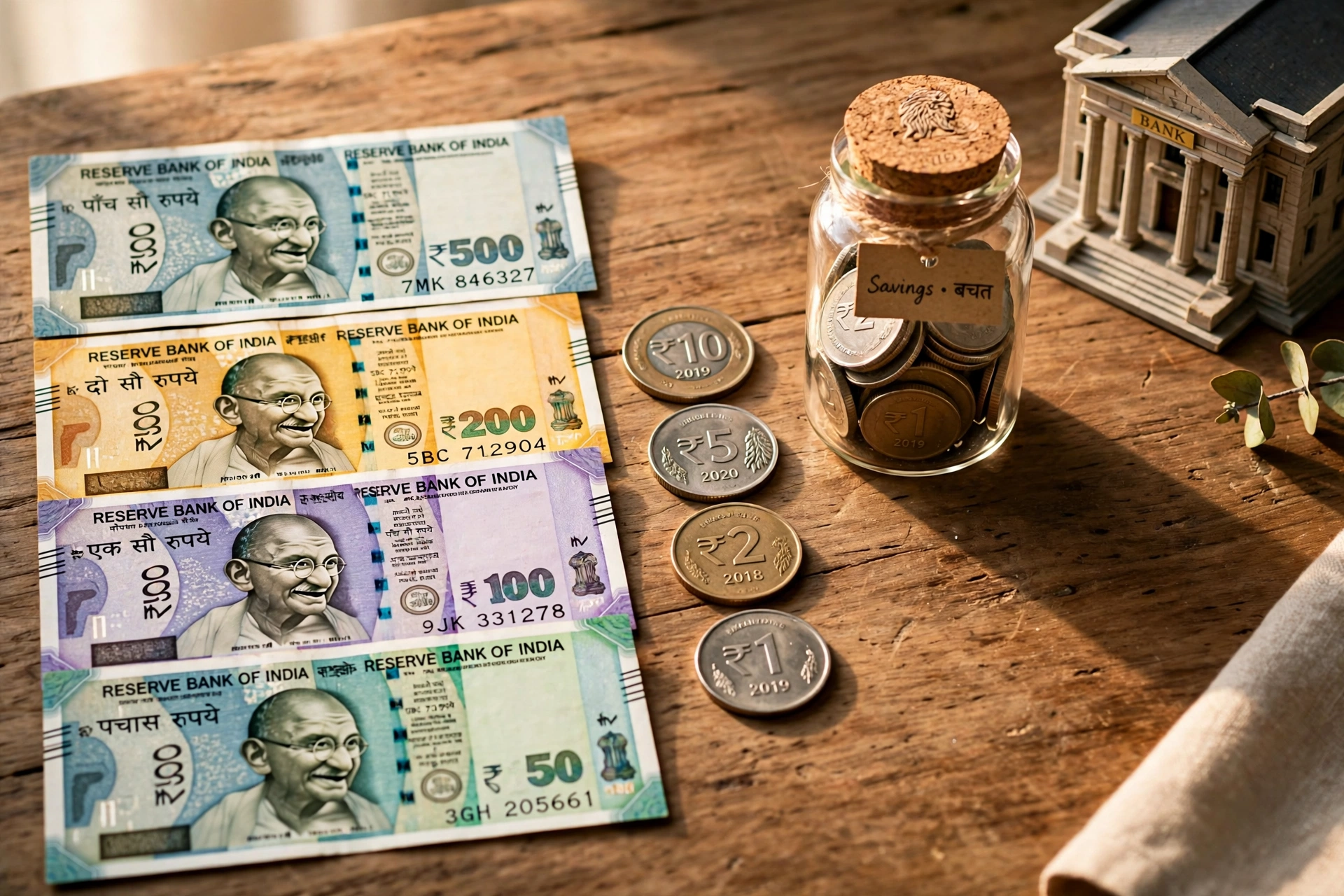
Open any bank app in India and you will see the same two options staring back at you: a savings account where your salary lands, and a fixed deposit that promises a better interest rate. Most people use both without ever really deciding why. Salary goes into savings, some amount gets locked into an FD when a relative suggests it, and the rest sits wherever it landed.
That casual approach costs real money. The gap between what a savings account pays and what a fixed deposit pays is not small, and neither is the gap in flexibility. The right answer is not one or the other — it is knowing which kind of money belongs where.
The savings account: your money’s front door
A savings account is where your financial life happens. Your salary is credited here, your UPI payments go out from here, your SIPs and EMIs are debited from here. It is the account you touch every day.
What it pays you is modest. Most large banks pay 2.7% to 3% a year on savings balances. Some small finance banks and newer banks pay 5% to 7%, sometimes more on higher balances, but those rates usually come with conditions and balance slabs. The interest is calculated on your daily balance and credited quarterly, so a balance that sits at ₹50,000 through a quarter earns you roughly ₹375 at 3%.
The savings account’s real value is not its interest rate — it is instant access. You can withdraw any amount at any time, pay anyone through UPI, and set up automatic payments. No notice, no penalty, no waiting. That is exactly what you need for money you might need this week: rent, groceries, EMIs, an unexpected car repair.
There is one tax point worth knowing. Interest earned on savings accounts is taxable as income, but you get a deduction of up to ₹10,000 a year under Section 80TTA (₹50,000 for senior citizens under Section 80TTB, which covers FD interest too). For most people with modest balances, that deduction means the savings interest effectively escapes tax.

The fixed deposit: the same money, working harder
A fixed deposit is simple: you give the bank a lump sum for a fixed period — anywhere from 7 days to 10 years — and the bank pays you a higher interest rate in return for the commitment. Rates on FDs from large banks currently run roughly 6.5% to 7.5% for one to five year tenures, with senior citizens getting an extra 0.5% on top. Small finance banks often offer 8% or more.
The maths is what makes people look twice. Put ₹1 lakh in a savings account at 3% and you earn ₹3,000 in a year. Put the same ₹1 lakh in a one-year FD at 7% and you earn ₹7,000. That is a ₹4,000 difference on money that would otherwise just be sitting there — and it scales. On ₹5 lakh, the difference is ₹20,000 a year. That is not a rounding error; it is a month of groceries for many families.
There is a trade-off, and it is real. Break an FD before maturity and the bank charges a penalty, usually by paying you a lower rate — typically 0.5% to 1% less than the rate for the period the money actually stayed deposited. You still get your money back, and usually within a day, but the penalty eats into the extra return. FDs are also less convenient for money that moves in and out: every deposit is a separate FD with its own maturity date.
And then there is tax. FD interest is fully taxable at your income tax slab rate, and if the interest from a bank crosses ₹40,000 in a year (₹50,000 for senior citizens), the bank deducts TDS at 10%. TDS is not the final tax — it is an advance — but it means part of your interest is held back before you see it. If your total income is below the taxable limit, you can submit Form 15G (or 15H for senior citizens) to stop the TDS.
Side by side: the differences that matter
The honest comparison comes down to four things.
Returns. An FD pays roughly double what a regular savings account pays. On any sum you will not need for a few months, that difference is worth having.
Access. A savings account gives you your money instantly, any time, with no cost. An FD gives it back quickly too, but with a penalty for early withdrawal. For an emergency fund, that penalty matters — you do not want to lose money at the exact moment you need it most.
Safety. Both are equally safe in practical terms. Deposits in both are insured by the DICGC up to ₹5 lakh per depositor per bank, covering your principal and interest. That insurance applies per bank, which is why spreading large sums across banks is a sensible habit for anyone holding more than ₹5 lakh in deposits.
Tax. Savings interest gets the ₹10,000 deduction under 80TTA. FD interest has no such deduction, and it is taxed at your slab rate, with TDS above the threshold. For someone in the 30% tax bracket, a 7% FD effectively returns about 4.9% after tax. That is still better than 3% from savings, but the gap narrows, and for high earners it is worth comparing FDs with other options like debt funds or, for the long term, PPF.
So where should each rupee go?
The practical rule most financial planners suggest is to split your money by when you will need it.
Money you need in the next few weeks — savings account. This is your monthly spending money, your EMI buffer, and the first layer of your emergency fund. Keep one to two months of expenses here. Chasing an extra 3% on money you will spend next Tuesday is not worth the hassle.
Money you need in three months to a year — short-term FDs or a sweep facility. If you have ₹2 lakh set aside for a house deposit due in eight months, or school fees due next term, a short-term FD earns you meaningfully more than a savings account while keeping the money safe. Many banks also offer a sweep-in facility, where money above a threshold in your savings account automatically moves into an FD and earns FD rates, while still being available instantly if your balance drops. If your bank offers it, turning it on is one of the easiest wins in personal finance.
Money you will not need for one to five years — FDs. This is where FDs do their best work. A goal with a fixed date — a wedding in two years, a car in three — maps neatly onto an FD of the same tenure. You know exactly what you will get and when, which is the whole point.
Money you will not need for more than five years — look beyond FDs. For long horizons, an FD’s fixed return starts to lose to inflation and to other options. Equity mutual funds through SIPs, and tax-saving instruments like PPF, have historically done better over long periods, though with more risk. An FD is the wrong tool for a ten-year goal, not because FDs are bad, but because you are paying for certainty you do not need.
The ladder trick: getting FD returns without locking everything away
There is a simple technique that solves the FD’s main weakness — the lock-in. Instead of putting ₹3 lakh into a single three-year FD, split it into three FDs of ₹1 lakh each, maturing in one, two and three years. This is called laddering.
The advantage is that every year, one FD matures and you get a decision point. If you need the money, it is there without a penalty. If you don’t, you reinvest it into a new three-year FD, and the ladder keeps rolling. You always have money maturing within a year, and you always earn the higher rates on the longer tenures. It takes ten minutes to set up and it removes the single biggest reason people avoid FDs — the fear of their money being stuck.
Mistakes people make with both
Keeping everything in savings. This is the most expensive habit on this list. A salary account that routinely holds ₹3-4 lakh is leaving ₹12,000 to ₹16,000 a year on the table. That money is not earning anything extra for being in savings — it is just waiting. Move the surplus.
Locking emergency money in long FDs. The opposite mistake. An emergency fund in a five-year FD is an emergency fund you will pay a penalty to reach. Keep the first layer of your emergency fund in savings, and only the second layer in short FDs you can break cheaply.
Ignoring the tax on FD interest. People compare the headline FD rate with the savings rate and forget that the FD interest is taxed at their slab. In the 20% or 30% bracket, the post-tax advantage shrinks considerably. If you are in a high bracket and the money is for the long term, PPF or debt funds deserve a look before you lock in an FD.
Auto-renewing without checking the rate. Most FDs auto-renew at maturity, and banks renew at the rate prevailing on the renewal date — which can be lower than what you originally got. Check your maturing FDs once a year. It takes five minutes and it is the difference between 7% and 5.5%.
Chasing the highest rate without checking the bank. A small finance bank offering 9% is not the same risk as a large bank offering 7%, even with DICGC insurance, because the insurance process takes time and has a cap. For your core savings, the extra 1-2% is rarely worth moving away from a bank you trust. Keep the high-rate experiments small.
A simple setup that works for most people
If you want a system you can set up once and stop thinking about, here it is. Keep one month of expenses in your savings account for daily spending. Keep another two to three months of expenses as your emergency fund — half in savings, half in a short-term FD or a sweep account. Put money for goals in the next one to three years into FDs matched to the goal’s date, laddered if the amount is large. And put money for goals beyond five years into SIPs or PPF, where the returns have room to beat inflation.
Then review it once a year. Check your FD maturities, check whether your savings balance has crept up beyond what you need for monthly expenses, and sweep the surplus into an FD. That one habit — moving surplus savings into FDs once a year — is worth more than most investment tips.
A savings account and a fixed deposit are not rivals. They are two shelves in the same cupboard, and the skill is knowing which shelf each rupee belongs on. Money you need soon stays in savings, where it is free to move. Money you can leave alone goes into an FD, where it earns its keep. Get that split right, and your idle money stops being idle — quietly earning you thousands of rupees a year, without any extra risk or effort.
Internal links: If you are building your safety net, read our guide on how much emergency fund you really need, and if you want your long-term money to grow faster, start with our guide on starting a SIP with ₹500 a month.