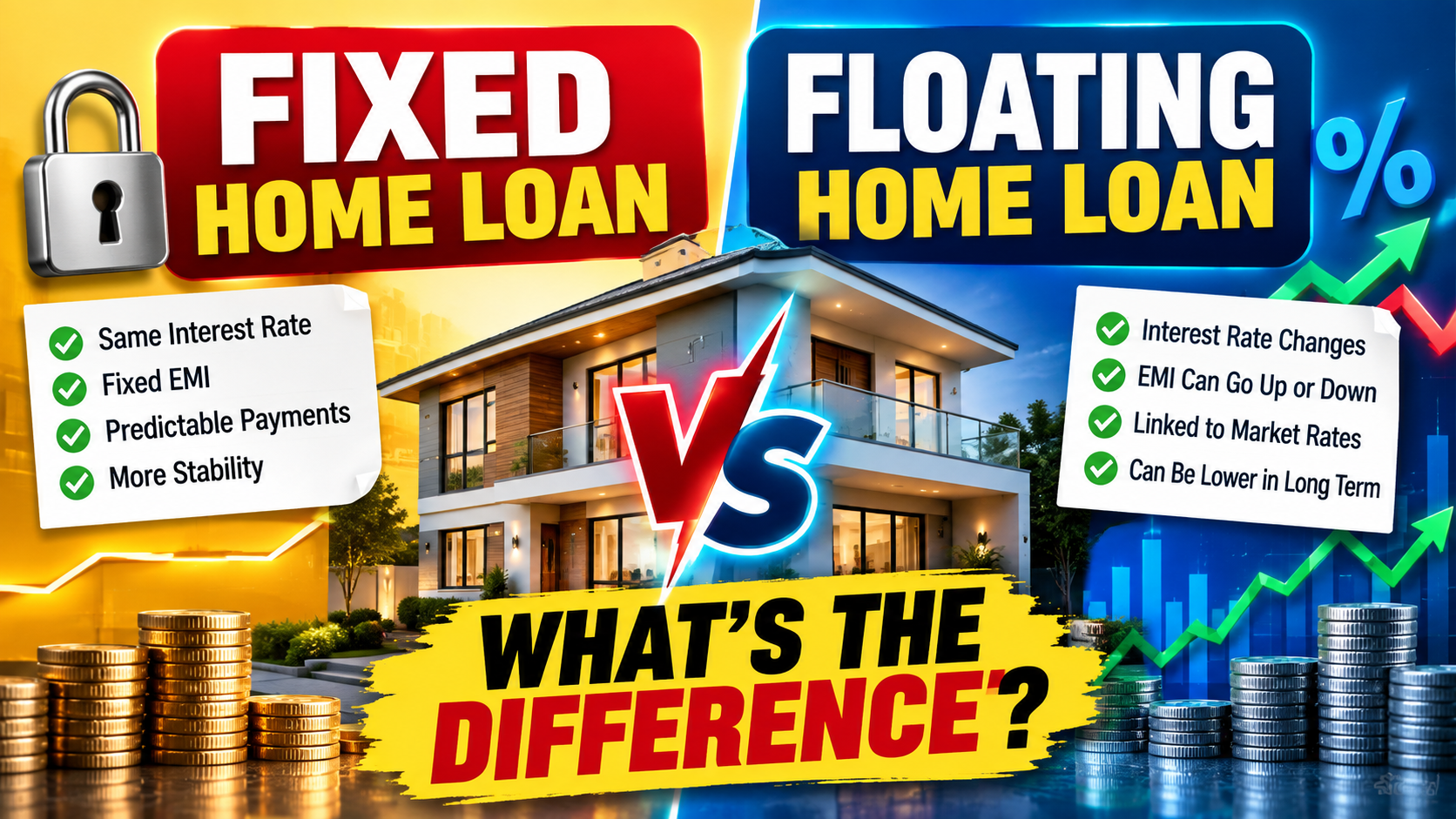
When you take a home loan, choosing the right interest rate can have a significant impact on your monthly EMI and the total amount you repay over the years. Two common types of home loan interest rates are fixed-rate home loans and floating-rate home loans.Fixed vs Floating Home Loan: What’s the Difference?
Understanding the difference between fixed and floating interest rates can help you choose a loan structure that matches your financial situation, income stability, and expectations about future interest rates.
In this guide, we explain fixed vs floating home loans, how both work, their advantages and disadvantages, and what you should consider before making a decision.
What Is a Fixed-Rate Home Loan?
A fixed-rate home loan is a loan where the interest rate remains unchanged for a specified period or, depending on the loan agreement, throughout the loan tenure.
For example, if your home loan has a fixed interest rate of 8.5%, your interest rate will remain at 8.5% during the applicable fixed-rate period, even if market interest rates increase.
This can make your EMI more predictable and easier to plan for.
Example
Suppose you take a ₹30 lakh home loan at a fixed interest rate of 8.5%.
If the applicable rate remains fixed, changes in market interest rates will not immediately affect your agreed interest rate during the fixed period.
This provides greater certainty when planning your monthly budget.
What Is a Floating-Rate Home Loan?
A floating-rate home loan has an interest rate that can change over time based on the lender’s benchmark or other applicable rate-setting mechanisms.
If interest rates increase, your home loan rate may increase as well. If rates decrease, your loan rate may also decrease, depending on the terms of your loan.
For borrowers, this means that the EMI or loan tenure may change over time.
Example
Imagine you have a home loan with a floating interest rate of 8.5%.
If the applicable benchmark changes and your lender revises the loan rate upward, your borrowing cost may increase. If the rate moves downward, your interest cost could potentially decrease.
Fixed vs Floating Home Loan: Key Differences
| Feature | Fixed-Rate Home Loan | Floating-Rate Home Loan |
|---|---|---|
| Interest Rate | Remains fixed for the applicable period | Can change over time |
| EMI Predictability | Higher | Can change |
| Impact of Rate Changes | Limited during fixed period | Directly affects loan cost |
| Budget Planning | Easier | Requires flexibility |
| Benefit From Falling Rates | Usually limited during fixed period | Potentially higher |
| Risk From Rising Rates | Lower during fixed period | Higher |
| Suitable For | Borrowers seeking predictability | Borrowers comfortable with rate fluctuations |
Advantages of Fixed-Rate Home Loans
1. Predictable EMIs
One of the biggest advantages of a fixed-rate loan is predictability. Knowing your applicable interest rate can make it easier to plan your monthly expenses.
2. Protection Against Rising Interest Rates
If market interest rates rise, borrowers with an applicable fixed rate may be protected from those increases during the fixed period.
3. Easier Financial Planning
A predictable EMI can make household budgeting easier, particularly for borrowers who prefer stable monthly expenses.
4. Lower Interest-Rate Uncertainty
With a fixed rate, you don’t have to constantly worry about changes in market rates affecting your loan cost during the fixed period.
Disadvantages of Fixed-Rate Home Loans
1. Limited Benefit From Falling Rates
If market interest rates fall, a borrower on a fixed rate may not immediately benefit from the lower rates during the fixed period.
2. Potentially Higher Initial Rate
Depending on the lender and market conditions, a fixed-rate option may have a higher interest rate than a floating-rate option.
3. Fixed-Period Conditions
Some home loans advertised as “fixed-rate” may only remain fixed for a specific period. After that, the loan may switch to another applicable rate structure.
Therefore, borrowers should carefully read the loan agreement before choosing a fixed-rate option.
Advantages of Floating-Rate Home Loans
1. Potential Benefit When Rates Fall
One major advantage of floating-rate loans is that borrowers may benefit when applicable interest rates decline.
A lower rate can potentially reduce the interest component of the loan or help shorten the repayment period, depending on how the lender adjusts the loan.
2. Greater Flexibility With Market Movements
Floating rates adjust according to the applicable benchmark and lender terms, allowing the loan rate to respond to changes in the interest-rate environment.
3. Potentially Lower Cost Over Time
If interest rates remain low or decline over the repayment period, a floating-rate loan may result in lower borrowing costs compared with a higher fixed rate.
However, future rates cannot be guaranteed.
Disadvantages of Floating-Rate Home Loans
1. EMI or Tenure Can Change
If the applicable interest rate rises, your monthly EMI may increase or the lender may extend the repayment tenure, depending on the loan structure.
2. Less Predictability
Because the interest rate can change, it can be harder to predict exactly how much your home loan will cost over a long period.
3. Higher Exposure to Rate Increases
If interest rates rise significantly, borrowers can end up paying more interest over the life of the loan.
Which Is Better: Fixed or Floating Home Loan?
There is no single option that is better for every borrower.
The right choice depends on factors such as:
- Your monthly income
- Existing financial obligations
- Loan amount
- Loan tenure
- Risk tolerance
- Expectations about interest rates
- Your ability to handle a higher EMI
- The lender’s specific loan terms
A borrower who prioritizes predictable payments may prefer a fixed-rate structure, while someone who is comfortable with changing EMIs and wants exposure to potentially lower rates may consider a floating-rate structure.
Fixed vs Floating: An Example
Consider a hypothetical ₹40 lakh home loan.
Suppose two borrowers receive the following rates:
- Fixed rate: 8.75%
- Floating rate: 8.50%
The floating-rate borrower starts with a lower rate. However, if the applicable floating rate rises in the future, the borrowing cost could increase.
On the other hand, if rates fall, the floating-rate borrower could potentially benefit.
The fixed-rate borrower gets greater predictability during the applicable fixed period but may not benefit from falling market rates during that period.
This illustrates why the headline interest rate alone should not be the only factor when choosing a home loan.
Factors to Check Before Choosing a Home Loan
Before selecting fixed or floating interest rates, compare the complete loan structure rather than focusing only on the advertised rate.
1. Interest Rate
Compare the applicable interest rate offered by different lenders.
2. Loan Tenure
A longer tenure generally means lower monthly payments but can result in a higher total interest outgo.
3. Processing Fees
Check the processing fee and other charges associated with the loan.
4. Prepayment and Foreclosure Terms
Understand the lender’s applicable rules and charges for making additional payments or closing the loan early.
5. Rate Reset Rules
For a floating-rate loan, understand how and when the lender can revise the interest rate.
6. Fixed-Rate Period
If you choose a fixed-rate loan, check exactly how long the rate remains fixed and what happens afterward.
7. EMI Adjustment
Find out whether changes in interest rates affect your EMI, loan tenure, or both.
How Interest Rate Changes Can Affect Your Home Loan
Even a small change in the interest rate can make a difference over a long repayment period.
For example, if a floating interest rate increases, the borrower may experience:
- Higher EMI
- Longer loan tenure
- Higher total interest cost
- Reduced ability to save or invest
If the rate decreases, the opposite may happen, depending on the lender’s adjustment mechanism.
This is why borrowers should understand how their lender handles rate changes before signing the loan agreement.
Should You Choose a Fixed or Floating Rate for a Long-Term Loan?
Home loans can run for 10, 15, 20, or even 30 years. Predicting interest rates over such a long period is difficult.
Instead of trying to perfectly predict future rates, borrowers should consider their ability to handle financial changes.
If a higher EMI would put significant pressure on your monthly budget, predictability may be particularly important.
If you have stable income, sufficient savings, and can comfortably handle changes in EMI or tenure, a floating-rate structure may provide more flexibility.
Tips to Reduce Your Home Loan Interest Burden
Regardless of whether you choose a fixed or floating rate, several strategies can help reduce your overall borrowing cost.
Make Part-Prepayments
Whenever financially possible and permitted under your loan terms, making additional payments toward the principal can reduce the outstanding balance.
Increase EMI When Income Rises
If your income increases, consider increasing your EMI rather than automatically extending your lifestyle expenses.
Compare Lenders
Don’t select a home loan solely based on the interest rate. Compare fees, service terms, reset mechanisms, and other conditions.
Maintain a Strong Credit Profile
A good credit history can help you qualify for competitive loan terms, although the rate offered depends on multiple factors.
Use a Home Loan EMI Calculator
Before applying, calculate the EMI for different interest rates and tenures. This can help you understand how changes in the rate could affect your finances.
Frequently Asked Questions
Is a fixed home loan better than a floating home loan?
Neither is universally better. The suitable option depends on your financial situation, risk tolerance, loan terms, and expectations about future interest rates.
Can a fixed home loan interest rate change?
It depends on the loan agreement. Some products have a fixed rate for a specific period and may change afterward. Always check the applicable terms.
Can floating home loan rates decrease?
Yes. If the applicable benchmark or rate-setting mechanism decreases, the lender may reduce the loan’s interest rate according to the applicable terms.
Does a floating interest rate affect EMI?
It can. Depending on the lender’s policy, a change in the interest rate may affect the EMI, loan tenure, or both.
Which is safer for monthly budgeting?
A fixed rate generally provides greater payment predictability during the applicable fixed period. However, borrowers should check the exact terms of the product.
Final Thoughts
Choosing between a fixed and floating home loan is an important financial decision. A fixed-rate structure can provide greater predictability, while a floating-rate structure can allow borrowers to benefit when applicable interest rates decline but also exposes them to potential increases.
Before choosing a loan, compare the interest rate, EMI, tenure, processing fees, prepayment terms, rate-reset mechanism, and overall cost.
Most importantly, don’t choose a home loan based only on the initial interest rate. Consider whether the loan remains affordable for you if your financial circumstances or applicable interest rates change in the future.