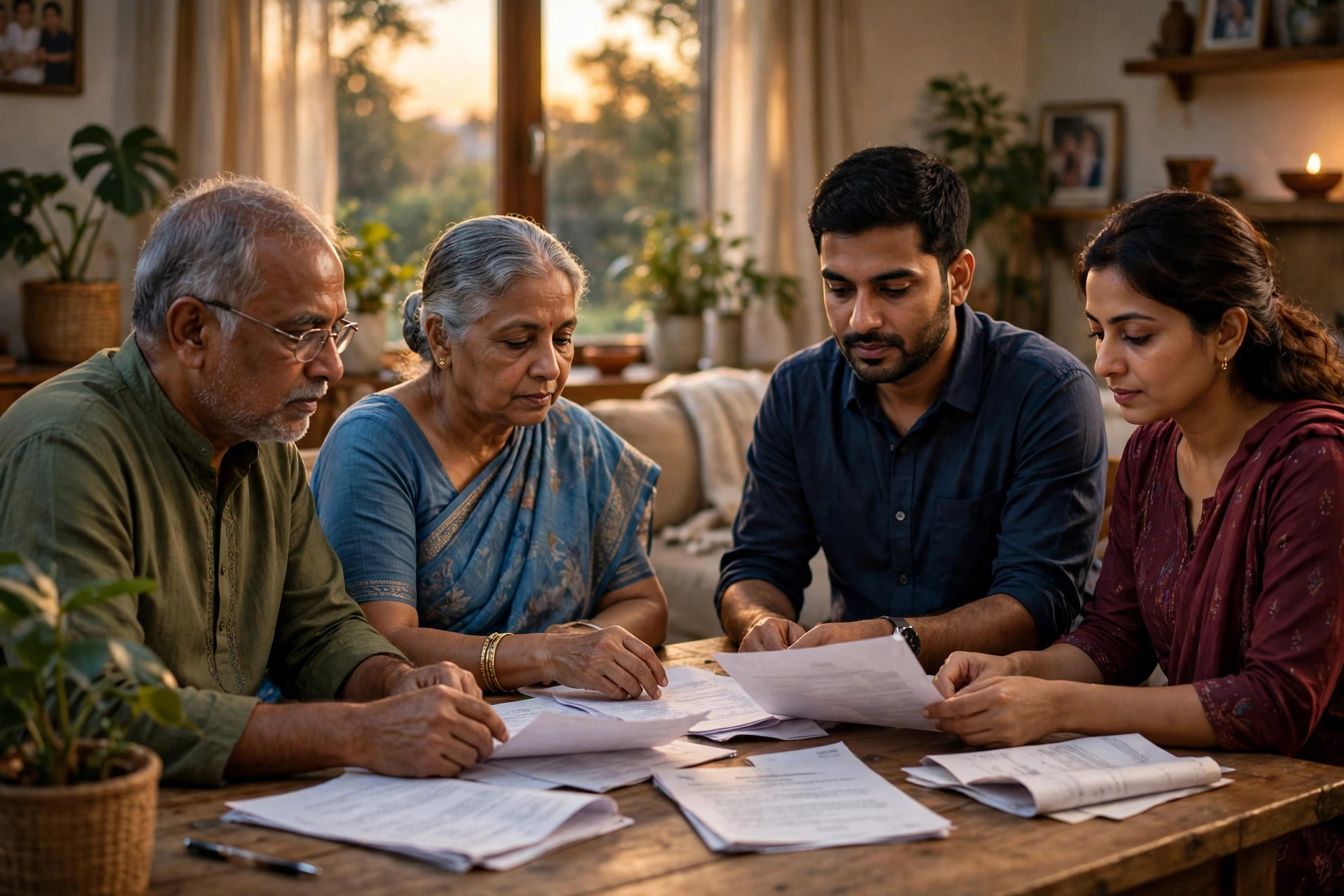
Most Indian families talk about buying a house, saving for a child’s education and planning retirement. Almost nobody talks about what happens to all of it afterwards. A will is the one document that decides who gets your savings, your flat, your mutual funds and even your car — and most of us keep putting it off for “later”.
It is not a document for the old or the very rich. If you have a bank account, a PF balance, an insurance policy or a home, you already have something worth passing on properly. A will makes sure it reaches the people you actually want it to reach, without your family fighting over it or running from one government office to another.
The good news is that making a will in India is simpler than most people think. You do not need a lawyer, you do not need stamp paper, and you do not even need to register it. What you need is a clear list of what you own, a clear decision about who gets what, and two witnesses. This guide walks through the whole process.
What Is a Will, Really?
A will is a legal document in which you write down how your property and assets should be distributed after your death. It only takes effect after you pass away, and you can change or cancel it any number of times while you are alive. The latest will — the one dated most recently — is the one that counts.
It is governed mainly by the Indian Succession Act, 1925. Hindus, Sikhs, Jains and Buddhists also fall under the Hindu Succession Act for matters the will does not cover. Muslims follow their personal law, which limits how much can be given away by will — generally one-third of the estate — with the rest going to legal heirs under Sharia rules. Christians and Parsis have their own succession provisions. The basic idea is the same across faiths: your written wishes, recorded properly, carry weight.
Here is the part that surprises most people: if you die without a will, the law decides for you. Your property gets divided among your legal heirs according to the succession law that applies to you. That may sound fair, but it is not always what you would have chosen. A parent who supported you through a difficult time, a sibling who stood by you, a charity you believed in — none of them may get anything. And if two heirs disagree, the matter can sit in court for years while the family falls apart.
A will also matters because of something most families discover too late: a nominee is not the owner. If you named your brother as the nominee on your bank account, he receives the money on your behalf — but legally, it still belongs to your legal heirs. A will overrides that confusion by naming the actual beneficiary. That is why financial planners keep saying the same thing: nomination plus a will, not nomination instead of a will.
Who Should Make a Will?
The short answer is anyone with assets and dependents. But a few situations make it urgent rather than optional.
If you are married with young children, a will lets you name a guardian for them — the person who will look after them if both parents pass away. Without it, the court decides, and the court does not know your family the way you do.
If you own property jointly with a sibling or parent, or if you have a second marriage, a will is almost essential. Blended families are where the bitterest disputes happen, and a clear will is often the only thing standing between a grieving family and a courtroom.
If you are single and your parents are elderly, you might assume everything goes to them anyway. It usually does under succession law. But a will still helps — it speeds up the process enormously. With a will, your family applies for probate and moves on. Without one, they need a succession certificate, which means more paperwork, more waiting and more expense.
Even a young person earning their first salary has something to protect: a savings account, a PF account, a term insurance policy worth ₹50 lakh or ₹1 crore. If anything happens, that money should reach your parents or your spouse quickly — not sit frozen in paperwork for two years.
What Should You Include in Your Will?
Start by making a list. Sit down with a notebook or a spreadsheet and write out everything you own. Most people own more than they think.
Include your bank accounts and fixed deposits, your EPF and PPF balances, mutual funds and shares, insurance policies, your house or flat, any land, your car or bike, gold and jewellery, and any loans you have given to others. For each item, note where it is held — the bank name, the folio number, the policy number — so your family is not left guessing.
Then decide who gets what. You can leave a specific item to a specific person: the flat to your wife, the FD to your mother, a fixed sum to your daughter. Or you can divide everything by percentage: 50% to your spouse, 25% each to your two children. Percentages are easier to maintain when the value of your assets changes over time.
You should also name an executor. This is the person who makes sure your will is carried out — they inform the bank, file for probate if needed, and distribute the assets. Pick someone organised and trustworthy: a spouse, an adult child, a close friend, or a professional like a lawyer or a chartered accountant. Tell them you have chosen them, and tell them where the will is kept.
If you have minor children, name a guardian for them. And if you have a pet, a business, or a charity you care about, you can mention those too — a will can cover far more than money.

Who Can Be an Executor?
Almost any adult can be your executor, but the choice deserves some thought. The person should be younger than you or at least in good health — an executor who passes away before you does not help anyone. They should be comfortable dealing with banks, lawyers and paperwork, because that is the job.
A common mistake is naming someone as both a beneficiary and the sole witness, or naming your executor as a witness. A witness should ideally not be a beneficiary, because that can raise questions about whether the will was made freely. Keep the roles separate where you can: beneficiaries receive, the executor carries out, and the witnesses simply confirm that you signed it in front of them.
You can also name an alternate executor, in case your first choice is unable or unwilling to act when the time comes. It costs nothing to add, and it removes a single point of failure.
How to Write a Will: Step by Step
You do not need a lawyer to write a valid will in India, though getting one to review it is sensible if your assets are complicated. For most families, a simple will written carefully is enough. Here is the process.
Step 1: List your assets. Go through your bank statements, investment accounts, property papers and insurance policies. Write down each asset with enough detail to identify it: account numbers, folio numbers, addresses. This list becomes the backbone of your will.
Step 2: Decide your beneficiaries and their shares. Be specific. Instead of “my savings go to my family”, write “my savings account with HDFC Bank, account number ending 4521, goes to my wife, Sunita Sharma”. Clarity now saves arguments later.
Step 3: Choose your executor and guardian. Name the executor and, if you have minor children, their guardian. Speak to both people first. A surprised executor is a reluctant one.
Step 4: Write the will. Start with a declaration: your full name, address, age, and a statement that you are of sound mind and making this will of your own free will. Then list your assets and who gets each one. Then name the executor. Then add a line saying this will cancels all earlier wills. Sign every page.
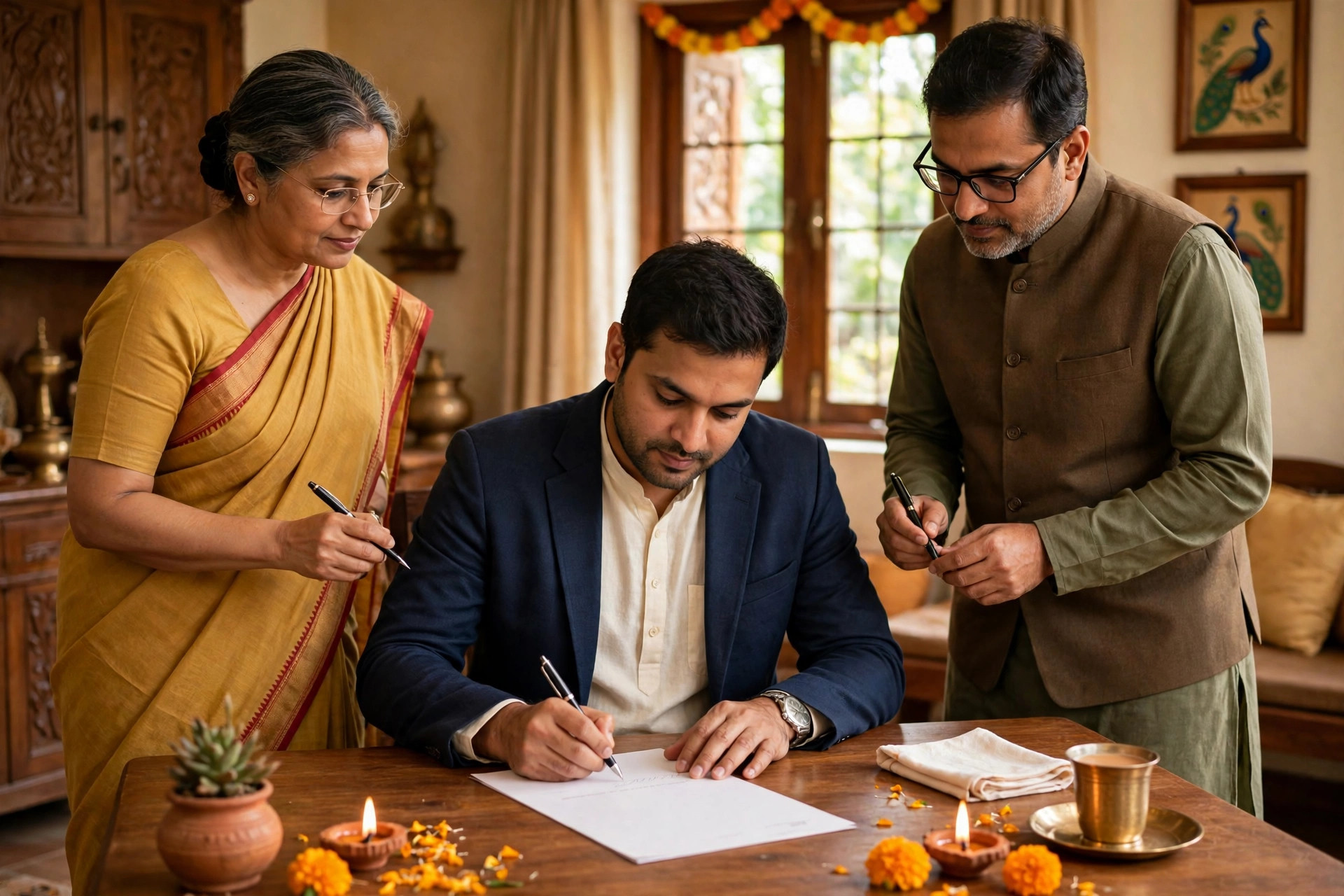
Step 5: Sign in front of two witnesses. Both witnesses must be present together when you sign, and they must sign in your presence and in each other’s presence. They should be adults of sound mind. A doctor’s certificate confirming you are mentally fit is not legally required, but it is a smart addition if you are elderly or unwell — it makes the will much harder to challenge.
Step 6: Store it safely and tell someone. A will locked in a drawer nobody knows about is useless. Keep the original in a safe place — a bank locker, a lawyer’s office, or a fireproof folder at home — and tell your executor and at least one family member where it is. Keep a photocopy somewhere accessible.
Do You Need to Register Your Will?
No, registration is not compulsory in India. An unregistered will, properly signed and witnessed, is perfectly valid. But registering it has real advantages, and it is cheap: the fee at the sub-registrar’s office is usually a few hundred rupees.
A registered will is kept as a record with the government, which makes it much harder for anyone to claim it was forged or to produce a fake later will. The sub-registrar also verifies your identity and, in many offices, notes that you appeared to be of sound mind. For families where disputes are likely — a large estate, a second marriage, a difficult relative — registration is worth the effort.
To register, take the will to the sub-registrar’s office in your area with two witnesses, your ID proof, and the registration fee. The process usually takes a couple of hours. If you move house later, remember that your will is still valid; you do not need to re-register it. You only need a new will if your wishes change.
How Much Does It Cost?
A will written by yourself costs nothing except your time. A lawyer will typically charge somewhere between ₹5,000 and ₹15,000 to draft a straightforward will, and more for complex estates involving businesses, trusts or property in multiple states. Online will-writing services charge around ₹3,000 to ₹8,000, and some banks and financial platforms now offer will-writing as part of their services.
Whatever the route, compare that cost with the alternative. A family fighting over an estate without a will can easily spend ₹1 lakh or more on legal fees, and wait years for a resolution. Against that, a few thousand rupees and an afternoon of work is a bargain.
Common Mistakes to Avoid
The most common mistake is not making a will at all — but there are several others worth knowing about.
Do not leave your will vague. “Divide my property equally among my children” sounds simple, but it does not say which child gets the flat and which gets the FDs. Be specific about each asset.
Do not forget to update your will. A will written before your second child was born, before you bought a second flat, or before you got divorced is a will that no longer matches your life. Review it every three to five years, and after any major event: marriage, divorce, a birth, a death, a big purchase, or a big change in wealth. Every time you make a new will, say clearly that it cancels all previous ones.
Do not store the only copy in a bank locker that nobody else can open. If your family cannot access the locker without the will — and the will is inside the locker — they are stuck. Keep the original somewhere your executor can actually reach.
Do not name a witness who is also a beneficiary. It is not illegal, but it can complicate probate and give a disgruntled relative grounds to challenge the will.
And do not rely only on nominations. As mentioned earlier, a nominee is a trustee, not an owner. Your bank nomination, your EPF nomination and your insurance nomination all need a will behind them to make your intentions legally clear.
What Happens After You Pass Away?
When the time comes, your executor presents the will to the family and begins the process. For most assets, the executor or the beneficiaries submit the death certificate and a copy of the will to the bank, the mutual fund house or the insurance company, which then transfers the assets.
If the estate includes immovable property — a flat or land — the will usually needs to be probated. Probate is a court process that confirms the will is genuine and gives the executor legal authority to act. In Mumbai, Chennai and Kolkata, probate is compulsory for wills; in other cities it is often needed anyway because banks and property offices ask for it. Probate typically takes a few months and costs a small court fee based on the estate’s value. It is far simpler and faster than the succession-certificate route your family would face without a will.
One practical point: make sure your family knows your will exists and where it is kept. Tell your spouse, your adult children, or your executor — someone you trust completely. The best-drafted will in the world is worthless if nobody finds it.
A Will Is an Act of Care, Not a Morbid Task
Nobody enjoys thinking about their own death, which is exactly why most of us avoid this. But a will is not really about death. It is about the people you leave behind. It is the difference between your family grieving in peace and your family grieving while fighting over a flat, standing in queues at government offices, and paying lawyers to settle what you could have settled in an afternoon.
You do not need to be wealthy. You do not need a lawyer. You need a list of what you own, a clear decision about who gets it, two witnesses, and a safe place to keep the document. Set aside a Sunday afternoon, get it done, and then get on with your life. Your family will be quietly grateful — even if they never say it.