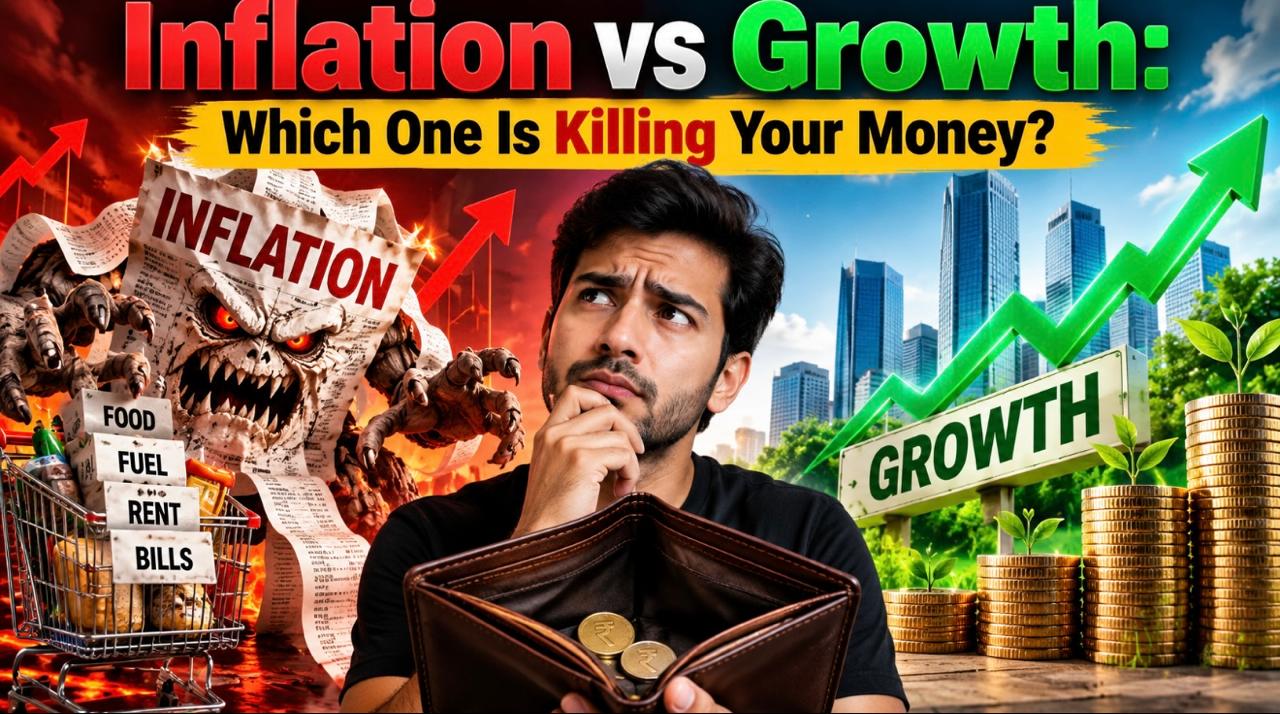
Have you ever noticed that you are earning more money than before, but you still feel like you have less money?
Your salary goes up. Your savings increase. You may even get a bonus.
But at the same time, groceries are more expensive. Rent is higher. Fuel costs more. Eating out costs more.
So, where is all your money going?
The answer is connected to two big things in the economy: inflation and economic growth.
You hear these words all the time in the news, but what do they actually mean for your money?
And more importantly, which one is hurting your finances more?
Let’s understand it in the simplest way possible.
⸻
What Is Inflation?
Inflation simply means prices are going up over time.
Think about something you regularly buy.
Maybe a product cost $10 a few years ago.
Today, the same product might cost $12.
You didn’t suddenly become a bigger spender.
The product simply became more expensive.
That’s inflation.
The biggest problem with inflation is that it reduces the buying power of your money.
For example, imagine you have $100.
Today, that $100 can buy 10 things.
If prices increase a lot over the next few years, that same $100 might only buy 8 or 9 things.
You still have $100.
But your $100 doesn’t have the same power anymore.
That’s why inflation can quietly hurt your wealth.
⸻
💸 Why Does Inflation Feel So Painful?
Because inflation affects almost everything.
Food can become more expensive.
Rent can increase.
Electricity bills can rise.
Transportation can cost more.
Healthcare can become more expensive.
Even small price increases can become a big problem when they happen everywhere.
Imagine your monthly expenses are $2,000.
If your expenses increase by 5%, you’re suddenly spending another $100 every month.
That’s $1,200 more in one year.
And that’s just one example.
This is why inflation can slowly put pressure on your budget.
⸻
💰 Your Salary Can Go Up… But You Can Still Get Poorer
This is one of the most important things to understand.
Let’s say your salary increases by 6%.
Sounds great, right?
But what if prices increase by 7%?
Your salary increased.
But your cost of living increased even more.
So you may actually have less purchasing power.
This is why looking only at your salary can be misleading.
You shouldn’t just ask:
“How much money am I making?”
You should also ask:
“What can my money actually buy?”
That’s the difference between making more money and becoming financially better off.
⸻
📈 So, What Is Economic Growth?
Economic growth is basically when the economy becomes bigger.
Businesses produce more.
People buy more.
Companies invest more.
More jobs can be created.
People may earn more money.
One common way economists measure economic growth is through GDP.
GDP measures the value of goods and services produced by an economy.
When GDP grows, it is generally considered a positive sign.
But there’s something important to remember.
A growing economy doesn’t automatically mean that everyone is getting richer.
⸻
🤔 How Can the Economy Grow While People Struggle?
Imagine a country where businesses are doing very well.
Companies are making more products.
Profits are increasing.
The economy is growing.
Sounds great.
But now imagine that your rent is increasing quickly.
Your grocery bill is higher.
Your electricity bill is higher.
And your salary hasn’t increased much.
Would you feel richer?
Probably not.
This is why economic growth and personal financial well-being are not exactly the same thing.
The economy can be growing while some people are still struggling with their monthly expenses.
⸻
Inflation vs Growth: The Real Battle
Now let’s put the two together.
Inflation affects the value of your money.
Economic growth affects the opportunities to earn money.
Think about it this way.
Inflation says:
“The things you buy are getting more expensive.”
Weak economic growth says:
“It may become harder to increase your income.”
That’s where the real problem begins.
If prices keep rising but your income doesn’t keep up, your financial situation can get worse.
⸻
📊 Here’s a Simple Example
Imagine you earn $50,000 a year.
After a year, your salary increases to $53,000.
That’s a $3,000 increase.
You might think:
“Great! I’m doing better.”
But now imagine that the cost of everything you buy has increased by even more.
Your rent is higher.
Food is more expensive.
Transportation costs more.
Your insurance costs more.
So although you are earning more money, you may not have much more money left at the end of the month.
This is why income growth alone isn’t enough.
What really matters is how your income compares with your expenses.
⸻
🏦 Inflation Can Also Hurt Your Savings
Here’s another problem.
Many people believe that keeping money in a bank account means their money is completely safe.
Your money may be safe from losing its actual dollar amount.
But there’s another risk.
Inflation.
Suppose you have $10,000 saved.
Your bank account still shows $10,000 next year.
But if prices have gone up significantly, that $10,000 may not buy as much as it did before.
So your balance didn’t fall.
But your purchasing power did.
That’s an important difference.
A bigger bank balance doesn’t always mean you’re getting richer.
⸻
📉 What Happens When Growth Is Weak?
Inflation isn’t the only problem.
Weak economic growth can also hurt people.
When businesses aren’t growing, they may become more careful with their money.
They may hire fewer workers.
They may delay opening new locations.
They may reduce investment.
In some cases, companies may even cut jobs.
And when fewer jobs are available, finding a better-paying job can become harder.
So weak growth can affect your income.
That’s why both inflation and growth matter.
⸻
🚨 The Worst Situation: High Inflation + Weak Growth
Now imagine something even worse.
Prices are rising quickly.
But the economy isn’t growing much.
Businesses are struggling.
Job opportunities are limited.
People are spending less because everything is expensive.
This situation is often called stagflation.
It’s a difficult situation because policymakers have to deal with two problems at the same time.
They need to control inflation.
But they also don’t want to damage economic growth.
There is no easy solution.
⸻
💳 Why Interest Rates Matter
You’ve probably heard about interest rates in the news.
But why do they matter?
When inflation becomes too high, central banks may raise interest rates.
Higher interest rates make borrowing more expensive.
For example, loans and mortgages can become more expensive.
People may decide to borrow less.
Businesses may also delay spending and expansion.
This can reduce demand in the economy.
And lower demand can eventually help slow down inflation.
But there’s a catch.
Higher interest rates can also slow economic growth.
That’s why central banks have to be careful.
They don’t want inflation to stay too high.
But they also don’t want to slow the economy too much.
⸻
📈 What Does This Mean for Investors?
Inflation and growth also matter if you invest your money.
When the economy is growing strongly, companies may sell more products and services.
That can help their profits grow.
And when company profits grow, investors may benefit.
But high inflation can create problems.
Companies may have to pay more for workers, materials, transportation and other costs.
If companies can’t raise their prices enough, their profits can suffer.
Interest rates can also affect investments.
When interest rates rise, some investments may become less attractive.
This is why financial markets often react to inflation and central-bank decisions.
⸻
🪙 Is Inflation Always Bad?
Not necessarily.
Some level of inflation is normal in a growing economy.
The bigger problem is high or persistent inflation, especially when people’s incomes aren’t increasing fast enough.
Think about it simply.
If your income increases by 7% and your expenses increase by 3%, that’s good for you.
But if your income increases by 3% and your expenses increase by 7%, you’re losing ground.
So inflation itself isn’t the only thing that matters.
What matters is how fast your income and wealth are growing compared with prices.
⸻
🌎 Is Economic Growth Always Good?
Economic growth is generally a positive thing.
But again, it doesn’t tell the whole story.
A country can have strong GDP growth while some households continue to struggle.
Why?
Because economic growth doesn’t always benefit everyone equally.
Some people may see their incomes rise quickly.
Others may see very little change.
Some businesses may grow rapidly.
Others may struggle.
So when you hear that the economy is growing, don’t assume that everyone’s financial situation is automatically improving.
⸻
💡 So, Which One Is Actually Killing Your Money?
Now we can answer the big question.
Inflation can reduce the value of the money you already have.
Weak economic growth can make it harder to earn more money.
Both can hurt you, but in different ways.
If inflation is high and your salary isn’t increasing, your lifestyle becomes more expensive.
If economic growth is weak, finding better jobs and increasing your income may become harder.
And if both problems happen together, things can become even more difficult.
⸻
🛡️ How Can You Protect Your Money?
You can’t control inflation.
You can’t control GDP.
And you can’t decide what central banks will do.
But you can control your own financial decisions.
- Keep an Emergency Fund
Unexpected expenses happen.
A medical bill.
A car repair.
A job loss.
An emergency fund gives you a financial cushion when something goes wrong.
- Be Careful With High-Interest Debt
Credit cards and expensive loans can become a major burden.
The more interest you pay, the less money you have for saving and investing.
- Don’t Keep All Your Long-Term Money in Cash
Cash is useful for emergencies and short-term needs.
But for long-term goals, you may want to consider investments that have the potential to grow over time.
Your choice should depend on your goals and how much risk you can handle.
- Focus on Increasing Your Income
This is often overlooked.
One of the best ways to deal with rising prices is to increase your earning power.
Learn new skills.
Improve your qualifications.
Look for better opportunities.
Ask for a raise when appropriate.
Build an additional source of income if it makes sense for you.
The more your income can grow, the easier it may be to keep up with rising costs.
⸻
🔥 The Number You Should Really Watch
Most people focus on one number:
Their salary.
But that’s not enough.
You should look at three things together:
Income + Expenses + Inflation
If your income is rising faster than your expenses, you’re moving in the right direction.
If your expenses are rising faster than your income, you need to pay attention.
And if your savings aren’t growing enough to maintain their purchasing power over the long term, inflation may be quietly reducing your wealth.
⸻
🎯 The Bottom Line
Inflation and economic growth aren’t just boring economic terms.
They affect your everyday life.
They affect what you pay for food.
They affect your rent.
They affect your loans.
They affect your savings.
They affect your investments.
And they can affect how much money you have left at the end of every month.
Economic growth can create new opportunities and help incomes rise.
But inflation can quietly make those gains worth less.
That’s why you shouldn’t just ask:
“Is the economy growing?”
Ask:
“Is my income growing faster than my cost of living?”
That’s the question that really matters.
Because at the end of the day, becoming financially stronger isn’t just about earning more dollars.
It’s about making sure those dollars continue to have value.
So, inflation or growth — which one is killing your money?
The answer depends on one simple thing:
Is your money growing faster than the cost of living?
If yes, you’re moving forward.
If no, inflation may be quietly eating away at your wealth.