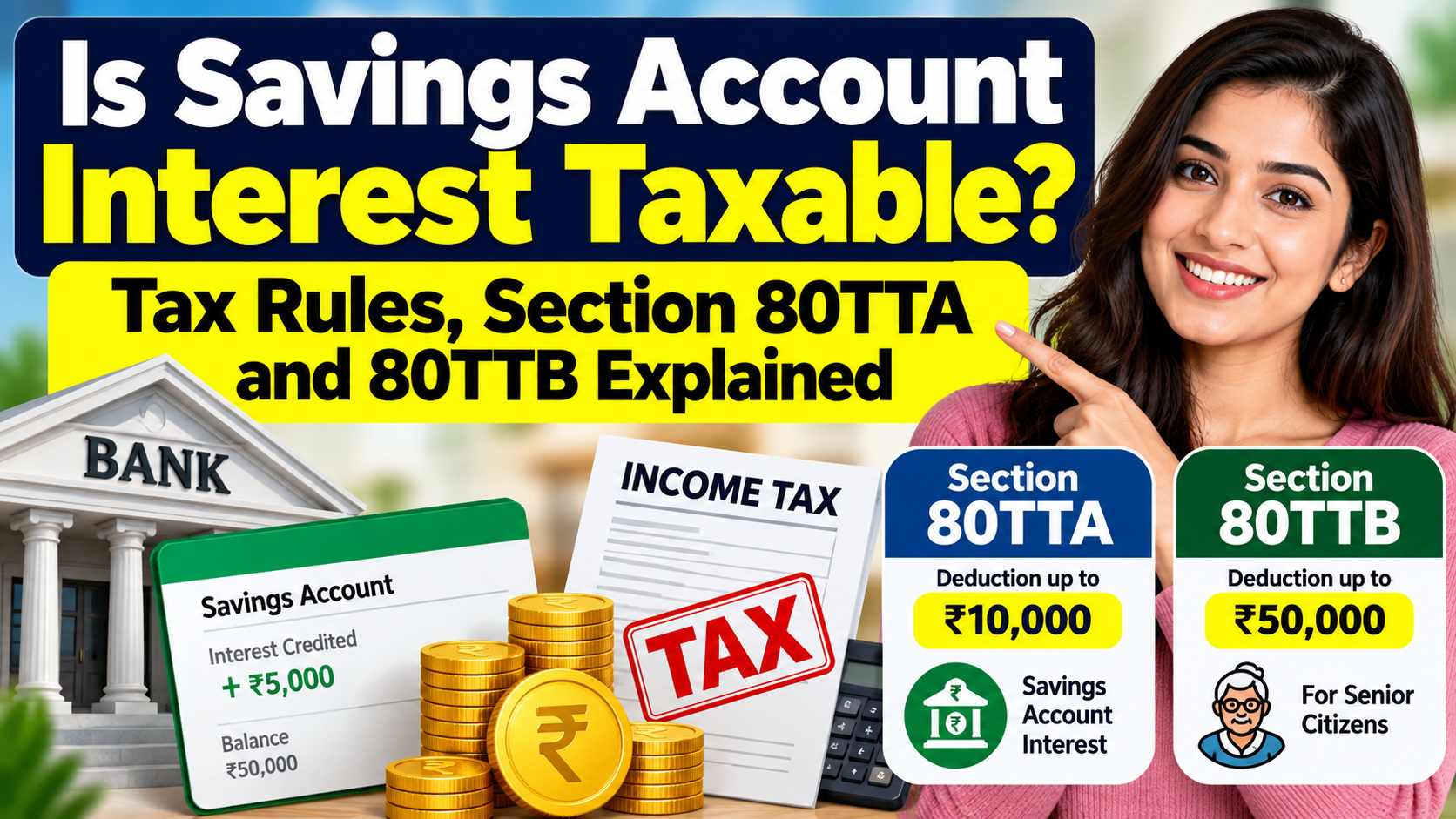
A savings account is one of the most common financial products used by individuals in India. People keep money in savings accounts for everyday expenses, emergency funds, salary credits, UPI payments and other financial needs. Banks also pay interest on the balance maintained in a savings account. But an important question many account holders have is: Is savings account interest taxable?
The short answer is yes, savings account interest is generally taxable in India. However, eligible taxpayers can claim deductions that may reduce the taxable portion of their savings account interest. The most important provisions in this regard are Section 80TTA for eligible non-senior citizens and Section 80TTB for eligible resident senior citizens.
The tax treatment also depends on the tax regime selected. Under the current Income Tax Department guidance, deductions under Sections 80TTA and 80TTB are not available when the new tax regime is selected. They are relevant when the taxpayer opts for the old tax regime and meets the applicable conditions.
This article explains how savings account interest is taxed, how Section 80TTA works, what senior citizens can claim under Section 80TTB, how to calculate taxable interest and what taxpayers should keep in mind while filing their income tax return.
What Is Savings Account Interest?
When you deposit money in a savings bank account, the bank generally pays interest on the eligible balance. The rate of interest varies from one bank and account type to another.
For example, if you maintain ₹2,00,000 in a savings account and the applicable interest rate is 3% per year, the approximate annual interest could be ₹6,000, subject to the bank’s method of calculating interest and the actual balances maintained during the year.
This interest is considered income for tax purposes. The Income Tax Department’s return forms specifically include interest from savings banks under Income from Other Sources.
Therefore, simply leaving money in a savings account does not make the interest automatically tax-free.
Is Savings Account Interest Taxable in India?
Yes. Interest earned from a savings bank account is generally taxable as income.
The important point is that there is a difference between:
- Interest being taxable, and
- Tax actually being payable on that interest.
A taxpayer may earn savings account interest but still have little or no additional tax liability because of available deductions, exemptions, rebates or the taxpayer’s overall taxable income.
For example, assume an individual earns ₹7,000 as savings account interest during a financial year. If the individual is eligible for the Section 80TTA deduction and chooses the old tax regime, the entire ₹7,000 may be covered by the deduction because the maximum Section 80TTA limit is ₹10,000.
This does not mean that savings account interest is inherently tax-free. Rather, the eligible deduction reduces taxable income.
Under Which Head Is Savings Account Interest Taxed?
Savings account interest is generally reported under the head “Income from Other Sources” when filing an income tax return.
This is important because taxpayers should not ignore savings account interest simply because the bank has already credited it to their account.
For example:
- Salary income: ₹8,00,000
- Savings account interest: ₹15,000
- Other income: ₹20,000
The savings account interest forms part of the taxpayer’s income and must be considered while calculating total taxable income.
After calculating the applicable income, eligible deductions can be considered depending on the tax regime and the taxpayer’s circumstances.
What Is Section 80TTA?
Section 80TTA provides a deduction for eligible taxpayers in respect of interest earned on savings accounts.
Under the current Income Tax Department guidance, the maximum deduction available under Section 80TTA is ₹10,000 per financial year. The deduction applies to eligible interest received from savings accounts maintained with banks, co-operative banks and post offices.
The deduction is generally available to:
- Individuals who are not senior citizens
- Hindu Undivided Families (HUFs)
- Eligible taxpayers who satisfy the conditions of the section
The deduction is limited to the actual eligible savings interest or ₹10,000, whichever is lower.
Example of Section 80TTA
Suppose you earn ₹6,000 as savings account interest during the year.
Your calculation would be:
| Particulars | Amount |
|---|---|
| Savings account interest | ₹6,000 |
| Maximum 80TTA deduction | ₹10,000 |
| Eligible deduction | ₹6,000 |
| Taxable amount after deduction | ₹0 |
Now suppose your savings account interest is ₹18,000.
| Particulars | Amount |
|---|---|
| Savings account interest | ₹18,000 |
| Maximum 80TTA deduction | ₹10,000 |
| Eligible deduction | ₹10,000 |
| Remaining amount | ₹8,000 |
In this example, ₹8,000 remains after the Section 80TTA deduction and forms part of taxable income, subject to the taxpayer’s applicable tax rules.
Who Cannot Claim Section 80TTA?
Section 80TTA is not available to senior citizens who qualify for the separate Section 80TTB deduction.
The Income Tax Department’s filing rules also specify that Section 80TTA is restricted to eligible savings account interest and is available under the old tax regime.
Therefore, taxpayers should first determine their age, eligible income and selected tax regime before claiming the deduction.
What Is Section 80TTB?
Senior citizens have a separate deduction under Section 80TTB.
A resident senior citizen can claim a deduction of up to ₹50,000 on eligible interest from deposits with banks, co-operative banks and post offices. The Income Tax Department states that this can include interest from savings deposits as well as fixed deposits.
This is different from Section 80TTA, which is primarily for non-senior-citizen taxpayers and is limited to eligible savings account interest.
Example of Section 80TTB
Suppose a resident senior citizen earns:
- Savings account interest: ₹15,000
- Fixed deposit interest: ₹30,000
- Total eligible interest: ₹45,000
The eligible Section 80TTB deduction could be ₹45,000, assuming all conditions are satisfied.
If the eligible interest is ₹70,000, the maximum deduction would generally be restricted to ₹50,000.
Therefore:
₹70,000 interest − ₹50,000 deduction = ₹20,000 remaining
The remaining amount is considered according to the applicable tax rules.
Section 80TTA vs Section 80TTB
The two deductions are often confused, but there are important differences.
| Feature | Section 80TTA | Section 80TTB |
|---|---|---|
| Main beneficiaries | Eligible non-senior citizens | Resident senior citizens |
| Maximum deduction | ₹10,000 | ₹50,000 |
| Savings account interest | Eligible | Eligible |
| Fixed deposit interest | Not covered under 80TTA | Covered under 80TTB |
| Post-office interest | Eligible savings interest | Eligible deposits |
| New tax regime | Not available | Not available |
| Old tax regime | Available subject to conditions | Available subject to conditions |
The Income Tax Department currently lists the Section 80TTA limit as ₹10,000 and the Section 80TTB limit as ₹50,000.
Is Savings Account Interest Taxable Under the New Tax Regime?
This is an important point for taxpayers.
Under the current Income Tax Department filing rules for AY 2026–27, Section 80TTA and Section 80TTB deductions cannot be claimed under the new tax regime. These deductions are available when the taxpayer uses the old tax regime and satisfies the applicable conditions.
This means a taxpayer should not automatically assume that ₹10,000 of savings interest can be deducted simply because they earned it.
The tax regime selected matters.
For example, if a taxpayer earns ₹12,000 in savings account interest:
- Under the eligible old-regime conditions, Section 80TTA may allow a deduction of up to ₹10,000.
- Under the new tax regime, the Section 80TTA deduction is not available.
The taxpayer should therefore consider their complete income, deductions and applicable tax regime while calculating tax.
Is Savings Account Interest Tax-Free Up to ₹10,000?
This is a common misunderstanding.
It is more accurate to say that eligible taxpayers can claim a deduction of up to ₹10,000 under Section 80TTA, rather than saying that the first ₹10,000 of savings interest is automatically tax-free.
For example, if an eligible taxpayer earns ₹9,000 of savings account interest and can claim Section 80TTA under the old tax regime, the deduction may cover the entire ₹9,000.
However, if the taxpayer earns ₹20,000, only up to ₹10,000 can be claimed under Section 80TTA.
The remaining ₹10,000 is not covered by this particular deduction.
How to Calculate Taxable Savings Account Interest
Calculating taxable savings interest is relatively straightforward.
Step 1: Find Your Total Savings Interest
Check your bank statements, interest certificates or account records to determine how much savings account interest you received during the financial year.
If you have multiple savings accounts, consider the interest from all eligible accounts.
Step 2: Report the Interest
Savings account interest is generally reported under Income from Other Sources.
Step 3: Check Your Tax Regime
Determine whether you are using the old tax regime or new tax regime.
Step 4: Check Your Eligibility for Deduction
If you are eligible for Section 80TTA or 80TTB and are using the old tax regime, calculate the applicable deduction.
Step 5: Add the Remaining Amount to Taxable Income
Any interest not covered by the applicable deduction becomes part of your taxable income.
Example: Savings Interest of ₹25,000
Consider a taxpayer below the senior-citizen age who earns ₹25,000 in savings account interest during the year.
Under eligible old-regime conditions:
- Total savings interest = ₹25,000
- Section 80TTA deduction = ₹10,000
- Remaining interest = ₹15,000
The ₹15,000 remaining amount is considered taxable according to the taxpayer’s applicable tax situation.
Under the new tax regime, Section 80TTA cannot be claimed, so the deduction would not reduce the interest income.
Does the Bank Deduct TDS on Savings Account Interest?
Taxability and TDS are two different concepts.
The fact that a bank does not deduct TDS from a particular interest payment does not automatically mean that the interest is tax-free.
Taxpayers are responsible for reporting taxable income and paying the applicable tax, even when tax has not been deducted at source.
For senior citizens, the Income Tax Department states that under Section 194A, no TDS is deducted on interest payments up to ₹50,000 by a bank, post office or co-operative bank, subject to the applicable conditions.
Therefore, taxpayers should not use the presence or absence of TDS as the only method of deciding whether interest is taxable.
Is Interest from a Fixed Deposit Covered Under Section 80TTA?
No.
Section 80TTA is intended for eligible interest from savings accounts. Interest from fixed deposits is not covered by the Section 80TTA deduction.
However, eligible resident senior citizens may receive a broader benefit under Section 80TTB, which can cover interest from both savings and fixed deposits, subject to the ₹50,000 limit and applicable conditions.
This distinction is particularly important for senior citizens who keep a substantial portion of their savings in fixed deposits.
Does Having Multiple Savings Accounts Change the ₹10,000 Limit?
Having multiple eligible savings accounts does not generally mean that you receive a separate ₹10,000 Section 80TTA deduction for each account.
The deduction is subject to the overall statutory limit of ₹10,000 for the eligible taxpayer.
For example, suppose you have three savings accounts:
- Bank A interest: ₹4,000
- Bank B interest: ₹3,500
- Bank C interest: ₹5,000
Total savings interest = ₹12,500.
The Section 80TTA deduction, if otherwise eligible under the old regime, would be limited to ₹10,000 rather than ₹10,000 per bank account.
Does Savings Account Balance Get Taxed?
No. The balance or principal amount lying in your savings account is not itself treated as taxable income merely because it is in the bank.
What is relevant here is the income generated from the money, such as interest.
For example, if you have ₹5 lakh in your savings account, you are not taxed simply because the account contains ₹5 lakh. The interest earned on that balance may be taxable according to the applicable rules.
Of course, the source of the money and other tax provisions can matter in specific situations. Taxpayers should maintain records for significant transactions and deposits.
How to Report Savings Account Interest in an Income Tax Return
While filing an income tax return, taxpayers should include eligible savings account interest under the appropriate income category.
The Income Tax Department’s return forms identify “Interest from Savings Bank” under the Income from Other Sources section.
Taxpayers should therefore avoid simply leaving the interest out because the amount is small.
If eligible for Section 80TTA, the deduction can then be claimed under the appropriate section when the old tax regime and other conditions permit it.
Common Mistakes Taxpayers Should Avoid
1. Assuming Savings Interest Is Automatically Tax-Free
The ₹10,000 limit under Section 80TTA is a deduction, not a blanket exemption for everyone.
2. Claiming 80TTA Under the New Tax Regime
Current filing rules do not permit Section 80TTA under the new tax regime.
3. Claiming 80TTA on Fixed Deposit Interest
Fixed deposit interest does not qualify for the Section 80TTA deduction.
4. Ignoring Interest from Multiple Accounts
If you maintain several savings accounts, consider the interest earned across all relevant accounts.
5. Assuming No TDS Means No Tax
TDS and income-tax liability are separate concepts.
6. Confusing 80TTA and 80TTB
Senior citizens should check Section 80TTB because its scope and maximum deduction are different.
Frequently Asked Questions
Is savings account interest taxable in India?
Yes. Savings account interest is generally taxable and is reported under Income from Other Sources. Eligible taxpayers may claim deductions under applicable provisions.
How much savings account interest is tax-free?
For an eligible non-senior citizen using the old tax regime, Section 80TTA allows a deduction of up to ₹10,000 on eligible savings account interest. It is not a universal exemption.
Can I claim 80TTA under the new tax regime?
No. Under the current Income Tax Department filing rules, Section 80TTA cannot be claimed when the new tax regime is selected.
What is the 80TTA limit?
The maximum deduction under Section 80TTA is ₹10,000 per financial year for eligible taxpayers.
What is Section 80TTB?
Section 80TTB provides eligible resident senior citizens with a deduction of up to ₹50,000 on qualifying interest from deposits with banks, co-operative banks and post offices.
Is fixed deposit interest eligible for 80TTA?
No. Section 80TTA is for eligible savings account interest. Fixed deposit interest is not covered by 80TTA.
Can senior citizens claim 80TTA?
Senior citizens generally use Section 80TTB instead of Section 80TTA, subject to the applicable conditions.
Is savings account interest included in taxable income?
Yes. It is generally included under Income from Other Sources.
Conclusion
So, is savings account interest taxable? Yes, savings account interest is generally taxable in India. However, the tax impact can be reduced through applicable deductions.
For eligible non-senior citizens following the old tax regime, Section 80TTA provides a deduction of up to ₹10,000 on eligible savings account interest. Resident senior citizens may instead claim Section 80TTB, with a maximum deduction of ₹50,000 on eligible deposit interest, subject to the applicable conditions.
One of the most important points to remember is that these deductions are not available under the new tax regime according to the current Income Tax Department filing rules.
Taxpayers should therefore calculate their total income, savings interest, eligible deductions and selected tax regime before determining their final tax liability.
If you maintain savings accounts with multiple banks, keep track of the interest earned throughout the financial year and report it correctly in your income tax return. When in doubt, reviewing the latest Income Tax Department rules or consulting a qualified tax professional can help ensure that the return is filed accurately.