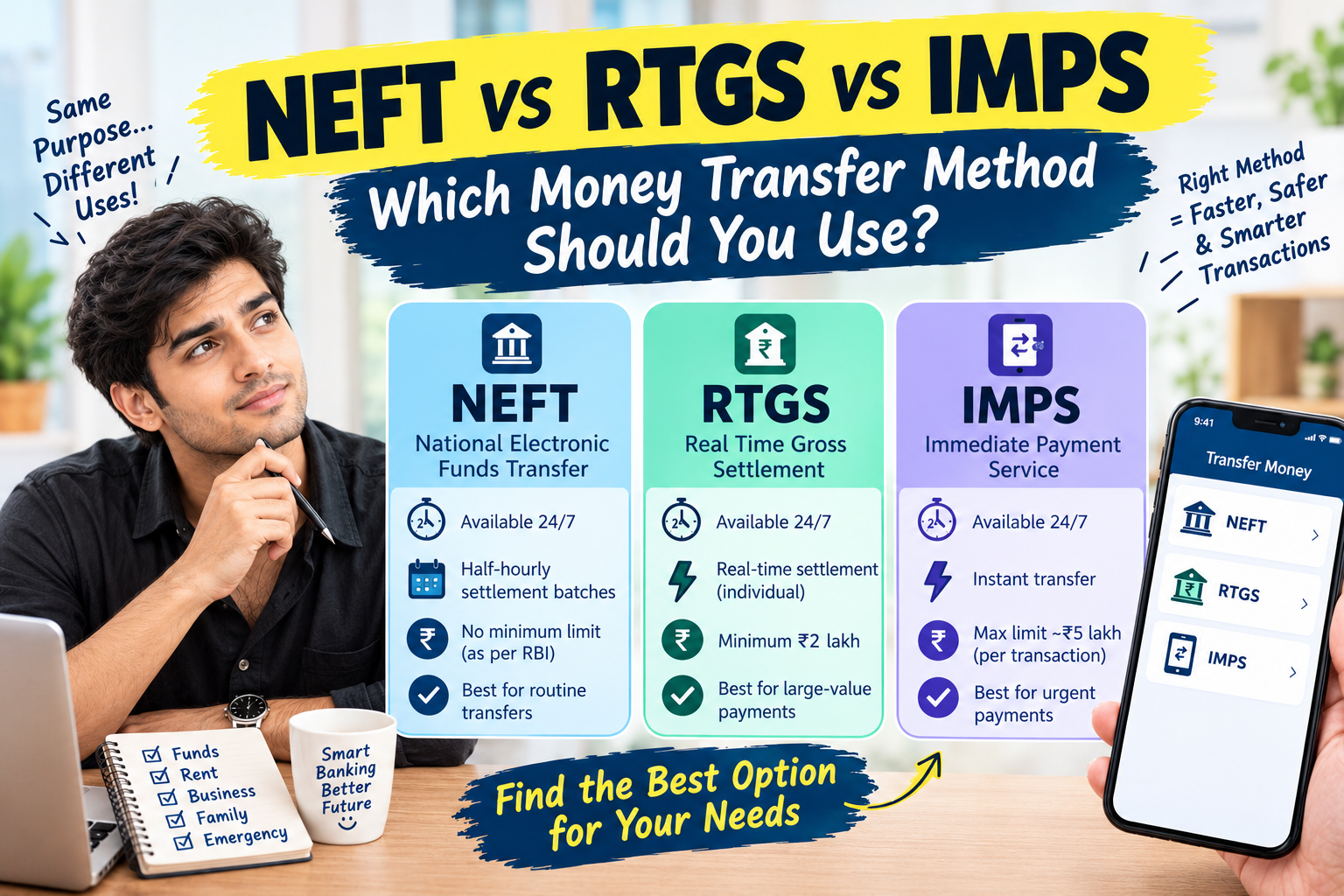
Today, sending money from one bank account to another has become very easy. You don’t need to visit a bank branch every time you want to transfer money. With mobile banking and internet banking, you can send money from your home in just a few minutes.
But when you open your banking app, you may see three options: NEFT, RTGS, and IMPS. If you have ever wondered which one you should choose, don’t worry. Many people have the same question.
All three services help you transfer money, but they work a little differently. Some are better for regular payments, while others are more suitable for large or urgent transactions.
In this article, we will explain NEFT vs RTGS vs IMPS in simple English, with practical examples, so you can choose the right option for your needs.
What Is NEFT?
NEFT stands for National Electronic Funds Transfer. It is a banking service that allows you to transfer money electronically from one bank account to another.
You can use NEFT for many everyday payments. For example, you might want to pay your house rent, send money to your parents, or transfer funds to another account.
One useful thing about NEFT is that it is available 24 hours a day, seven days a week. You can initiate a transfer on Sundays, public holidays, or late at night.
NEFT payments are settled in half-hourly batches. This means transactions are processed in batches rather than being settled individually in real time.
How Does NEFT Work?
Suppose you want to send ₹10,000 to your friend. You open your banking app, enter the beneficiary’s details, select NEFT, and confirm the payment.
Your bank processes the transaction through the NEFT system. The money is then credited to the recipient’s account according to the applicable processing timelines.
You don’t need to visit a bank branch for a regular online transfer. However, you should always check the payment status after completing the transaction.
Main Features of NEFT
- Available 24/7, including weekends and bank holidays.
- No minimum transfer amount prescribed by the RBI.
- No RBI-wide maximum transaction amount, although your bank may set its own limits.
- Payments are settled in half-hourly batches.
- Suitable for regular bank transfers and everyday payments.
When should you use NEFT?
NEFT is a good choice when you want to transfer money for regular expenses and don’t specifically need individual real-time settlement.
What Is RTGS?
RTGS stands for Real Time Gross Settlement. It is mainly used for transferring large amounts of money.
The most important thing to remember is that the minimum amount for an RTGS transaction is ₹2 lakh. If you need to send less than ₹2 lakh, the standard RTGS service is not suitable for that payment.
Unlike NEFT, RTGS processes transactions individually in real time. This makes it useful for high-value payments where individual settlement is important.
RTGS is available 24 hours a day, including weekends and bank holidays.
How Does RTGS Work?
Imagine you need to transfer ₹5 lakh to a business partner. You want the payment to be settled individually rather than through a batch-based system.
In this situation, RTGS may be a suitable option. You enter the beneficiary’s bank details, confirm the amount, and submit the transaction through your bank.
Once the transaction is successfully processed, it is settled individually through the RTGS system.
Main Features of RTGS
- Available 24/7.
- Minimum transaction amount of ₹2 lakh.
- No maximum amount prescribed by the RBI, although your bank may impose limits.
- Transactions are settled individually in real time.
- Suitable for large business payments and other high-value transfers.
When should you use RTGS?
Choose RTGS when you need to transfer ₹2 lakh or more and individual real-time settlement is important. Before making the payment, check your bank’s transaction limit and verify the beneficiary details carefully.
What Is IMPS?
IMPS stands for Immediate Payment Service. It allows you to transfer money electronically between participating banks with immediate payment processing.
IMPS is especially useful when you need to send money quickly. You don’t have to wait for the next working day because the service is available 24/7.
For many people, IMPS is a convenient option for urgent personal payments.
How Does IMPS Work?
Suppose your brother calls you late at night because he needs ₹5,000 urgently. You open your mobile banking app, enter the required details, and select IMPS.
After you confirm the transaction, the payment is processed immediately, subject to successful validation and bank processing.
The standard IMPS limit is generally ₹5 lakh per transaction, although certain transaction categories may have different limits and banks may impose their own restrictions.
Main Features of IMPS
- Available 24 hours a day, seven days a week.
- No general RBI-prescribed minimum transfer amount.
- Generally, the standard maximum is ₹5 lakh per transaction, subject to applicable exceptions and bank limits.
- Designed for immediate payment processing.
- Useful for urgent transfers and everyday payments.
When should you use IMPS?
IMPS is a practical choice when you want to send money quickly and the transaction falls within your bank’s permitted limit.
NEFT vs RTGS vs IMPS: Key Differences
Now that you understand the three services, let’s compare them.
| Feature | NEFT | RTGS | IMPS |
|---|---|---|---|
| Full form | National Electronic Funds Transfer | Real Time Gross Settlement | Immediate Payment Service |
| Availability | 24/7 | 24/7 | 24/7 |
| Minimum amount | No RBI-prescribed minimum | ₹2 lakh | No general RBI-prescribed minimum |
| Payment processing | Half-hourly batches | Individual real-time settlement | Immediate payment processing |
| Maximum amount | Bank limits may apply | Bank limits may apply | Generally ₹5 lakh under standard limits |
| Best for | Regular transfers | Large-value payments | Urgent transfers |
The simplest way to remember the difference is this: NEFT is useful for routine transfers, RTGS is designed for large payments, and IMPS is convenient when you need an immediate transfer.
Which Is Faster: NEFT, RTGS, or IMPS?
Speed is an important factor when choosing a money transfer method.
IMPS is designed for immediate payment processing, which makes it useful when you need to send money quickly.
RTGS settles individual transactions in real time. It is particularly useful for large payments where individual settlement matters.
NEFT works differently because transactions are settled in half-hourly batches. It is still available throughout the day and night, but it does not settle each payment individually in real time.
Keep in mind that the actual time taken can depend on bank processing, verification checks, and technical issues. No payment method guarantees that every transaction will be completed instantly.
Which Money Transfer Method Is Best for You?
The right option depends on how much money you want to send and how quickly the recipient needs it.
1. For Small Amounts
Suppose you want to send ₹2,000 to a friend. You can consider NEFT or IMPS, depending on your needs.
If it is a regular payment and immediate processing is not essential, NEFT may be suitable. If you want immediate payment processing, IMPS may be more convenient.
2. For Large Payments
If you need to transfer ₹3 lakh or ₹5 lakh, RTGS may be a suitable option because it is designed for high-value payments.
However, the best method also depends on your bank’s limits and how quickly you need the transaction to be settled.
3. For Emergency Transfers
Imagine a family member needs money urgently. In this case, IMPS can be a convenient option because it is designed for immediate transfers.
Before sending money, make sure the beneficiary details are correct and the amount is within your bank’s permitted limit.
4. For Regular Expenses
For payments such as rent, household expenses, or routine transfers, NEFT can be a practical choice.
You don’t always need to choose the fastest service. It is better to select a method that matches your requirements.
Are NEFT, RTGS, and IMPS Available on Sundays?
Yes, all three services are generally available 24 hours a day, seven days a week.
You can initiate an eligible transfer on Sundays, public holidays, or outside normal banking hours.
However, service availability does not guarantee that every transaction will be completed successfully. Incorrect account details, security checks, maintenance, or technical problems may sometimes affect the process.
Always check your transaction status if the payment takes longer than expected.
What Are the Charges for NEFT, RTGS, and IMPS?
Bank charges are another thing to consider before transferring money.
Online NEFT transfers initiated by savings bank account customers are free under RBI guidelines. Other eligible NEFT transactions may have charges within the limits permitted by the RBI.
For RTGS, the RBI has prescribed maximum charges for certain outward transactions. The actual charges depend on your bank’s fee structure and applicable rules.
IMPS charges, if any, depend on your bank and account terms.
Before making a payment, check your bank’s official website or mobile banking app for the latest charges. This will help you avoid unexpected fees.
Is It Safe to Use These Money Transfer Methods?
NEFT, RTGS, and IMPS are established electronic banking services. However, you should still take basic precautions whenever you send money online.
Always double-check the recipient’s account number and IFSC code. A small mistake can create unnecessary problems, especially when transferring a large amount.
Never share your OTP, PIN, or banking password with anyone. Use only your bank’s official website or mobile app, and keep your transaction reference number until the payment is confirmed.
If money is deducted from your account but the recipient has not received it, check the transaction status and contact your bank if necessary. Avoid sending the same payment again until you know what happened to the original transaction.
Final Thoughts
NEFT, RTGS, and IMPS all make online money transfers easier, but each serves a slightly different purpose.
NEFT is a practical option for regular payments. RTGS is designed for large transactions of ₹2 lakh or more. IMPS is useful when you need immediate payment processing.
Before choosing a method, think about the amount you are sending, how urgently the recipient needs the money, and whether any charges or limits apply.
Once you understand these basic differences, choosing the right transfer method becomes much easier.
Disclaimer: This article is for educational purposes only. Banking rules, transaction limits, and charges may change. Please check the latest information with your bank or the Reserve Bank of India before making a transfer.