Introduction
Have you ever wondered how some people earn money from their jobs while others receive income from rental properties, investments, or products they created months ago?
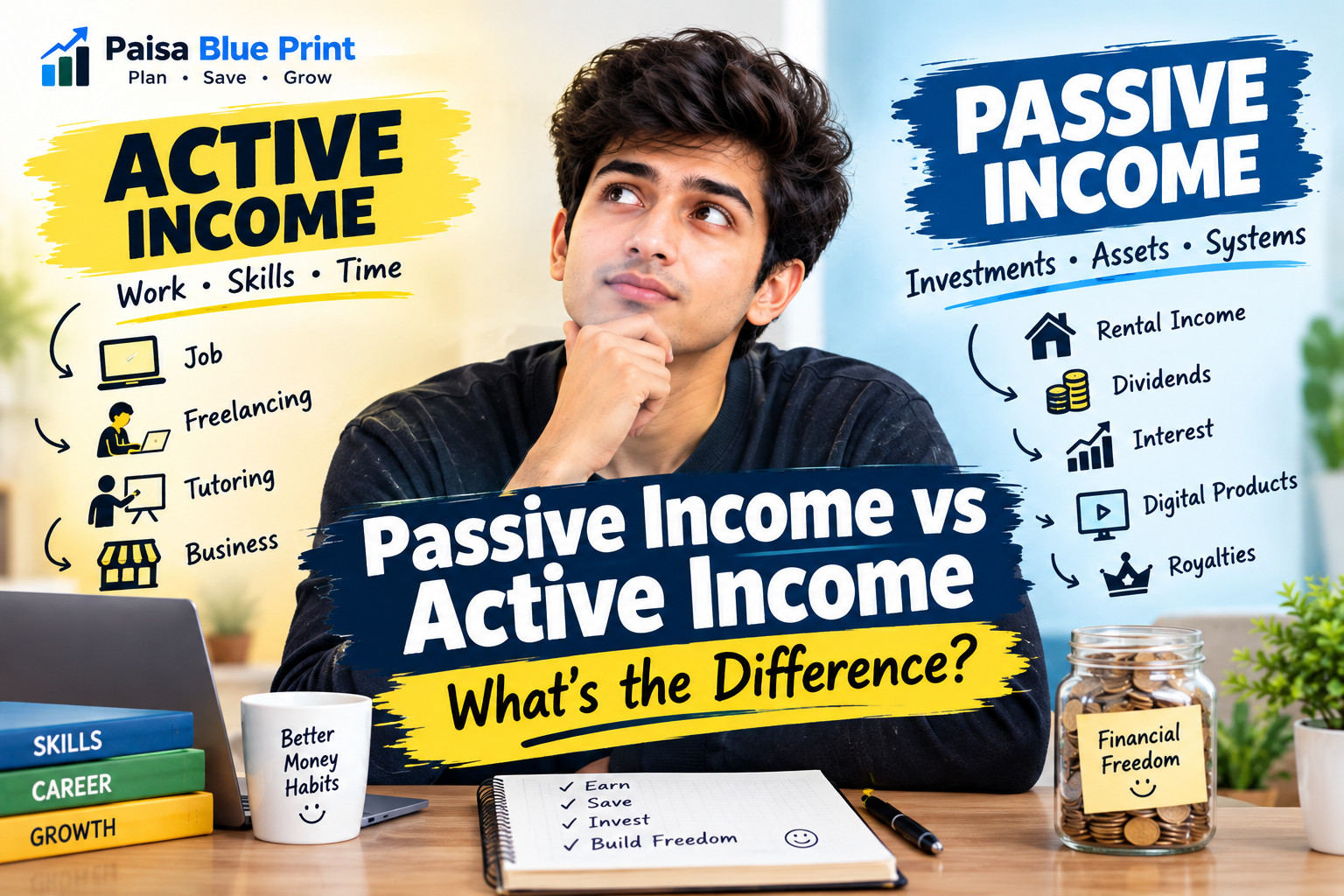
The difference often comes down to two types of income: active income and passive income.
Most of us start earning through active income. We get a job, work for a company, receive a salary, and use that money to pay our bills. Some people earn through freelancing, tutoring, or running small businesses. In each case, they put in time and effort to earn money.
But as life becomes more expensive, relying on just one source of income can feel limiting. Rent, groceries, transport, and other everyday expenses can take up a large part of a monthly salary. This is why many people start looking for additional ways to earn.
You’ve probably heard people talk about passive income and the idea of making money while you sleep. It sounds attractive, especially if you’re a student or someone working a full-time job. However, the reality is a little different from what social media sometimes suggests.
Passive income usually requires something to be built, purchased, or invested in first. It may also need regular attention.
So, what’s the real difference between passive income and active income? Let’s understand both with practical examples from India.
What Is Active Income?
Active income is money you earn by doing work or providing a service.
Think about your daily routine. If you work in an office, teach students, design websites, or write articles for clients, you’re earning active income. You provide your time, skills, and effort in exchange for payment.
For most working people, a monthly salary is their main source of active income.
For example, imagine Priya works as a graphic designer and earns ₹35,000 per month. She receives that salary because she performs her job responsibilities. If she changes jobs or gets promoted, her income may increase. But if she stops working and has no paid leave or other income arrangements, her salary may eventually stop.
Freelancers work in a similar way. A freelance writer might earn ₹2,000 for an article, while a video editor might charge ₹5,000 for a project. Their earnings depend on the work they complete and the rates they charge.
Common examples of active income
- Monthly salary from a full-time or part-time job
- Money earned through freelancing
- Fees from private tuition classes
- Payments for photography or design projects
- Consulting fees for professional services
- Income from working as a delivery partner or providing other services
One advantage of active income is that you can often start earning without making a large financial investment. Your skills, experience, and willingness to work can be enough to get started.
However, there is one limitation: your time is finite. You cannot work every hour of the day, and taking on more work isn’t always possible.
That’s why some people look for ways to supplement their earnings rather than depending entirely on the hours they work.
What Is Passive Income?
Passive income is money generated through investments, assets, or systems that don’t require you to personally perform every task for every payment.
The important thing to understand is that passive income doesn’t mean effortless income.
In many cases, you need to invest money, spend time developing something, or create a system before it starts generating returns. Even after that, you may need to manage expenses, update products, or deal with changing market conditions.
For example, suppose you create an e-book about budgeting for beginners. You spend several weeks researching, writing, and designing it. Once it’s published, people may purchase it without needing you to write a new copy for every customer.
That gives you the potential to earn repeatedly from the same product. However, you’ll still need to attract readers, answer questions, and update the book when necessary.
Common examples of passive income
1. Rental income
If you own a property and rent it to a tenant, you may receive rent every month. However, repairs, maintenance, vacancies, and other expenses can affect your actual earnings.
2. Interest from fixed deposits
A bank fixed deposit can generate interest according to its terms. The return depends on the applicable rate, tenure, taxes, and other conditions.
3. Dividend income
Some companies distribute dividends to their shareholders. These payments are not guaranteed and depend on the company’s decisions and financial performance.
4. Digital products
E-books, online courses, templates, and downloadable guides can generate repeated sales after they are created. Success depends on product quality, customer demand, pricing, and marketing.
5. Royalties
Writers, musicians, photographers, and other creators may receive royalties when their work is sold or licensed under an arrangement that provides ongoing payments.
These income sources work differently, and none guarantees success. Some require substantial capital, while others require more time and specialised skills.
Passive Income vs Active Income: What’s the Difference?
The easiest way to understand the difference is to look at what each type of income requires from you.
| Factor | Active Income | Passive Income |
|---|---|---|
| How you earn | By working or providing services | Through assets, investments, or established systems |
| Time required | Usually ongoing | Often involves upfront work and continued maintenance |
| Starting cost | May be relatively low | Can range from low to substantial |
| Earnings | Often linked to work performed | Depend on investment returns or demand |
| Main challenge | Limited time and workload | Uncertainty, costs, and ongoing management |
| Examples | Salary, freelancing, tutoring | Rental income, dividends, digital products |
Neither type is automatically better than the other.
A stable job may provide a dependable foundation for paying monthly expenses. An additional income source may offer opportunities to save more or work towards long-term goals.
For many people, combining both can be more practical than trying to replace a salary with passive income immediately.
Why Active Income Is Important
It’s easy to become excited about passive income, especially when people online share stories about earning money without working traditional jobs. But active income still plays an important role in building financial stability.
It helps you meet everyday expenses
A regular salary or consistent freelance income can help you pay rent, buy groceries, cover transport costs, and support your family.
Without money coming in regularly, managing these expenses can become difficult.
It helps you build skills
Working gives you opportunities to gain experience, improve your communication, and learn how your industry operates.
A person who develops valuable skills may qualify for better-paying jobs, promotions, or more profitable freelance projects.
You may not need much money to get started
Someone can begin tutoring, writing, editing videos, or offering design services with relatively little initial capital, depending on their circumstances.
This makes active income a useful starting point for students and young professionals who don’t have much money to invest.
The main challenge is finding a balance between earning enough and protecting your time and energy.
Why People Want to Build Passive Income
Once people have a regular source of income, they often start thinking about how to become less dependent on a single salary.
There are several reasons for this.
1. An opportunity to earn additional money
Suppose you earn ₹30,000 a month from your job. You create a useful digital guide and occasionally earn money from its sales.
That additional income could help you save for a course, build your emergency fund, or work towards another financial goal.
Of course, sales may be inconsistent, and your product might not generate much income at all.
2. More than one source of income
Depending entirely on one employer or client can create financial pressure if that income disappears.
An additional income source may reduce some of that dependence. However, it should not be treated as a guarantee against job loss or financial difficulty.
3. Potential long-term benefits
Some assets can continue generating income over time. A digital product may sell repeatedly, while an investment may generate interest or dividends, depending on its terms and performance.
Building these sources often takes patience, money, or considerable initial effort.
4. More flexibility over time
A well-organised income source may require less direct involvement than a job where you exchange hours for payment.
That doesn’t mean you’ll never need to work on it again. It simply means some systems can continue operating without your involvement in every individual transaction.
How Can You Start Building Passive Income in India?
You don’t need to own several properties or have lakhs of rupees in the bank to begin exploring additional income sources.
The right starting point depends on your skills, available savings, responsibilities, and willingness to take risks.
Step 1: Get your monthly finances in order
Before starting a new project, understand where your money goes.
Write down your monthly income, essential expenses, outstanding debt, and savings. This gives you a clearer picture of how much time or money you can realistically commit.
If you’re struggling to cover basic expenses, focus on improving your financial position first rather than chasing uncertain income opportunities.
Step 2: Build an emergency fund
Unexpected expenses can appear at any time. Having some money set aside can reduce the need to borrow when something goes wrong.
A common long-term target is three to six months of essential expenses, although the appropriate amount depends on your circumstances.
Start with a manageable amount and increase it gradually.
Step 3: Choose something that suits your situation
If you have useful knowledge, you might create an e-book, a spreadsheet template, or an online course.
If you have savings available, you could learn about fixed deposits and different investment products. Understand the risks, liquidity, costs, and tax treatment before making a decision.
If you own a suitable property, rental income may be another possibility, provided the costs and responsibilities make sense.
You don’t need to pursue every option. One carefully chosen approach is often easier to manage than several unrelated projects.
Step 4: Start small and learn from experience
Let’s say you’re interested in selling a digital product.
Instead of spending a large amount on advertising immediately, start by creating a useful, well-researched product. Show it to potential readers, gather feedback, and improve it.
Track how much you spend and how much you actually earn. A product that generates ₹10,000 in sales but costs ₹8,000 to produce and promote has a very different financial result from one with much lower costs.
The same principle applies to other income sources: look at the actual numbers rather than relying on promises.
Step 5: Be patient
Building an additional income source usually takes longer than many online success stories suggest.
A digital product may receive few sales initially. An investment portfolio may take years to grow. A rental property may experience periods without tenants.
There is no guaranteed timeline for success.
Give yourself room to learn, adjust your approach, and stop pursuing an idea if the risks or costs no longer make sense.
A Realistic Example: Combining Active and Passive Income
Consider Aman, a 26-year-old professional who earns ₹32,000 per month.
He uses his salary to pay his expenses and support his financial goals. After reviewing his budget, he starts saving a manageable amount each month and works towards building an emergency fund.
Aman also enjoys writing about personal finance. In his spare time, he creates a simple budgeting e-book for beginners.
The first month, he sells only a few copies. Instead of expecting instant results, he improves the content and shares useful information about budgeting with his intended audience.
Over time, the e-book may generate occasional sales. Aman still needs to promote it, maintain the product, and respond to customers, but he doesn’t have to create a completely new book for every purchase.
His salary remains his primary source of income, while the e-book offers an additional earning opportunity.
This is a more realistic way to think about passive income: start with what you already have, build something useful, and see whether it can generate sustainable results.
Common Myths About Passive Income
Before choosing an income source, it’s worth understanding a few common misconceptions.
Myth 1: Passive income means no work.
In reality, many income sources require significant initial effort and occasional maintenance.
Myth 2: You need to be rich to start.
Some investment options require capital, but certain skill-based projects can be started with relatively little money.
Myth 3: Passive income guarantees financial freedom.
There are no guaranteed results. Income can fluctuate, expenses can rise, and investments can lose value.
Myth 4: You should quit your job to build passive income.
For many beginners, keeping their regular income while testing a new idea is a more manageable approach. Major career decisions deserve careful planning.
Be particularly cautious of schemes promising guaranteed profits or effortless daily earnings.
Conclusion
Active income and passive income serve different purposes, and understanding both can help you make better financial decisions.
Active income usually comes from the work you do today. It helps you pay bills, support your family, build skills, and save money.
Passive income may come from assets, investments, or products that can generate earnings over time. However, it often requires upfront work, money, maintenance, and patience.
You don’t need to choose one and reject the other. For many people, a sensible approach is to build a reliable income foundation first and gradually explore additional opportunities.
Start by managing your monthly expenses, reducing unnecessary debt, and building savings. Then choose an income idea that fits your skills and resources.
Don’t worry if your progress is slow. You don’t have to build a successful business or investment portfolio overnight.
The real goal is to make your money work alongside your own efforts, giving you more financial choices and greater flexibility as time goes on.
Disclaimer: This article is for educational purposes only and does not constitute personalised financial or investment advice. Income and investment returns are not guaranteed. Research the risks and costs before making financial decisions.