Introduction
Have you ever wondered how a small amount of money can turn into a much bigger amount over time? You might think that building wealth requires a high salary, a successful business, or a large amount of money to invest. But that is not always true.
Sometimes, the secret lies in understanding how your money grows over time.
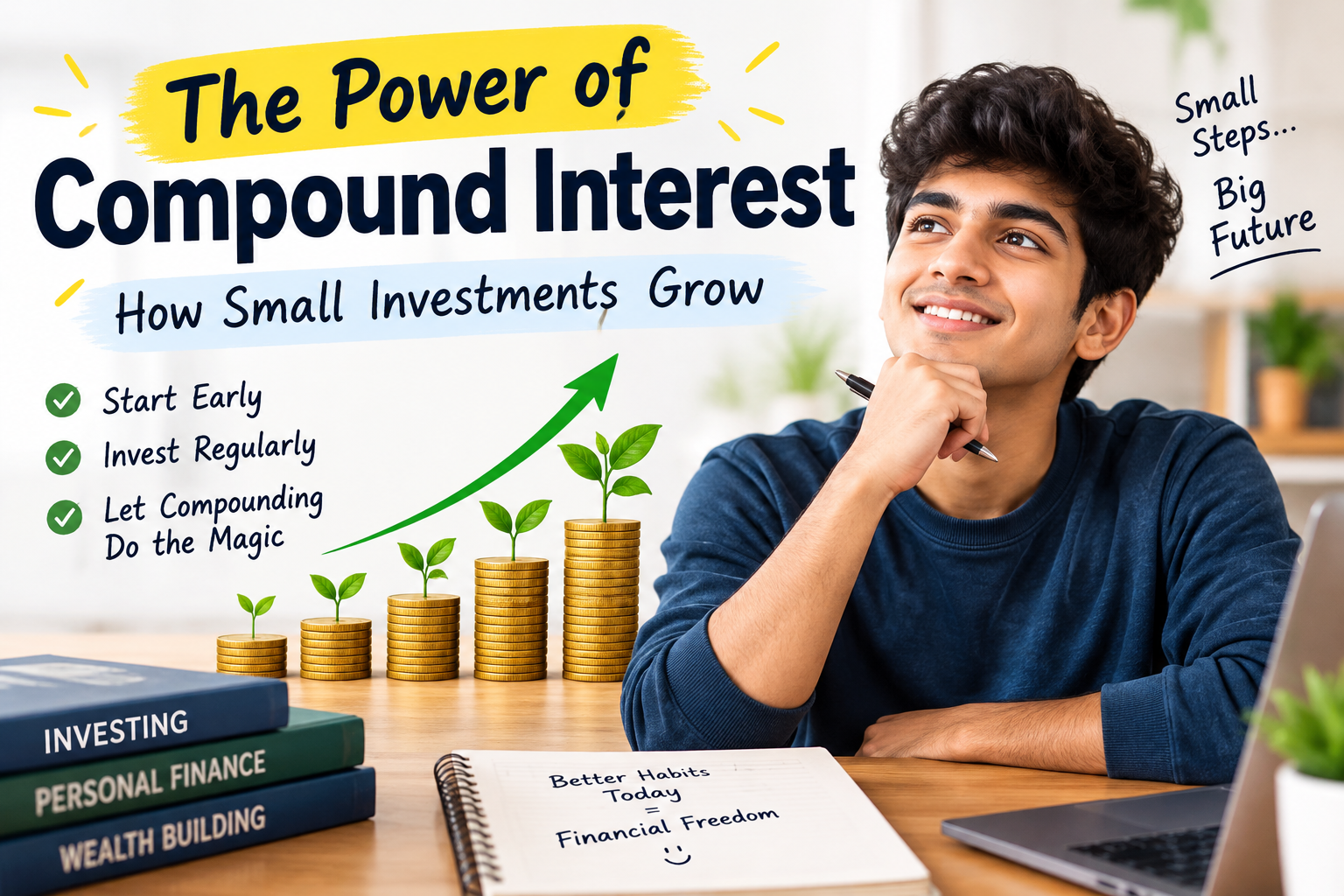
One of the most important concepts in personal finance is compound interest. It is a simple idea, but it can make a big difference when you give your money enough time to grow. Instead of earning returns only on the money you originally invested, you also start earning returns on the gains you have already made.
For example, imagine saving a little money every month instead of spending it all. In the beginning, the progress might seem slow. But as time passes, your savings and investment returns can start working together.
This is why compound interest is worth understanding, especially for students, young professionals, and people who are just beginning their financial journey.
In this article, we will look at how compound interest works, why starting early can help, and how small investments may grow over the years.
What Is Compound Interest?
Compound interest means earning interest on your original money as well as on the interest that has already accumulated.
Let’s understand this with a simple example.
Suppose you invest ₹10,000 in a financial product that earns a hypothetical return of 10% per year.
After the first year, your money becomes ₹11,000. You have earned ₹1,000.
Now, suppose you leave the entire amount invested for another year and earn the same return. This time, the 10% return is calculated on ₹11,000, not just your original ₹10,000. Your balance becomes ₹12,100.
You have earned ₹1,100 during the second year.
That extra ₹100 is the result of earning a return on your previous gain.
This is how compound interest works. Your money can gradually begin to grow on its own, provided the returns are positive and remain invested.
Of course, real investments do not always provide the same return every year. This example simply explains the basic concept.
Compound Interest vs. Simple Interest
Many people confuse compound interest with simple interest, but there is an important difference.
Simple interest is calculated only on the original amount you invest. Compound interest, on the other hand, includes the interest accumulated over time.
Let’s say you invest ₹20,000 at a hypothetical annual interest rate of 8% for five years.
With simple interest, you would earn ₹1,600 each year. After five years, your total interest would be ₹8,000, giving you ₹28,000.
With annual compounding at the same assumed rate, the amount would grow to approximately ₹29,387.
The difference may not seem very large initially. However, over longer periods, the gap can become more noticeable.
This is one reason people who understand long-term investing pay attention to compounding. It allows accumulated returns to contribute to future growth.
Why Starting Early Makes a Difference
One common mistake people make is waiting too long to start saving or investing.
Many young people believe they should wait until they get a better job or earn a higher salary before thinking about investments. However, starting early with an affordable amount can give your money more time to grow.
Consider a simple example.
Imagine two people who want to build savings for their future.
The first person starts investing at age 22, while the second starts at age 32. Both invest ₹2,000 every month and assume a hypothetical annual return of 8%, compounded monthly.
If both invest until age 42, the first person will have contributed money for 20 years, while the second will have contributed for 10 years.
Under these assumptions, the first person’s investment could grow to approximately ₹11.8 lakh. The second person’s investment could reach around ₹3.7 lakh.
The first person has contributed ₹4.8 lakh in total, while the second has contributed ₹2.4 lakh.
These figures are estimates, not guaranteed outcomes. Actual investment returns can change, and taxes and fees can affect the final amount.
The important point is that starting earlier gives your money more time to benefit from compounding.
You do not need to wait until you have a perfect financial situation. Once your essential expenses are covered and you have a sensible savings plan, you can explore investments that match your goals and risk tolerance.
How Small Investments Can Grow Over Time
You might be surprised by what regular investments can achieve over a long period.
Let’s say you invest ₹500 every month for 20 years.
Your total contribution would be ₹1,20,000. If the investment earned a hypothetical annual return of 8%, compounded monthly, the final value could be approximately ₹2.9 lakh.
Now imagine investing ₹1,000 every month under the same assumptions. Your total contribution would be ₹2,40,000, and the estimated final value could reach approximately ₹5.9 lakh.
These examples assume regular month-end contributions and a constant rate of return. They do not account for taxes, fees, or inflation, and real investment returns are not guaranteed.
Still, they demonstrate an important lesson: you do not always need a large amount of money to begin building an investment habit.
For someone who is just starting their career, even a small monthly contribution can be a reasonable first step. As income grows, contributions can gradually increase.
The key is to choose an amount that fits your budget rather than investing money you may need for everyday expenses.
How SIPs Help Investors Benefit From Compounding
In India, many beginners start investing through a Systematic Investment Plan, commonly called an SIP.
An SIP allows you to invest a fixed amount in a mutual fund at regular intervals, usually every month.
For example, you might decide to invest ₹1,000 every month instead of waiting until you have ₹12,000 available at the end of the year.
Over time, your contributions purchase mutual fund units at the applicable prices. The value of those units changes depending on the performance of the fund’s investments.
When your investment grows and the gains remain invested, those gains may contribute to further growth. This is how compounding can work in a mutual fund investment.
However, it is important to understand that an SIP does not guarantee profits. Mutual funds, especially equity funds, can experience market ups and downs. The value of your investment may fall, and you could receive less than the amount you invested.
An SIP is simply a way of investing regularly. It does not remove market risk.
Before investing, consider your financial goals, how long you can stay invested, and how comfortable you are with potential losses.
For beginners, understanding the investment is more important than choosing an amount based on what other people are investing.
Where Can Compound Interest Work for You?
Compound growth can be relevant to different financial products, but each option works differently.
1. Fixed Deposits
Fixed deposits are a familiar savings option for many Indian households. Depending on the deposit terms, interest may be compounded at regular intervals or paid out separately.
If interest is reinvested, it can contribute to further interest earnings.
Before opening a fixed deposit, check the interest rate, maturity period, premature withdrawal rules, and payout options.
2. Public Provident Fund (PPF)
The Public Provident Fund is a government-backed savings scheme designed for long-term saving. It has specific contribution, withdrawal, and maturity rules.
The interest rate is notified by the government and can change over time.
PPF may suit people who want to build long-term savings, but it is important to understand its restrictions before committing money.
3. Mutual Funds
Mutual funds invest in assets such as shares or bonds, depending on the type of fund.
If the value of your investment increases and you keep the gains invested, the accumulated amount may continue to grow. However, returns depend on the underlying investments and are not guaranteed.
Equity mutual funds can be volatile, so they may not be suitable for money needed in the near future.
4. Retirement Savings
Retirement may feel far away when you are young, but it is one of the clearest examples of why time matters in financial planning.
Regular contributions over several decades can build a retirement fund, while investment growth may increase the final amount.
The result depends on how much you contribute, how your investments perform, and the costs, taxes, and inflation involved.
Starting early can help, but your plan should remain realistic and flexible as your income and responsibilities change.
Common Mistakes That Can Hold You Back
Understanding compound interest is useful, but a few common mistakes can make it harder to build wealth.
Waiting for the Perfect Time
Some people postpone investing because they think they need a high salary first.
In reality, the first step is understanding your budget and building good financial habits. Once you have enough money available after essential expenses, you can consider starting with a manageable amount.
Expecting Quick Results
Compounding is not a shortcut to becoming rich overnight.
During the early years, the growth may look slow. This can make people impatient, especially when they compare their progress with someone else’s.
Long-term investing requires realistic expectations and patience. It is also important to remember that investment values can fall as well as rise.
Investing Without an Emergency Fund
Putting all your available money into investments can create problems when an unexpected expense appears.
Medical bills, job changes, or urgent household repairs can happen at any time. Having accessible emergency savings can reduce the need to withdraw long-term investments at an inconvenient moment.
The right emergency fund depends on your expenses, responsibilities, and income stability.
Ignoring Fees and Taxes
Investment returns are not the only thing that matters. Fees and taxes can also affect how much money you keep.
Before choosing a financial product, understand its charges and applicable tax treatment.
Even when two products appear similar, their costs and rules may differ.
Forgetting About Inflation
Seeing your account balance increase can feel encouraging, but the purchasing power of money changes over time.
For example, something that costs ₹1,000 today may cost more in the future because of inflation.
This means your financial plan should consider not only how much money you accumulate but also what that money may be able to buy later.
Simple Ways to Start Using Compounding
You do not need to make complicated financial decisions to get started. A few practical habits can help you build a foundation.
Start by understanding your spending. Track your income, household expenses, subscriptions, and other regular payments. This helps you identify how much you can comfortably save.
Set a clear goal. Decide what you are saving for. An emergency fund, a future education expense, and retirement all have different time horizons.
Choose an appropriate option. Learn about the risks, liquidity, fees, and rules of the financial products you are considering.
Invest an affordable amount regularly. Consistency is useful, but your contributions should not interfere with essential expenses or force you to borrow money.
Increase contributions when possible. If your salary rises or your expenses decrease, consider directing part of the extra money towards your financial goals.
Review your progress. Check your plan periodically and make changes when your circumstances change. Avoid making decisions based entirely on short-term market movements.
Most importantly, do not compare your financial journey with someone else’s. People have different incomes, responsibilities, and starting points. A plan that works for one person may not work for another.
Final Thoughts
Compound interest may sound like a complicated financial term, but the basic idea is simple. When money earns returns and those returns remain invested, the accumulated amount can generate further growth over time.
You do not have to begin with a large investment. Understanding your finances, saving regularly, and choosing suitable financial products are more useful first steps than chasing quick profits.
For students and young professionals in India, learning about compounding early can help create better habits for the future.
Remember that compounding does not guarantee wealth, and market-linked investments involve risk. The examples in this article are illustrations rather than predictions of future returns.
The real advantage comes from making informed decisions and giving a suitable financial plan enough time to work.
Start small if that is what your budget allows, stay consistent when you can, and focus on making better financial decisions one step at a time.
Disclaimer: This article is for educational purposes only and is not personalised financial or investment advice. Returns on market-linked investments are not guaranteed. Always understand the risks and terms of a financial product before investing.