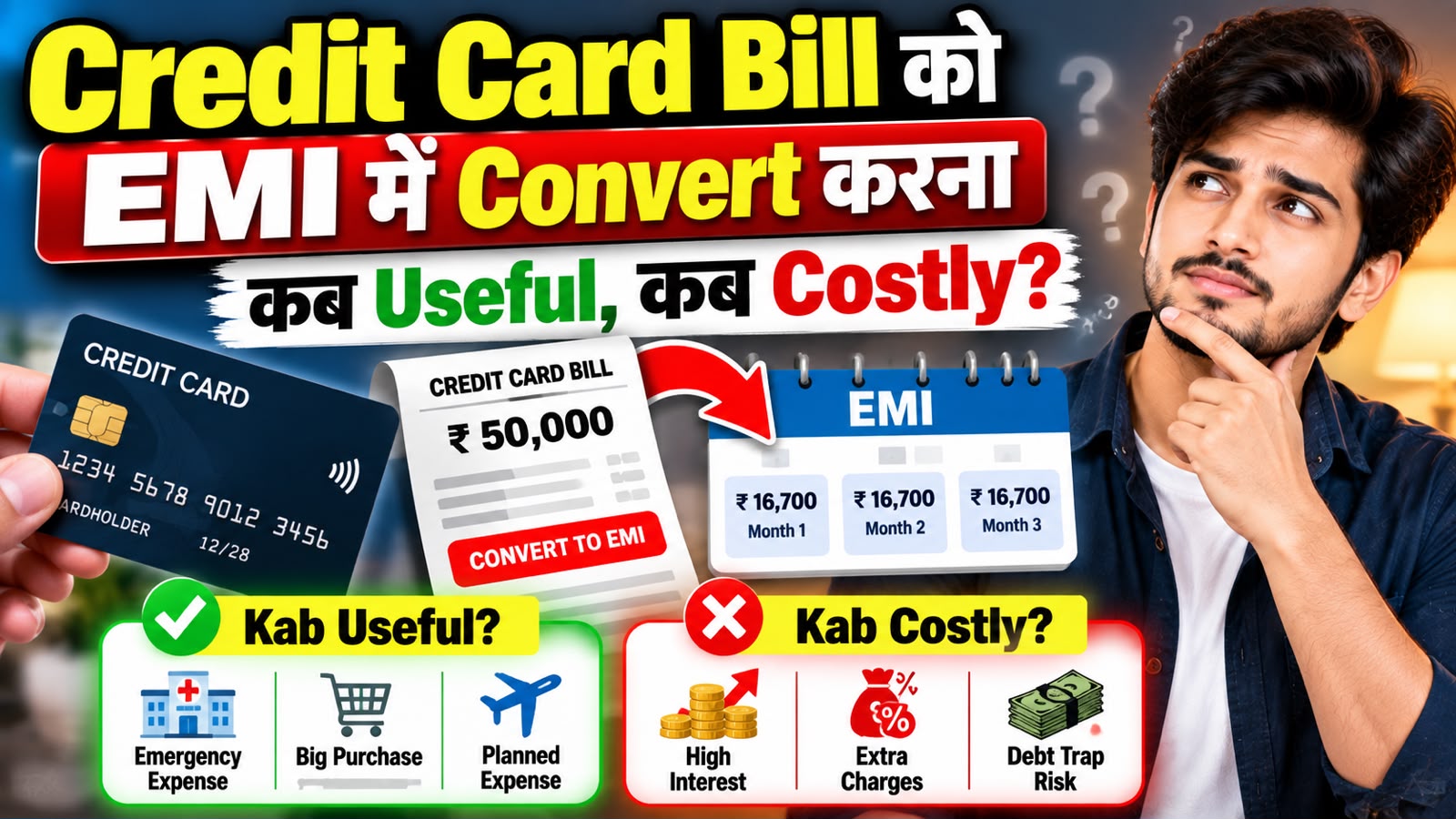
A credit card can be really helpful when you need to make a big payment but don’t want to pay the entire amount immediately. Many banks and credit card companies also give you the option to convert a large purchase or your outstanding credit card bill into EMI (Equated Monthly Instalments).
At first, EMI sounds quite convenient. Instead of paying ₹50,000 or ₹60,000 at once, you can divide the payment into smaller amounts and pay every month.
But there is something you should know before choosing this option.
A smaller monthly payment does not always mean a cheaper deal.
Interest, processing fees, taxes and other charges can increase the total amount you pay. So, before converting a credit card bill into EMI, it’s important to understand how much it will actually cost you.
Let’s look at it in a simple way.
What Does Credit Card Bill to EMI Mean?
When you convert a credit card purchase or outstanding bill into EMI, you don’t pay the entire amount at once. Instead, you repay it over a fixed period, such as 3, 6, 9 or 12 months, depending on the offer available to you.
For example, suppose your credit card bill is ₹60,000.
Instead of paying the full ₹60,000 immediately, your card issuer may offer you an option to pay it in monthly instalments.
Sounds easy, right?
But remember, the EMI amount may include interest and other charges. So, if you originally spent ₹60,000, you may end up paying more than ₹60,000 by the time all the EMIs are completed.
That’s why you should never judge an EMI offer only by looking at the monthly amount.
Always check the total amount you will pay.
Why Do People Convert Credit Card Bills Into EMI?
The most common reason is simple: they don’t want a large payment to disturb their monthly budget.
Let’s say you suddenly have a credit card bill of ₹70,000. You have money coming in every month, but paying the entire ₹70,000 at once could leave you short of cash for other important expenses.
In such a situation, converting the amount into EMI can make the payment easier to manage.
People commonly use EMI for things like:
- Expensive electronics
- Home appliances
- Medical expenses
- Education-related expenses
- Travel
- Furniture
- Other large purchases
There is nothing wrong with using EMI when it is planned properly. The problem starts when EMI becomes a reason to buy things that you actually cannot afford.
When Can Converting a Credit Card Bill Into EMI Be Useful?
EMI can make sense in certain situations, especially when you have a large expense and enough regular income to handle the monthly payments.
1. When You Have a Necessary Large Expense
Imagine your refrigerator suddenly stops working and you need to buy a new one. The new refrigerator costs ₹50,000, but paying the full amount at once would put pressure on your monthly budget.
If the EMI terms are reasonable, spreading the payment over a few months may make things easier.
Instead of losing ₹50,000 from your savings immediately, you can manage the expense through smaller monthly payments.
Of course, you should first check the total EMI cost before making the decision.
2. When You Don’t Want to Use Up Your Emergency Savings
Your savings can be especially important when you have an unexpected expense.
For example, suppose you have ₹1 lakh saved for emergencies and suddenly need to spend ₹70,000 on an urgent expense.
Paying the entire amount from your savings would leave you with only ₹30,000.
In some cases, using an EMI option could allow you to keep more of your savings available for future emergencies.
However, this only works if the EMI is affordable and you have a stable source of income to make the payments.
3. When the Monthly EMI Fits Your Budget
Before choosing EMI, take a proper look at your monthly finances.
Don’t just think, “I can easily pay ₹4,000 this month.”
Think about the next 6 or 12 months as well.
Your rent, groceries, bills, insurance, existing loans and other EMIs will still have to be paid. So, the new EMI should leave you with enough money for your regular expenses and savings.
A good question to ask yourself is:
“Can I comfortably pay this amount every month until the EMI ends?”
If the answer is yes, the EMI may be manageable.
4. When the Purchase Was Already Planned
EMI is generally easier to manage when you’ve planned the purchase beforehand.
For example, if you need a laptop for work and have already decided how much you can spend, an EMI can help you spread the cost.
The situation is different when you see something you like and immediately buy it just because the website says, “Only ₹2,999 per month.”
That monthly amount may look small, but the purchase could still be expensive.
When Can Credit Card EMI Become Costly?
This is the part many people overlook.
An EMI can make a purchase feel affordable because you only see a small amount going out of your bank account every month. But the actual cost can be higher.
Here are some things to watch out for.
Interest Can Increase Your Total Cost
If your EMI carries interest, you will pay more than the original purchase amount.
For example, if you convert a ₹50,000 purchase into an EMI, the total repayment could be higher than ₹50,000 because of the interest.
The exact amount depends on the interest rate, EMI tenure and the terms offered by your card issuer.
That’s why it’s better to ask:
“How much will I pay in total?”
rather than only asking:
“How much is the EMI per month?”
Processing Fees Can Add More Cost
Some EMI offers come with a processing fee.
It might look like a small amount, but it still increases the overall cost of your purchase.
For example, if you convert a large transaction into EMI and a processing fee is added, you should include that fee when calculating what the purchase is really costing you.
Taxes may also apply to certain fees or interest components, depending on the applicable rules.
A Longer EMI Can Cost More
A longer EMI period usually means a smaller monthly payment.
That sounds good, but there’s a catch.
If interest is charged, paying over a longer period can mean paying more interest overall.
For example, compare a 6-month EMI with a 12-month EMI.
The 6-month option may have a higher monthly payment, but you may finish the repayment sooner.
The 12-month option may be easier on your monthly budget, but the total interest could be higher depending on the terms.
So, don’t automatically choose the longest tenure just because the EMI looks smaller.
Don’t Get Tricked by the “Small EMI” Effect
This is one of the easiest ways to overspend with a credit card.
You might see an advertisement saying:
“Buy now for just ₹2,999 per month!”
₹2,999 doesn’t sound like much.
But what if you have to pay it for 24 months?
That’s nearly ₹72,000 in instalments.
So before accepting an EMI offer, check:
- How many months will I have to pay?
- What is the interest rate?
- Is there a processing fee?
- Are there any taxes?
- What is the total amount payable?
- Are there charges for closing the EMI early?
Once you know these numbers, the offer becomes much easier to judge.
What About No-Cost EMI?
“No-Cost EMI” is another term you will often see while shopping online.
It sounds like you are getting an EMI without paying interest, but you should still read the offer details carefully.
Depending on the offer, there may be processing fees or other applicable charges. Sometimes the pricing or discount structure is also different from a normal purchase.
For example, if a product costs ₹50,000 normally, don’t simply assume that the no-cost EMI option has exactly the same overall cost.
Compare the final price, discount, processing fee and total amount payable before choosing.
No-cost EMI does not always mean zero additional charges.
What Happens to Your Credit Card Limit?
This is another thing worth checking.
When you convert a large credit card purchase into EMI, the amount may continue to affect your available credit limit according to your card issuer’s rules.
As you repay the EMI, your available credit limit may gradually become available again.
So, don’t assume that converting a ₹60,000 transaction into EMI immediately gives you that ₹60,000 back as available credit.
If you’re planning another large purchase, check your available credit limit in your card app or statement first.
Can Having Multiple EMIs Become a Problem?
Absolutely.
One EMI may seem easy to manage. But several small EMIs can quickly turn into a large monthly commitment.
For example:
- Phone EMI: ₹4,000
- Laptop EMI: ₹6,000
- Furniture EMI: ₹5,000
- Travel EMI: ₹5,000
That’s already ₹20,000 every month.
Each individual EMI might have seemed affordable when you took it, but together they can put serious pressure on your budget.
This is why you should always look at your total monthly EMI payments, not just the EMI for your next purchase.
Credit Card EMI vs Paying the Full Bill
If you can comfortably pay your credit card bill in full by the due date, you may avoid the interest associated with carrying a revolving credit card balance, subject to your card’s terms.
Let’s say your bill is ₹30,000 and you have enough money to pay it without affecting your emergency savings or other important expenses.
In that situation, taking an interest-bearing EMI simply to reduce the monthly payment may increase your overall cost.
But if paying ₹30,000 at once would seriously affect your finances, an EMI may give you more breathing room.
It really comes down to your cash flow and the actual cost of the EMI.
What Should You Check Before Converting Your Bill?
Don’t accept an EMI offer in a hurry. Take a few minutes to check the following details.
1. Interest Rate
Find out whether interest is being charged and what rate applies.
2. Total Amount Payable
This is one of the most important numbers. It tells you what the purchase will actually cost after interest and other charges.
3. Processing Fee
Check whether the bank or card issuer charges a one-time processing fee.
4. Taxes and Other Charges
Check whether taxes are applicable to interest, processing fees or other charges.
5. EMI Tenure
Compare different repayment periods instead of choosing one just because the monthly amount is smaller.
6. Prepayment or Foreclosure Charges
If you want to close the EMI before the scheduled end date, check whether any additional charges apply.
7. Your Monthly Budget
Finally, ask yourself whether the EMI comfortably fits into your monthly budget.
A Simple Example
Let’s say you make a credit card purchase worth ₹60,000.
Your card issuer gives you two options:
6-month EMI: Higher monthly payment but a shorter repayment period.
12-month EMI: Lower monthly payment but a longer repayment period.
The 12-month option may look more comfortable because you pay less every month.
But if interest is charged, you could end up paying more overall.
Now add a processing fee and applicable taxes, and the difference becomes even more important.
So instead of asking only, “Which EMI has the lowest monthly payment?”, compare the total amount payable under each option.
That will give you a much clearer picture.
When Should You Think Twice About Taking an EMI?
You should be careful about converting a credit card bill into EMI if:
- You are already paying several EMIs
- Your monthly budget is already tight
- You are using credit to pay regular household expenses
- You don’t have a clear plan for repayment
- The interest and other charges are very high
- You are buying something mainly because EMI makes it look affordable
- You are using one credit card or loan to manage another payment
If you regularly need EMIs just to cover everyday expenses, it may be worth taking a closer look at your monthly spending and cash flow.
Final Thoughts
Converting a credit card bill into EMI isn’t automatically a good or bad financial decision. It depends on the situation.
For a large and necessary purchase, EMI can make things easier by spreading the payment over several months. It can also help you avoid using a large portion of your savings at once.
But EMI can become expensive when you focus only on the monthly payment and forget about interest, processing fees, taxes and the total repayment amount.
Before converting your credit card bill into EMI, ask yourself three simple questions:
How much will I actually pay in total?
Can I comfortably afford the EMI every month?
Do I really need to spread this payment over several months?
If you have clear answers to these questions, you can make a more informed choice.
And remember one simple rule:
An EMI doesn’t make an expensive purchase cheaper. It only spreads the cost over time.
The real cost is what you pay from the first EMI to the last one, including all applicable interest and charges.