Introduction
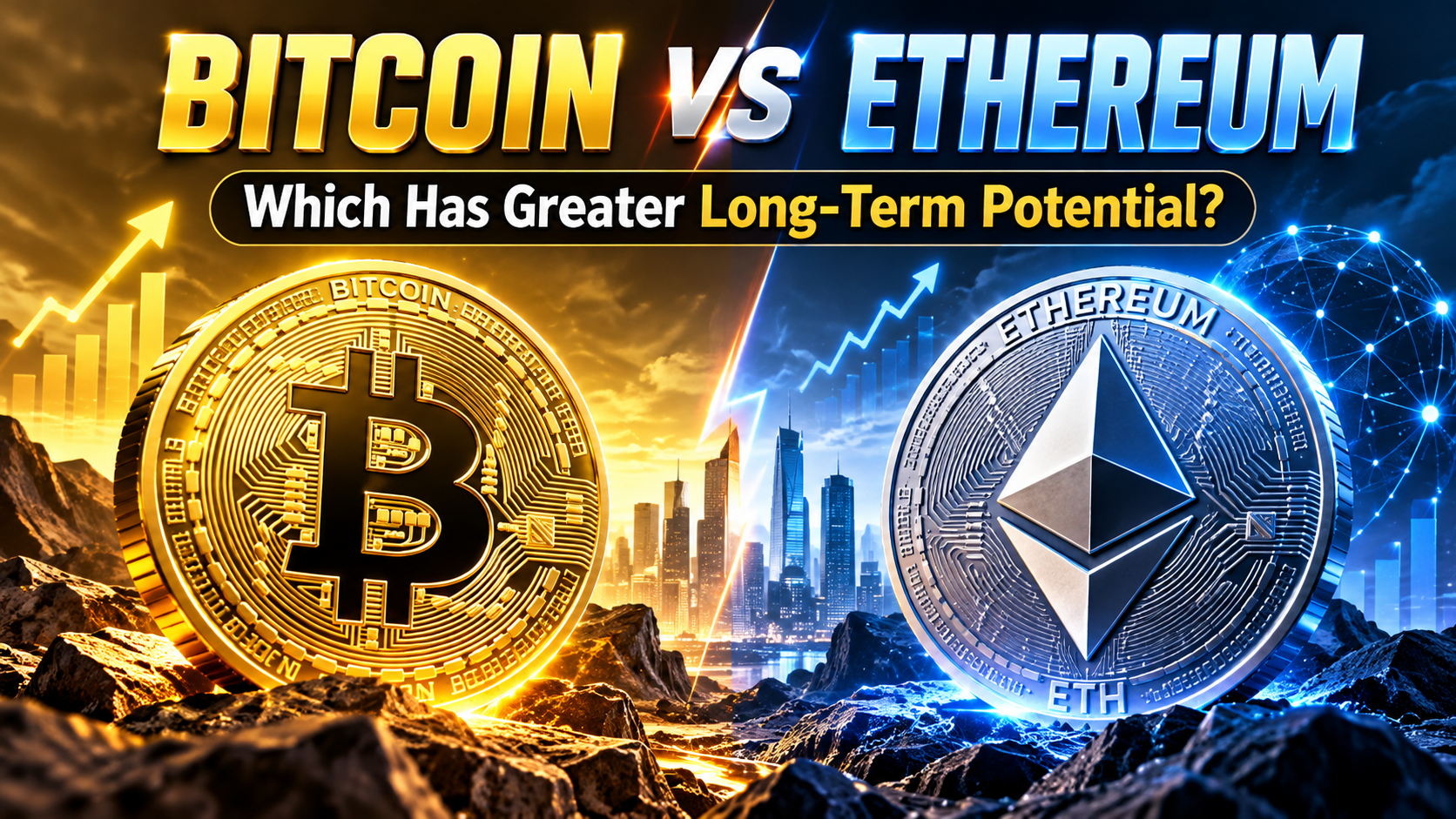
Bitcoin and Ethereum are two of the most influential cryptocurrencies in the world. Both have transformed the digital asset industry, attracted institutional investors, and introduced new ways to think about money, technology, and financial systems. However, despite their shared position in the cryptocurrency market, Bitcoin and Ethereum serve very different purposes.
Bitcoin was created to function as decentralized digital money and a potential store of value. Ethereum, on the other hand, was designed as a programmable blockchain that allows developers to build decentralized applications, financial services, digital assets, and automated agreements known as smart contracts.
This difference raises an important question for investors: Which cryptocurrency has greater long-term potential—Bitcoin or Ethereum?
The answer depends on how the cryptocurrency industry evolves, which use cases gain adoption, how regulatory frameworks develop, and what investors value most in the coming years. Bitcoin may have an advantage as a scarce digital asset, while Ethereum could offer greater exposure to the growth of blockchain-based applications.
Understanding their strengths, weaknesses, and long-term opportunities can help investors make more informed decisions.
1. Understanding Bitcoin
Bitcoin was introduced in 2009 by the pseudonymous creator Satoshi Nakamoto. It was developed as a peer-to-peer electronic payment system that could operate without relying on banks or centralized financial institutions.
Its most distinctive characteristic is its limited supply. The Bitcoin protocol caps the maximum supply at 21 million coins. This predictable scarcity is one reason many investors compare Bitcoin to gold.
Why Bitcoin matters
Bitcoin’s long-term investment thesis rests on several important factors.
Limited supply: Unlike traditional currencies, which central banks can expand, Bitcoin has a predetermined issuance schedule. Its scarcity may become more attractive if demand increases over time.
Decentralization: Bitcoin operates through a distributed network of participants. No single company or government controls the protocol, although governments can regulate its use within their jurisdictions.
Institutional recognition: Bitcoin has become a recognized investment asset, with regulated investment products available in some markets. This gives traditional investors additional ways to gain exposure without directly managing cryptocurrency wallets.
Security and network maturity: Bitcoin’s long operating history and proof-of-work consensus mechanism have contributed to its reputation as a robust monetary network.
Bitcoin’s limitations
Bitcoin also has disadvantages. Its base layer supports fewer complex applications than Ethereum, and its transaction capacity is limited compared with many conventional payment systems. Additional technologies, including the Lightning Network, aim to improve payment speed and scalability.
Bitcoin’s price can also experience significant volatility. Scarcity does not guarantee increasing value, and future returns depend on sustained demand, investor confidence, competition, and broader economic conditions.
Consequently, Bitcoin’s strongest long-term argument is relatively straightforward: it could become an increasingly important global store of value if adoption continues to expand.
2. Understanding Ethereum
Ethereum launched in 2015, building on the concept of a blockchain that could do more than transfer digital currency. Its native cryptocurrency, Ether (ETH), powers transactions and computational activity across the network.
Ethereum’s defining feature is its ability to execute smart contracts. These are programs that run according to predefined rules on the blockchain.
This functionality has enabled developers to build decentralized finance platforms, tokenized assets, digital collectibles, blockchain games, decentralized autonomous organizations, and numerous other applications.
Why Ethereum matters
Smart contracts: Ethereum allows developers to create applications that operate without depending entirely on a central intermediary.
Decentralized finance: Ethereum has played a major role in the development of lending protocols, decentralized exchanges, stablecoins, and other blockchain-based financial services.
Tokenization: Real-world assets, including certain financial instruments and ownership interests, can be represented using blockchain tokens. Ethereum’s infrastructure is one option for these applications.
Staking rewards: Since Ethereum transitioned to proof-of-stake in 2022, ETH holders can participate in network validation through staking, either directly or through service providers. Staking can generate rewards, but it involves technical, market, and potentially liquidity-related risks.
Layer-2 scaling: Networks built on top of Ethereum aim to make transactions cheaper and faster while using Ethereum as a settlement or security layer to varying degrees.
Ethereum’s limitations
Ethereum faces competition from other smart-contract platforms, including Solana and alternative blockchain ecosystems. High transaction fees can occur during periods of heavy demand, although layer-2 networks help address this problem.
Its technology is also more complex than Bitcoin’s relatively focused monetary design. Changes to network infrastructure, application vulnerabilities, validator concentration, and regulatory uncertainty can affect Ethereum’s ecosystem.
Unlike Bitcoin, Ether does not have a fixed maximum supply of 21 million coins. ETH issuance and fee burning influence its supply dynamics, so its long-term monetary characteristics depend partly on network activity and protocol rules.
Ethereum’s central investment argument is that ETH could benefit if demand for decentralized applications, blockchain settlement, tokenization, and related infrastructure grows substantially.
3. Bitcoin vs Ethereum: Key Differences
Although both assets use blockchain technology, their long-term investment cases are different.
| Feature | Bitcoin (BTC) | Ethereum (ETH) |
|---|---|---|
| Primary purpose | Digital money and potential store of value | Programmable blockchain infrastructure |
| Maximum supply | 21 million BTC | No fixed maximum supply |
| Consensus mechanism | Proof of work | Proof of stake |
| Main network use | Value transfer and settlement | Smart contracts and decentralized applications |
| Investment thesis | Scarcity and monetary adoption | Network utility and ecosystem growth |
| Additional potential benefit | Exposure to digital gold adoption | Staking rewards and ecosystem participation |
| Major risks | Volatility, regulation, competition, adoption | Competition, complexity, application risks, regulation |
Bitcoin’s simpler purpose may make its investment thesis easier to understand. Ethereum’s broader functionality, however, creates more potential sources of demand for its native asset.
Neither design guarantees superior investment performance.
4. Which Cryptocurrency Has Greater Long-Term Growth Potential?
The comparison becomes more interesting when we examine how each cryptocurrency could perform over a five-to-ten-year period.
Bitcoin: The digital gold opportunity
Bitcoin could benefit if more individuals, companies, financial institutions, and investment funds treat it as a long-term store of value.
Gold has historically served as a store of value for many investors, while Bitcoin offers a digitally transferable asset with a transparent issuance schedule. Although the two assets have important differences, the comparison helps explain Bitcoin’s appeal.
If Bitcoin continues gaining acceptance as a portfolio asset, demand could grow relative to its limited supply. Its established brand recognition may also strengthen its position against competing cryptocurrencies.
However, Bitcoin’s long-term success depends on more than scarcity. Investors must continue to believe it is valuable, secure, transferable, and worth holding despite its price volatility.
Ethereum: The blockchain economy opportunity
Ethereum could benefit from a different development: the expansion of blockchain-based economic activity.
Imagine a future in which businesses issue tokenized financial assets, financial institutions use blockchain settlement, applications process transactions through smart contracts, and digital services rely on decentralized infrastructure.
Ethereum could capture some of this activity directly or through its layer-2 ecosystem. ETH is used to pay network fees, and staking helps secure the proof-of-stake network.
Nevertheless, growth in Ethereum usage does not automatically translate into proportional growth in ETH’s price. Some applications may shift activity to layer-2 networks or competing chains, and the economic value captured by ETH depends on fee demand, issuance, burning, staking participation, and investor expectations.
Ethereum’s opportunity is therefore potentially broader, but its investment case is more dependent on technological execution and the economics of its ecosystem.