Introduction
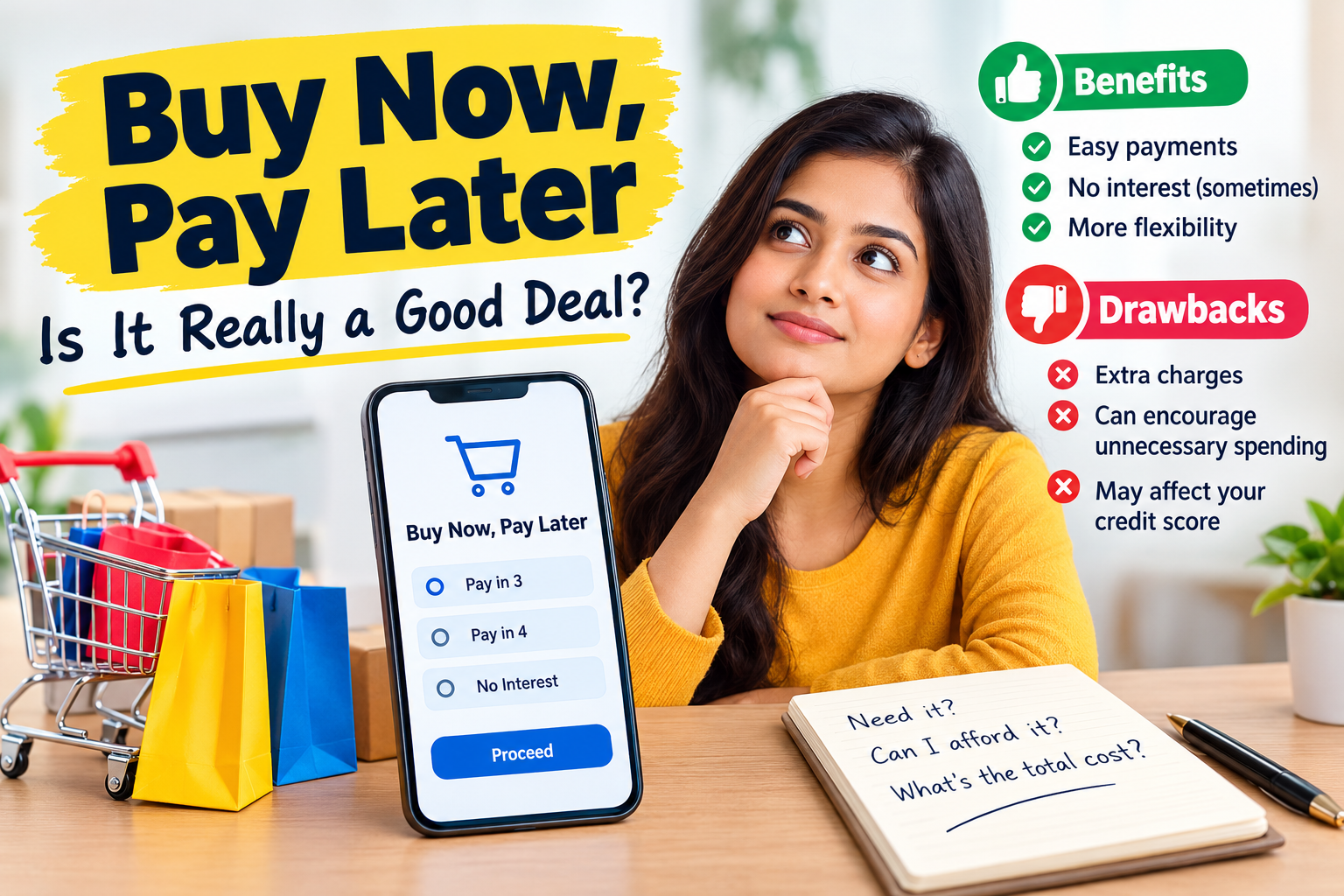
Have you ever wanted to buy a new phone, clothes, or something for your home but did not have enough money to pay for it at that moment? If yes, you may have seen an option called Buy Now, Pay Later (BNPL) while shopping online.
This option allows you to buy something today and pay for it later. Some services let you divide the payment into smaller installments instead of paying the full amount at once.
At first, it sounds like a good idea. You get the product you want without spending all your money immediately. Some companies even offer interest-free payment plans.
But is Buy Now, Pay Later really a good deal?
The answer depends on how you use it. It can help you manage a planned purchase, but it can also create money problems if you spend more than you can afford.
In this article, we will explain how Buy Now, Pay Later works, its advantages and disadvantages, and when you should or should not use it.
What Is Buy Now, Pay Later?
Buy Now, Pay Later is a payment option that allows you to purchase something now and pay for it in the future.
Instead of paying the full price immediately, you may be able to pay after a few weeks or divide the amount into smaller installments.
For example, imagine you want to buy a pair of shoes worth ₹3,000.
You may have two options. You can pay ₹3,000 immediately, or you can choose a payment plan that allows you to pay the amount in installments.
If the plan has three equal payments, you might pay ₹1,000 each time.
This can make the purchase easier to manage because you do not need to pay the entire amount at once.
However, remember that you still have to pay the full price. Buy Now, Pay Later does not mean you are getting the product for free.
Some plans also charge interest or additional fees. That is why you should always check the payment terms before choosing this option.
How Does Buy Now, Pay Later Work?
Using Buy Now, Pay Later is usually simple.
First, you choose the product you want to buy from an online store or a participating merchant.
When you reach the payment page, you may see a Buy Now, Pay Later option. If you are eligible, you can select it.
Depending on the provider, you may need to share some personal details, verify your identity, or complete a credit check.
Once your payment plan is approved, you can complete your purchase.
After that, you must pay the amount according to the agreed schedule. Some plans ask you to pay the full amount on a later date, while others divide it into several installments.
For example, if you buy a product worth ₹6,000 and choose three equal installments, you may need to pay ₹2,000 per installment.
The exact payment amount and schedule depend on the plan you choose.
Before accepting the offer, check the due dates, interest rate, processing fees, and late-payment charges.
A Simple Example of Buy Now, Pay Later
Let’s understand this with a simple example.
Suppose you want to buy a smartphone worth ₹12,000.
You choose a three-month payment plan with no interest or extra fees.
Your payments might look like this:
| Payment | Amount |
|---|---|
| First payment | ₹4,000 |
| Second payment | ₹4,000 |
| Third payment | ₹4,000 |
| Total amount paid | ₹12,000 |
In this example, you pay the same amount as the original price of the phone.
Now imagine the provider charges an additional fee of ₹500.
Your total payment would increase to ₹12,500.
This means you are paying more for the same phone.
That is why you should never choose a payment plan just because the monthly installment looks small. Always check how much you will pay in total.
Benefits of Buy Now, Pay Later
Buy Now, Pay Later has some advantages when you use it carefully.
1. You Do Not Need to Pay Everything at Once
One of the main benefits is that you can divide the cost of a purchase into smaller payments.
For example, if your washing machine suddenly stops working, buying a new one may become necessary.
If you do not have enough money to pay the full amount immediately, a suitable payment plan may help you manage the expense.
However, you should use this option only when you are confident that you can pay the installments on time.
2. Some Plans Do Not Charge Interest
Some Buy Now, Pay Later services offer interest-free payment plans.
This means you may be able to divide the cost without paying extra interest, provided you follow the terms of the offer.
For example, if you buy something worth ₹6,000 and repay exactly ₹6,000 in installments, you do not pay more than the original price.
But read the terms carefully. Some plans have processing fees or late-payment charges.
An interest-free offer is useful only when the total cost is clear and you can make every payment on time.
3. The Process Is Often Quick
Many BNPL services work through websites and mobile apps.
You may be able to apply and complete the payment process without visiting a bank branch.
However, approval depends on the provider’s rules. You may need to verify your identity or meet certain eligibility requirements.
4. It Can Help You Manage Planned Expenses
Sometimes, an important expense comes up before your salary arrives.
A suitable payment plan may help you manage the timing of that expense.
For example, you may need to replace an essential household item a few days before payday.
But remember that you will still need money for the upcoming installments. Do not depend on uncertain income to repay your purchases.
Disadvantages of Buy Now, Pay Later
Although BNPL can be convenient, it also has some disadvantages.
1. It Can Make You Spend More
This is one of the biggest problems with Buy Now, Pay Later.
When you see that you only need to pay ₹500 today, buying something may feel easy.
You may end up purchasing things that you do not really need.
For example, you might buy clothes for ₹3,000, headphones for ₹4,000, and accessories for ₹2,000 using different payment plans.
Each purchase may look affordable on its own. But together, they cost ₹9,000.
You still have to repay the full amount, even if your salary is not enough to cover all the installments.
Before buying anything, ask yourself one simple question: Do I really need this product, or am I buying it because payment looks easy?
2. Late Payments Can Cost You More
Buy Now, Pay Later payments have due dates.
If you forget to pay on time, the provider may charge a late fee or other charges allowed under your agreement.
Missing payments repeatedly can create bigger financial problems.
For example, if you have several installments due in the same month, forgetting even one payment may lead to extra costs.
To avoid this, keep track of your due dates and make sure you have enough money in your account.
3. It May Affect Your Credit Score
Many people think Buy Now, Pay Later has nothing to do with their credit score. However, that is not always true.
Some BNPL plans are linked to credit provided by a bank or another lending institution. Depending on the arrangement, your account and repayment history may be reported to credit bureaus.
If you miss payments on a reported credit account, it may negatively affect your credit profile.
A poor credit history can make it harder to get certain loans or credit products in the future.
Before using BNPL, check whether the provider reports your repayment activity to a credit bureau.
4. Managing Multiple Payments Can Be Difficult
Imagine you have three different payment plans.
One payment is due on the fifth of the month, another on the fifteenth, and the last one on the twenty-fifth.
It can be easy to forget a payment, especially when you have other bills to pay.
This is why you should avoid using too many BNPL services at the same time.
Keep a list of your payments and the amount you still owe. It will help you understand your financial situation more clearly.
5. Extra Charges Can Increase the Cost
Not every BNPL plan is free.
Depending on the provider, you may have to pay interest, processing fees, or late-payment charges.
For example, a product may cost ₹10,000, but extra fees could increase the total amount you pay.
Before choosing a plan, compare the final amount with the original price.
If the extra charges are too high, paying upfront or choosing another payment method may be a better option.
Buy Now, Pay Later vs Credit Card
Buy Now, Pay Later and credit cards allow you to purchase things without paying the full amount from your bank account immediately. However, there are some important differences.
| Feature | Buy Now, Pay Later | Credit Card |
|---|---|---|
| Payment method | Pay later or in installments | Pay through a monthly bill |
| Interest | Depends on the plan | May apply if you carry an unpaid balance |
| Payment schedule | Often fixed installments | Usually follows a monthly billing cycle |
| Spending limit | Set by the provider | Based on your credit limit |
| Main risk | Missing installments | Building up unpaid credit card debt |
Which option is better depends on your needs and spending habits.
If you already have a credit card and can pay the full statement balance by the due date, it may be more convenient to use it for planned purchases.
However, credit cards can also become expensive if you keep carrying unpaid balances.
Do not choose either option just because it allows you to spend more money. Choose the one with clear terms and affordable repayments.
Is Buy Now, Pay Later Safe in India?
Buy Now, Pay Later can be a legitimate payment option in India, but you should understand who is providing the credit.
Some services work with banks or non-banking financial companies (NBFCs). The rules and responsibilities may differ depending on the type of arrangement.
Before using a BNPL service, take a few precautions.
Check the lender: Find out which bank or lending company is providing the credit, where applicable.
Read the terms: Understand the repayment dates, interest rate, fees, and late-payment rules.
Protect your personal information: Check what information the app collects and how it uses your data.
Avoid suspicious offers: Be careful with unknown apps that promise guaranteed approval or ask for unusual upfront payments.
Use official channels: Verify the provider and contact customer support through its official website or application.
Never share your OTP, password, or banking PIN with someone claiming to help you activate a BNPL service.
Taking a few minutes to check the details can help you avoid unnecessary risks.
When Is Buy Now, Pay Later a Good Deal?
Buy Now, Pay Later may be useful in certain situations.
For example, if you need an essential household item and have a reliable income, a payment plan with no interest and no extra fees may help you manage the expense.
It can also work for a planned purchase when you know exactly how you will repay the amount.
The most important thing is to make sure that the installments fit comfortably within your budget.
You should still have enough money for rent, groceries, electricity bills, transport, and other essential expenses.
If you can repay the installments without borrowing more money, the plan may be manageable.
However, if you are using BNPL because you cannot afford the product at all, it may be better to wait and save first.
When Should You Avoid Buy Now, Pay Later?
There are some situations where using BNPL is not a good idea.
When You Want to Buy Something Unnecessary
If you are buying a product only because the installment amount looks small, take a step back.
Wait a day or two and decide whether you really need it.
When You Already Have Too Much Debt
If you are struggling to repay existing loans or credit card bills, adding another payment can make your situation worse.
Focus on managing your current debt before taking on new financial commitments.
When Your Income Is Uncertain
If you do not know whether you will have enough money by the due date, avoid taking on another payment obligation.
A late payment can make an already difficult financial situation even harder.
When the Terms Are Not Clear
Never accept a payment plan if you do not understand its fees, interest rate, or repayment conditions.
If the provider does not clearly explain the total cost, consider another option.
How to Use Buy Now, Pay Later Wisely
If you decide to use BNPL, follow these simple tips.
1. Make a budget. Check your monthly income and expenses before taking on another payment.
2. Check the total cost. Add up all installments and applicable fees before accepting the offer.
3. Set reminders. Use your phone calendar to remember upcoming due dates.
4. Avoid unnecessary purchases. Use BNPL for planned expenses instead of shopping just because you can pay later.
5. Keep enough money aside. Make sure you can cover your installments after paying for essential needs.
6. Do not use one loan to repay another. Borrowing more money to cover old payments can create a cycle of debt.
7. Read the agreement. Understand the payment schedule and what happens if you miss a payment.
These simple habits can help you use payment plans more responsibly.
Frequently Asked Questions
Is Buy Now, Pay Later really interest-free?
Not always. Some plans offer zero interest, while others charge interest or fees. Check the complete terms before making a purchase.
Does Buy Now, Pay Later affect your CIBIL score?
It may, depending on the credit arrangement and the provider’s reporting practices. Missed payments on reported credit accounts can harm your credit profile.
Is BNPL better than a credit card?
Neither option is always better. Compare the fees, payment schedule, and total cost before deciding.
Can students use Buy Now, Pay Later?
Some services may allow eligible students to apply, but their rules vary. Students without a regular income should be particularly careful about taking on repayment obligations.
What happens if I miss a BNPL payment?
You may face late fees, and the missed payment may affect your credit profile if the account is reported. Contact the provider promptly if you are unable to pay.
Conclusion
Buy Now, Pay Later can be helpful, but it is not free money.
It allows you to purchase something today and pay for it later. This can make planned expenses easier to manage, especially when the payment plan has no interest or extra fees.
However, it can also encourage unnecessary shopping, create multiple payment obligations, and lead to extra charges if you miss a due date.
Before using BNPL, ask yourself whether you really need the product, how much you will pay in total, and whether you can comfortably afford every installment.
If the purchase is unnecessary, saving money and buying it later may be the smarter choice.
If the purchase is important and you have a clear repayment plan, BNPL may be worth considering.
Remember: The best financial decision is not always buying something today. Sometimes, waiting until you can comfortably afford it is the smartest way to manage your money.