
If you are salaried and live in a rented house, HRA is probably the simplest tax saving available to you — you are already paying rent every month, so the question is whether you are claiming the exemption on it properly.
HRA stands for House Rent Allowance, a part of your salary meant to help with rent. Under the old tax regime, a part of it is exempt from tax if you actually pay rent and live in rented accommodation. How much you save depends on your basic salary, the HRA you receive, and the rent you pay — get it right and it can save you ten to twenty thousand rupees in a year.
This is not a loophole. It is Section 10(13A) of the Income Tax Act. What confuses most people is the calculation: the exemption is the lowest of three figures, not your full HRA or your full rent.
What HRA actually is
Most salary slips split pay into basic salary, HRA, special allowance, and a few other heads. Basic is usually 40 to 50 percent of your CTC, and HRA is often 40 to 50 percent of basic. So if your basic is ₹50,000 a month, your HRA might be ₹20,000 to ₹25,000 a month.
Your employer pays you this HRA every month whether you claim the exemption or not. The exemption is a tax matter: when you submit rent proofs, usually in January or February, or file your return, you show how much rent you paid, and the exempt part is worked out from that. It applies to the HRA component only — it does not make your entire rent tax-free.
Who can claim HRA exemption
You can claim it if three conditions come together: you are salaried, you receive HRA as part of your salary, and you pay rent for the house you live in.
Each condition has a catch. Some companies, especially startups, pay a consolidated salary with no separate HRA head. If there is no HRA in your structure, there is nothing to exempt here, though Section 80GG may help instead. The rent has to be for the place where you actually live — not a house you have rented out, or one in another city where you do not stay. If you live with your parents and pay them rent, you can claim it, provided the arrangement is real, the rent is actually paid, and your parents show it as income.
You also need to be in the old tax regime. HRA exemption is not available under the new regime, so if you have opted for it, your full HRA is taxable even if you pay ₹20,000 a month in rent. That single fact changes the old-versus-new comparison for many people paying high rent in a metro city.
Related: New vs Old Tax Regime in India: Which Saves You More?
How HRA exemption is calculated
Your HRA exemption is the lowest of these three amounts:
- The actual HRA you received during the year.
- The rent you paid during the year minus 10 percent of your basic salary plus dearness allowance (DA).
- 50 percent of your basic salary plus DA if you live in a metro city — Delhi, Mumbai, Chennai, or Kolkata — or 40 percent if you live in a non-metro city.
Basic plus DA is the base for the second and third calculations; special allowance, bonuses, and reimbursements do not count. If your company does not pay DA separately, you just use basic salary. Many people assume the exemption will be the full HRA they received. It rarely is — rent has to be high enough relative to basic.
Take Rohan, who works in Bengaluru and rents a 2BHK in HSR Layout for ₹15,000 a month. His monthly breakup is basic ₹50,000, DA ₹5,000, HRA ₹25,000. Bengaluru counts as a metro city, so the 50 percent rule applies. Over a full year: basic plus DA is ₹6,60,000, HRA received is ₹3,00,000, and rent paid is ₹1,80,000.
| Calculation | Working | Amount per year |
|---|---|---|
| Actual HRA received | ₹25,000 × 12 | ₹3,00,000 |
| Rent minus 10% of basic + DA | ₹1,80,000 − ₹66,000 | ₹1,14,000 |
| 50% of basic + DA (metro) | 50% of ₹6,60,000 | ₹3,30,000 |
The lowest is ₹1,14,000. That is Rohan’s exempt HRA; the rest, ₹1,86,000, is taxable. In the 20 percent slab, that exemption saves him about ₹22,800 in tax, plus cess, without investing anything extra.
Notice what drives the result: the second figure, rent minus 10 percent of basic. After subtracting 10 percent of basic plus DA (₹5,500 a month), only ₹9,500 of his ₹15,000 monthly rent counts toward the exemption. If his rent were ₹25,000 a month, the second figure would be ₹2,34,000 a year, and that would become his exemption.
Documents you need to claim HRA
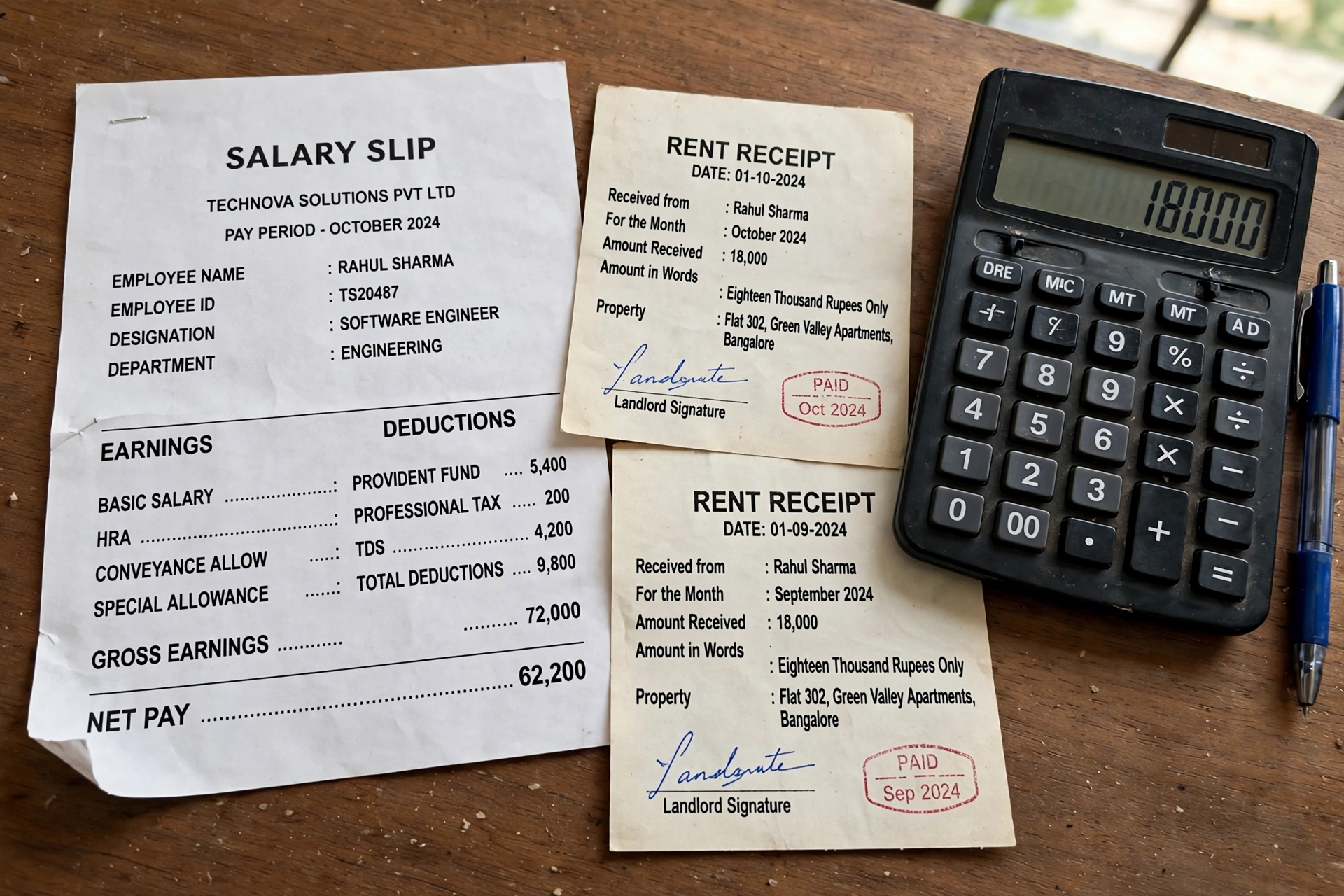
Rent receipts are the basic proof. For each month, keep a receipt showing the amount paid, the month, the address, and your landlord’s name and signature. Paying by UPI, bank transfer, or cheque helps — the bank statement becomes strong supporting evidence. If you pay in cash, a signed receipt matters even more.
A rent agreement is the second key document. If your rent is more than ₹1 lakh a year, about ₹8,333 a month, your employer will generally ask for a copy, showing the names of landlord and tenant, the address, the monthly rent, and the period. It does not have to be registered in most cases, but check what your HR team asks for.
Landlord PAN is required when your annual rent exceeds ₹1 lakh. If you pay ₹15,000 a month, your annual rent is ₹1,80,000, so you must give your landlord’s PAN to your employer, or the full exemption may not be allowed. If your landlord has no PAN, a declaration stating that, with their name and address, is an accepted alternative. Ask for the PAN when you sign the agreement, not in February.
Keep your bank statements or UPI records too — they prove rent was actually paid. Start a small folder for rent proof at the beginning of the financial year, and file each month’s receipt as you pay.
Paying rent to your parents
Can you pay rent to your parents and claim HRA? Yes, and it is perfectly legal if the arrangement is genuine. The tax law does not forbid it. It only asks that the transaction be real.
Real means three things: a rent agreement between you and your parent, just as with any other landlord; rent actually paid, ideally by bank transfer every month, so there is a clear trail; and your parent showing that rent as income in their return. If your parent is in a lower tax slab than you, the family as a whole may save tax, which is why this arrangement is popular. But if your parent does not declare the rent at all, the claim becomes shaky.
Take an example. You earn ₹12 lakh a year. Your mother owns the house you live in. You pay her ₹12,000 a month, or ₹1,44,000 a year, by bank transfer, under a written agreement. You claim HRA exemption on that rent, subject to the usual calculation. Your mother shows ₹1,44,000 as income from house property, and after the 30 percent standard deduction on rental income, only ₹1,00,800 is taxable in her hands. If she has no other income, her tax on that may be nil after the basic exemption limit. The family saves tax overall, and everything is documented.
Do not invent rent where there is none. If you live in your parents’ house and have never paid anything, writing rent receipts in February to claim HRA is a misstatement. Keep the rent in line with market rates — claiming ₹50,000 a month where similar houses rent for ₹10,000 will draw questions.

What if your employer doesn’t give you HRA?
Not every salary structure includes HRA. If yours does not, you cannot claim an HRA exemption — but you may still get relief under Section 80GG, which covers rent paid by people who do not receive HRA.
You can claim 80GG if you pay rent, receive no HRA, and neither you, your spouse, nor your minor child owns a house in the city where you live and work. You also need to file a declaration in Form 10BA stating these facts.
The deduction is the lowest of three figures: ₹5,000 a month, or ₹60,000 a year; 25 percent of your total income after certain adjustments; and the rent you paid minus 10 percent of your total income.
Say you earn ₹6,00,000 a year, receive no HRA, and pay ₹10,000 a month in rent. The three figures are ₹60,000, 25 percent of ₹6,00,000 (₹1,50,000), and ₹1,20,000 minus ₹60,000 (₹60,000). The lowest is ₹60,000, worth about ₹12,000 in tax for someone in the 20 percent slab.
Section 80GG is less generous than HRA for high-rent cases, because of the ₹60,000 cap. If your employer does not give HRA, ask HR whether they can restructure your salary to include one — it costs them nothing, it is just a re-split of your CTC. You cannot claim both HRA and 80GG for the same rent in the same year.
HRA under old vs new tax regime
HRA exemption is available only under the old tax regime. Under the new regime, your full HRA is taxable, however much rent you pay.
That does not automatically mean the old regime is better for everyone. The new regime has lower slab rates and a higher basic exemption, and for many people with few deductions it works out cheaper. But substantial rent can tilt the balance back toward the old regime, especially with other deductions like Section 80C and 80D.
A person paying ₹20,000 a month in rent in Mumbai, with an HRA exemption of ₹1,50,000 or more, may find the old regime cheaper by ₹20,000 to ₹30,000 a year. A person paying ₹6,000 a month in a small town may find the new regime cheaper.
Related: How to Save Tax Beyond Section 80C in India
Your employer will ask at the start of the financial year which regime you want for TDS. That choice is not final — you can change it when you file your return, except in some cases where you have business income. Do the comparison before you file, with your actual rent and HRA figures in hand.
Common mistakes that cost people money
The first mistake is not claiming HRA at all. Some people miss the employer’s proof deadline, or think the amount is too small to matter. Even a small exemption helps, and if you missed the deadline, you can still claim it when you file your return and get the extra TDS back as a refund.
The second mistake is claiming HRA without paying rent — claiming for a house you own, or creating backdated receipts. The department can ask for the agreement, the landlord’s PAN, and bank proof. A claim with no trail behind it can be disallowed, and in serious cases it can attract penalty.
The third mistake is getting the landlord PAN rule wrong. If your rent is above ₹1 lakh a year and you do not provide the PAN or a declaration, your employer may refuse the exemption. Get it at the start of the tenancy, not in February.
Other mistakes are easy to avoid: using the wrong metro percentage (50 percent for Delhi, Mumbai, Chennai, and Kolkata, 40 percent elsewhere), paying in cash with no receipts, claiming HRA and 80GG together, and claiming HRA under the new regime. Remember the 10 percent rule too — your exemption is rarely your full rent or your full HRA.
Making HRA work for you
Check that your salary includes HRA. Keep a rent agreement and month-wise receipts. Get the landlord’s PAN if your annual rent crosses ₹1 lakh, and pay by bank transfer where you can. Run the lowest-of-three calculation with your actual numbers, and compare the old and new regimes before you file. If you pay rent to your parents, treat it like any other tenancy; if your employer does not give HRA, look at Section 80GG. Rent is one of the biggest monthly expenses for most salaried people in India — a little paperwork at the start of the year is all it takes.