
Every February, when the Budget speech ends, the same question starts doing the rounds in offices across India: new regime or old regime? Since 2023, the new tax regime has been the default for salaried taxpayers, but the old regime has not gone away. You can still choose it, every year, if it saves you more. The trouble is that most people pick based on what a colleague did, or what an agent suggested in a hurry, rather than doing their own comparison. And that guess can easily cost ₹10,000 to ₹30,000 a year in extra tax.
This article settles the new vs old tax regime question in plain language. We will look at how the two regimes actually differ, work through real salary examples, list which deductions still matter under the old regime, and show you a simple way to compare the two in about fifteen minutes. No tax jargon for its own sake, and no advice tailored to your personal situation — just the maths and the rules, so you can make an informed choice and check it again next year when your salary or investments change.
What the Two Regimes Really Are
Think of the old and new regimes as two different ways of calculating tax on the same income. The old regime charges higher slab rates, but it lets you reduce your taxable income with a long list of deductions and exemptions — Section 80C investments, HRA, home loan interest, medical insurance premiums, and more. The new regime charges lower slab rates, but it takes away almost all of those deductions. You pay tax on nearly your full income, but at gentler rates.
Neither regime is “better” in the abstract. It depends entirely on how much you actually claim in deductions. Someone who pays rent, has a home loan, invests in PPF and ELSS, and pays health insurance premiums may save far more under the old regime, even at its higher rates. Someone with few deductions — a young professional living with parents, no home loan, minimal tax-saving investments — will usually pay less under the new regime, because the lower slabs do the work without any paperwork.
One important detail: salaried employees can switch between the regimes every year when they file their return. Business owners with business income face stricter rules about switching, so if you run a business, check that part carefully before assuming you can flip-flop. For most salaried readers, though, this is an annual decision, not a one-time choice.
The Slabs Side by Side
Under the new regime, the slabs are wider at the bottom. Income up to ₹3 lakh is tax-free, and the next slabs rise gradually — 5% up to ₹7 lakh, 10% up to ₹10 lakh, 15% up to ₹12 lakh, 20% up to ₹15 lakh, and 30% above ₹15 lakh. On top of that, the new regime offers a rebate under Section 87A: if your total income is up to ₹7 lakh, your tax can effectively become zero. That rebate is one reason the new regime suits lower and middle incomes so well.
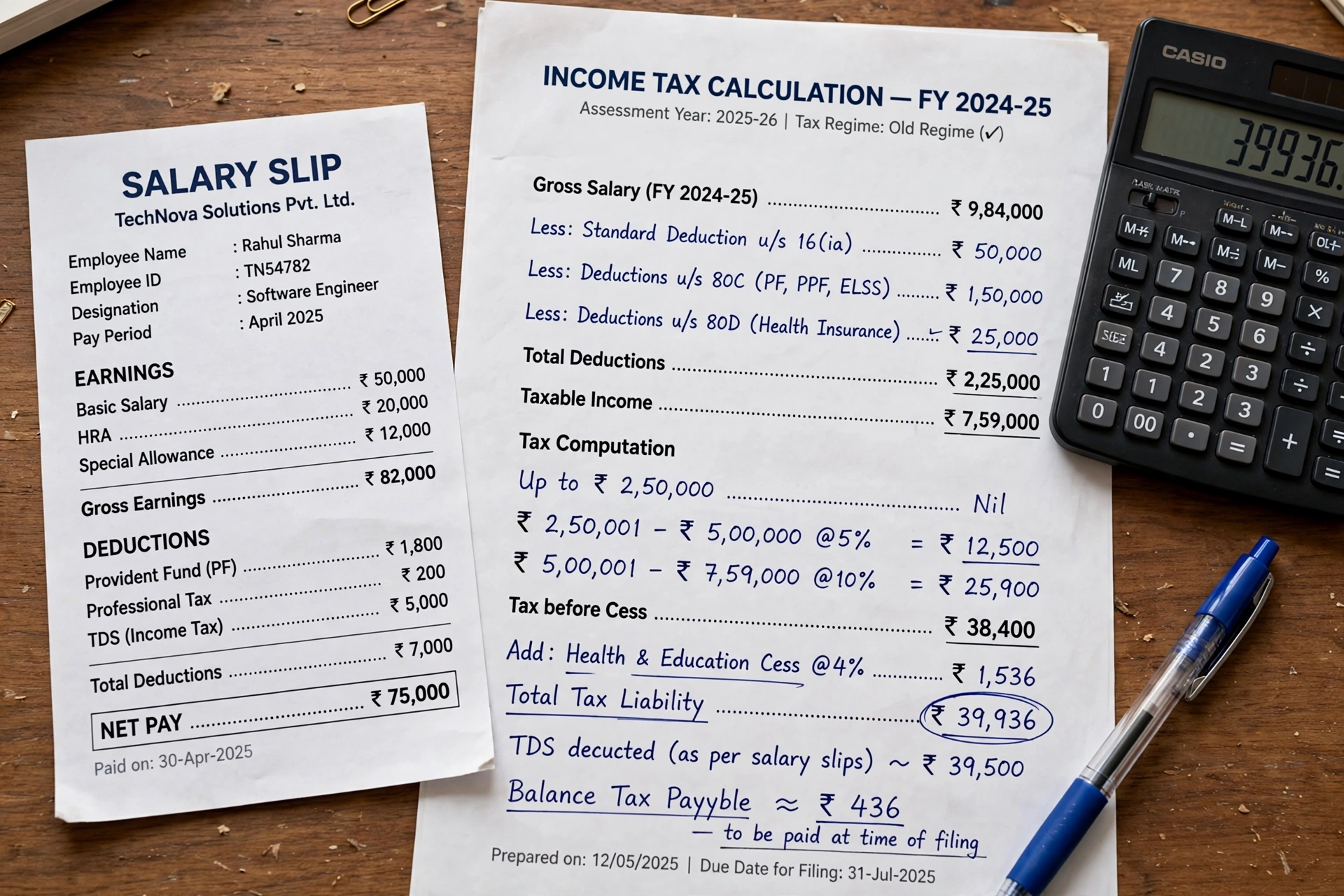
Under the old regime, the slabs are steeper. Income up to ₹2.5 lakh is tax-free for most taxpayers under 60, then 5% up to ₹5 lakh, 20% up to ₹10 lakh, and 30% above ₹10 lakh. There is also a rebate up to ₹5 lakh of income. On paper, those rates look much worse. In practice, they apply only after deductions. If you earn ₹12 lakh but claim ₹2.5 lakh in deductions, the old regime taxes you as if you earned ₹9.5 lakh — and that changes the comparison completely.
Both regimes add a 4% health and education cess on the tax amount, and a surcharge applies at very high incomes. Those details matter at the top end, but for most salaried readers the slab-and-deduction comparison is where the money is won or lost.
Which Deductions Actually Count Under the Old Regime
The old regime’s value comes from its deductions, so it is worth listing the ones most salaried people actually use. Section 80C allows up to ₹1.5 lakh a year for investments and payments like EPF contributions, PPF, ELSS mutual funds, life insurance premiums, children’s tuition fees, and principal repayment on a home loan. If you already contribute to EPF through your salary, a good part of that ₹1.5 lakh may already be filled without any extra effort.
House Rent Allowance, or HRA, is often the single biggest deduction for people living in rented homes in cities. If you live in Mumbai, Bengaluru, Delhi, or another metro and pay ₹20,000 a month in rent, your HRA exemption can easily run into lakhs, depending on your salary structure. Home loan interest under Section 24 gives up to ₹2 lakh a year for a self-occupied property. Health insurance premiums under Section 80D allow up to ₹25,000 for yourself and your family, and more if you pay premiums for senior citizen parents. Add the standard deduction of ₹50,000 under the old regime — ₹75,000 under the new regime — and you can see why the comparison is rarely close without doing the numbers.
Under the new regime, most of these go away. You keep the standard deduction, now ₹75,000, and a few specific items like employer contributions to NPS under Section 80CCD(2). But 80C, HRA, home loan interest, and 80D largely do not apply. That is the trade-off in one sentence: lower rates, far fewer deductions.
Example 1: ₹9 Lakh Salary, Few Deductions
Take Ananya, 27, a software engineer in Hyderabad earning ₹9 lakh a year. She lives with her parents, so there is no HRA claim and no home loan. She contributes to EPF through her salary — about ₹60,000 a year — and has a small PPF account she funds occasionally, but she has not bought tax-saving investments deliberately.
Under the new regime, her standard deduction of ₹75,000 brings her taxable income to about ₹8.25 lakh. At the new slabs, her tax works out to roughly ₹35,000 to ₹40,000 before cess. Under the old regime, her deductions are mainly the ₹50,000 standard deduction plus her EPF of ₹60,000 — about ₹1.1 lakh in total — leaving taxable income of roughly ₹7.9 lakh, taxed at the steeper old slabs. That comes to noticeably more, around ₹65,000 to ₹70,000. For Ananya, the new regime wins clearly, and it wins without her having to buy anything she does not want.
This is the typical story for young professionals with low deductions. The new regime was designed, in part, for exactly this group, and the maths usually confirms it.
Example 2: ₹15 Lakh Salary, Full Deductions
Now take Rohit, 38, a manager in Pune earning ₹15 lakh a year. He pays ₹22,000 a month in rent and receives HRA, he has a home loan on which he pays about ₹1.8 lakh in interest a year, he invests the full ₹1.5 lakh under 80C through EPF, PPF, and an ELSS fund, and he pays ₹30,000 a year in health insurance premiums for himself and his parents. His total deductions under the old regime add up to roughly ₹5 lakh or more, once HRA, home loan interest, 80C, 80D, and the standard deduction are combined.
Under the old regime, his taxable income falls from ₹15 lakh to around ₹10 lakh, and his tax comes to roughly ₹1.1 lakh to ₹1.2 lakh. Under the new regime, with only the ₹75,000 standard deduction, his taxable income stays near ₹14.25 lakh, and his tax comes to roughly ₹1.3 lakh to ₹1.4 lakh. In this case the old regime wins, by perhaps ₹15,000 to ₹25,000 a year — and that is before considering that his ELSS and PPF investments are also building long-term wealth. For readers in a similar position, it is worth reading about how ELSS funds combine tax saving with investing, since an 80C investment you would make anyway makes the old regime more attractive.
The lesson from these two examples is simple: the break-even point is not a fixed salary figure. It is a deductions figure. As a rough rule of thumb, if your total old-regime deductions are above about ₹2.5 lakh to ₹3 lakh, the old regime starts to look competitive, and above ₹3.5 lakh to ₹4 lakh it often wins. Below ₹1.5 lakh in deductions, the new regime usually wins. Between those ranges, you have to do the actual calculation — which brings us to the practical part.

How to Compare the Two in Fifteen Minutes
You do not need a chartered accountant for the first comparison, though professional advice is sensible for complex cases. Start with your Form 16 or your salary slips and note your gross salary. Then list your old-regime deductions honestly: EPF from your payslip, PPF and ELSS contributions, life insurance premiums, tuition fees, HRA exemption (your HR or payroll team can usually tell you this figure), home loan interest certificate from your bank, and health insurance premiums.
Next, use the Income Tax Department’s free tax calculator on incometaxindia.gov.in, or any reputable calculator from a bank or tax portal. Enter your income once under the new regime and once under the old regime with your deductions, and compare the final tax figures including cess. Run it twice, because a single typo in a deduction can flip the answer. If the difference is small — say under ₹5,000 — the new regime’s simplicity may be worth more than the saving, since it needs no investment proofs and no year-end scramble for receipts.
Do this comparison before you submit your investment declaration to your employer, not in March. Your employer deducts TDS based on the regime you declare, and while you can correct the choice when you file your return and claim a refund if too much was deducted, it is far easier to get the monthly deduction right from the start. If you switch regimes mid-year in your declaration, keep a copy of what you submitted and when.
Common Mistakes That Cost Money
The most common mistake is investing only for tax. Buying an insurance policy or an ELSS fund in March purely to claim 80C, without checking whether you need that product, often costs more in the long run than the tax saved. If you are in the new regime, you do not need to make those investments at all for tax purposes — invest because the product fits your goals, like a monthly SIP you can sustain, not because a deadline is approaching.
Another mistake is forgetting HRA documentation. To claim HRA, you generally need rent receipts and, if your annual rent exceeds ₹1 lakh, your landlord’s PAN. People who pay rent in cash without receipts sometimes discover in March that they cannot prove the claim. A third mistake is assuming last year’s winner will win again. A salary hike, a move from a rented flat to your own home, a new home loan, or stopping an ELSS SIP can all shift the balance. Re-run the comparison every year.
Finally, do not ignore the new regime’s rebate and the standard deduction changes announced in recent Budgets. The rules have been tweaked almost every year — the rebate limit, the standard deduction amount, and the slab boundaries have all moved. An article from two years ago may quote slabs that no longer apply, so always check the current year’s figures on the official tax portal before deciding.
What About NPS, and Should You Switch Every Year?
One deduction deserves a special mention: the National Pension System. Employer contributions to NPS are deductible under both regimes within limits, and an additional ₹50,000 under Section 80CCD(1B) is available under the old regime. If you are comparing NPS and PPF for retirement, remember that the tax treatment is only one part of the decision — lock-in periods, returns, and how much of the maturity amount is taxable matter just as much.
As for switching every year: for salaried employees, yes, that is allowed and often sensible. Your life changes, and your regime choice should change with it. Just keep records. Save your Form 16, your investment proofs, your rent receipts, and your home loan interest certificate every year, even in the new regime, so that if you switch back you are not hunting for documents in a panic.
So, Which Regime Should You Pick?
If your deductions are low and your financial life is simple, the new regime is probably your answer, and it is the default for a reason. If you pay substantial rent, carry a home loan, and already invest under 80C and 80D, run the old-regime numbers seriously before dismissing them — the saving can be real money every year, year after year. And if the two figures are close, choose the simpler option and spend the time you saved on something more useful than chasing a ₹3,000 difference, like reviewing your emergency fund or your insurance cover.
The new vs old tax regime debate will come back every Budget season, with new tweaks and new headlines. The habit that actually saves money is unglamorous: once a year, sit with your real numbers, run both calculations, and pick the lower tax bill. Do that, and you will never again have to guess based on what a colleague did.