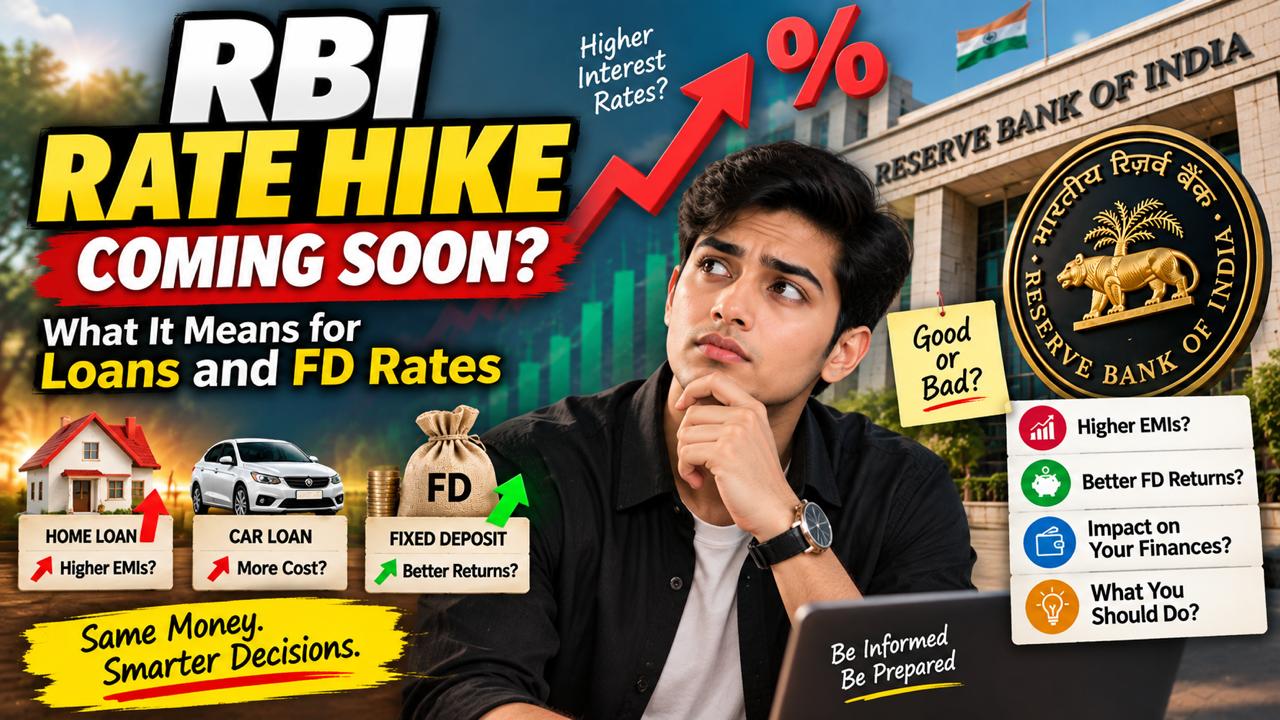
There has been a lot of discussion around RBI interest rates these days. The main reasons behind this are rising inflation, expensive crude oil, and pressure on the Indian rupee. This has raised an important question: Could the RBI increase the repo rate in the coming months?
So far, the RBI has not announced any rate hike. In its August 2026 policy meeting, the RBI kept the repo rate unchanged at 5.25%. However, since then, rising inflation and higher crude oil prices have increased expectations of a possible rate hike.
Some economists believe that if inflation continues to remain high, the RBI could consider increasing interest rates in its upcoming meetings. Some estimates are even pointing towards a possible cumulative increase of 50 basis points. However, these are only expectations from economists and the market — they are not a confirmed decision from the RBI.
So, the biggest question is: If the RBI increases interest rates, how could it affect ordinary people?
First, What Is the Repo Rate?
In simple terms, the repo rate is the interest rate at which the RBI lends short-term money to banks.
When the RBI increases the repo rate, borrowing money can become more expensive for banks. This can eventually affect the interest rates banks offer on loans and deposits.
On the other hand, when the RBI cuts the repo rate, borrowing can become relatively cheaper.
This is why whenever the RBI announces its monetary policy, people start paying attention to home loans, personal loans, FDs and other interest rates.
Why Is There So Much Talk About a Rate Hike?
The biggest concern right now is inflation.
India’s retail inflation increased to 4.82% in August 2026, compared with 4.45% in July. Food inflation also reached 5.95% in August.
At the same time, crude oil prices have also remained high. In September, Brent crude moved to around $108 per barrel. The rupee has also been under pressure against the US dollar, trading around the ₹96 level.
Expensive oil and a weaker rupee can create problems for India because the country imports a large portion of its crude oil requirements.
When oil becomes expensive and the rupee weakens, the cost of imports can increase. This can eventually put pressure on transportation and the prices of other goods and services.
This is one of the reasons why the RBI’s upcoming policy decisions are being closely watched.
Will the RBI Increase Rates Immediately?
It is difficult to say at this point.
In its August policy meeting, the RBI kept the repo rate unchanged at 5.25%. However, in the coming months, the central bank will likely keep an eye on inflation, crude oil prices, the rupee and economic growth.
Some economists have estimated that if inflation stays high for longer, the RBI could increase rates in upcoming meetings.
But one thing is important to remember — a rate hike has not been confirmed yet.
So, it would not be right to say that the RBI will definitely increase rates based only on current expectations.
What Could Happen to Home Loan Borrowers?
If you have a floating-rate home loan, an RBI rate hike could be important for you.
Suppose you already have a home loan from a bank and the interest rate increases. Your EMI could go up.
In some cases, instead of increasing the EMI significantly, the bank may increase the loan tenure, meaning you could take longer to repay the loan.
This means you may not always see a very big change in your monthly EMI, but over the longer term, you could end up paying more interest.
For example, if someone has a ₹50 lakh home loan, even a 0.50 percentage-point increase in the interest rate can affect the EMI and total interest payable.
However, the exact impact will be different for every borrower because it depends on the remaining loan tenure, current interest rate and the bank’s terms.
So, if you have a home loan, it is a good idea to first check your loan details.
What About Personal and Car Loans?
The impact of a rate hike is not limited to home loans.
Personal loans and car loans can also be affected, especially when they have floating interest rates.
Personal loans often carry higher interest rates than home loans. Therefore, if rates increase, the repayment cost for borrowers could also rise.
A similar situation can occur with car loans.
However, this does not mean that every bank will immediately increase the rates on all its loans by the same amount after an RBI rate hike.
Banks consider several factors while setting their interest rates, including their funding costs, competition and the borrower’s credit profile.
Could FD Investors Benefit?
There is another side to higher interest rates that could be useful for people who invest in Fixed Deposits, or FDs.
When interest rates in the market rise, banks may sometimes offer higher FD rates to attract deposits.
This could benefit people who are planning to open a new FD in the future.
For example, if a bank is currently offering 6.5% on an FD and later increases the rate to 7%, someone investing after the increase could potentially earn a higher return.
But there is an important point to remember:
An RBI rate hike does not automatically mean that FD rates will increase.
Banks decide their deposit rates based on market conditions, liquidity requirements and their own business needs.
Therefore, before opening an FD, it is better to compare the actual rates and terms offered by different banks.
What Happens If You Already Have an FD?
If you already have an FD, its interest rate generally does not change simply because the RBI increases the repo rate.
For example, if you have locked an FD at 6.5%, its applicable rate will generally continue according to the FD’s terms until maturity.
However, when the FD matures, you may have an opportunity to reinvest the money at a higher rate if market interest rates have increased.
This is why keeping track of your FD maturity dates can be useful.
What Could Happen to Savings Account Interest?
Savings account interest rates are also largely decided by individual banks.
If the overall interest-rate environment changes, some banks may adjust their savings and deposit rates.
However, savings account rates do not necessarily have to increase by the same amount as the repo rate.
So, if you want to know how much interest you will actually earn on your savings, it is better to check your bank’s current rate.
Could the Stock Market Be Affected?
RBI interest-rate decisions can also influence the stock market.
When interest rates rise, borrowing money can become more expensive for companies. Businesses with high levels of debt could feel more pressure because their interest expenses may increase.
At the same time, if FD and other fixed-income products start offering higher returns, they could become more attractive to some investors.
However, the stock market does not move based on RBI rates alone.
Company earnings, crude oil prices, global markets, inflation, foreign investment and economic growth can all influence the market.
So, it would be too simple to assume that “rate hike means the stock market will definitely fall.”
The actual market reaction can depend on several factors and how investors interpret the RBI’s decision.
Borrowers vs FD Investors
If interest rates rise, borrowers and savers can be affected differently.
If You Have a Loan:
- Your EMI could increase
- Your loan tenure could increase
- Your total interest cost could rise
- Taking a new loan could become more expensive
If You Invest in an FD:
- New FDs could potentially offer better interest rates
- You may get an opportunity to reinvest at a higher rate after maturity
- Fixed-income investors could benefit from higher deposit rates
However, the actual impact will depend on the bank and overall market conditions.
What Should Home Loan Borrowers Do?
If you have a floating-rate loan, there is no need to panic.
Start by checking these four things:
- What is your current interest rate?
- Which benchmark is your loan linked to?
- When does your interest rate reset?
- If the rate increases, will your EMI increase or will your loan tenure increase?
Understanding these points can help you make a more informed decision.
If your EMI is already taking up a large part of your monthly budget, maintaining an emergency fund can also be useful.
Instead of immediately refinancing or prepaying your loan because of a rate-hike headline, first calculate how much you could actually save and what charges may apply.
What Should FD Investors Keep in Mind?
If you are planning to invest in an FD, don’t look only at the bank offering the highest interest rate.
Also check the FD tenure, premature withdrawal rules, bank terms and tax implications.
If you believe interest rates may change in the future, you could consider dividing your money across FDs with different maturity dates.
This can give you access to your money at different times and provide some flexibility if interest rates change later.
What Should We Watch Going Forward?
There are several things worth watching in the coming months.
- Inflation
Will inflation continue to rise, or will it start coming down?
- Crude Oil Prices
If oil prices remain high for a long period, they could put additional pressure on India’s economy.
- Rupee vs Dollar
A weaker rupee can increase the cost of imported goods and crude oil.
- RBI’s Next Policy
The next Monetary Policy Committee decision will be closely watched by borrowers, investors and the financial markets.
- Actual Bank Rates
Ultimately, what matters most for ordinary customers is what banks actually do with their loan and deposit rates.
Bottom Line
The possibility of an RBI rate hike has become an important topic in September 2026. Retail inflation increased to 4.82% in August, food inflation stood at 5.95%, and crude oil prices have also remained high.
These factors have increased attention around the RBI’s upcoming policy decisions.
However, a rate hike has not been confirmed yet.
If the RBI increases rates in the future, floating-rate loans could become more expensive, which may result in higher EMIs or longer loan tenures. On the other hand, people opening new FDs could potentially get better interest rates if banks increase their deposit rates.
The impact will not be the same for everyone. Borrowers should look at their actual loan terms, while FD investors should compare rates, maturity periods, taxation and liquidity requirements before making a decision.
For now, four things are particularly important to watch:
Inflation + Crude Oil + Rupee + RBI Policy
These factors will give a better picture of where interest rates could be heading in the coming months.