Today, UPI has become a part of our everyday life. Whether it is buying something from a local shop, shopping online, or sending money to a friend, most people use UPI for payments. You simply scan a QR code and the payment is done within seconds.
Now, a new change related to UPI is making headlines.
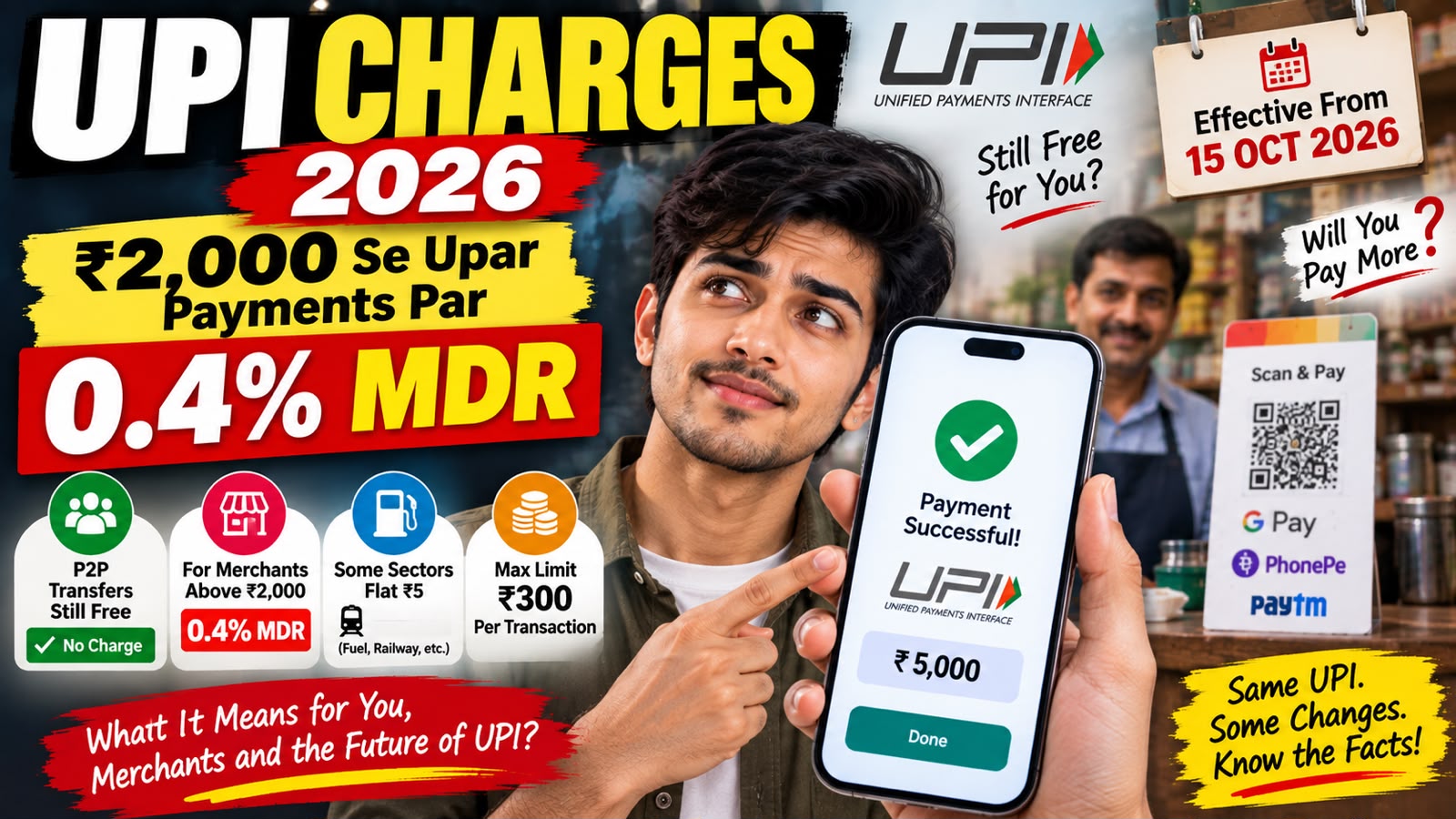
From October 15, 2026, a 0.4% MDR will apply to certain eligible UPI merchant payments above ₹2,000. However, this does not mean that customers will have to pay an extra 0.4% on every payment. The charge will mainly apply on the merchant side. (Reuters)
This is where most of the confusion comes from.
Many people are wondering whether they will be charged extra if they make a UPI payment of ₹5,000 or ₹10,000 using apps like Google Pay, PhonePe or Paytm.
Can a shopkeeper pass this charge on to the customer? How much MDR will apply to a ₹5,000 or ₹10,000 payment? And why is this charge being introduced in the first place?
Let’s understand everything in simple language.
First, What Exactly Has Changed?
Under the new framework, MDR will apply to certain Person-to-Merchant, or P2M, UPI transactions above ₹2,000.
The new rule is expected to come into effect from October 15, 2026. The maximum MDR has been capped at ₹300 per transaction. This means that even for a very large eligible payment, the MDR cannot exceed ₹300. (Moneylife)
But there is one important thing to understand:
This is not a UPI charge that customers directly have to pay.
If you make a UPI payment to an eligible shop, company or business, the MDR will apply within the payment ecosystem on the merchant side.
However, if you send money to a friend or family member, that is a P2P, or Person-to-Person, transaction. The new merchant MDR will not apply to it. (The Federal)
How Much MDR Will Apply to a ₹5,000 UPI Payment?
Let’s understand it with a simple example.
Suppose you make a ₹5,000 payment to an eligible merchant.
At 0.4%, the MDR would be:
₹5,000 × 0.4% = ₹20
For a ₹10,000 payment:
₹10,000 × 0.4% = ₹40
And for a ₹50,000 payment:
₹50,000 × 0.4% = ₹200
For a ₹75,000 payment, 0.4% comes to ₹300. Above that amount, the calculation could be higher, but because of the cap, the maximum MDR will remain ₹300. (Moneylife)
Payment Amount MDR at 0.4%
₹2,000 No new MDR
₹5,000 ₹20
₹10,000 ₹40
₹25,000 ₹100
₹50,000 ₹200
₹75,000 ₹300
₹1,00,000 ₹300 cap
Keep in mind that these calculations apply to eligible transactions. The same rule will not necessarily apply to every UPI payment.
Will Customers Have to Pay Extra?
This is probably the biggest question people have.
Generally, customers should not have to pay the 0.4% MDR separately.
The new framework is designed to keep UPI payments free for users. Banks and UPI providers are not allowed to directly pass this charge on to customers. (Reuters)
For example, if you make a ₹5,000 UPI payment to an eligible merchant, your bank account should not be charged ₹5,020 just because of the MDR.
Your payment amount remains ₹5,000.
The MDR is settled within the payment ecosystem between the merchant and other participants involved in processing the transaction.
What Exactly Is MDR?
MDR stands for Merchant Discount Rate.
When a shop or business accepts a digital payment, several banks and payment companies can be involved in processing that transaction.
These can include the merchant’s bank, the customer’s bank, payment service providers and other payment partners.
Running this payment system involves costs related to technology, servers, cybersecurity, fraud prevention and customer support.
MDR is part of the cost and revenue structure of this payment ecosystem.
So, it would not be accurate to simply call it a “UPI tax.” According to Business Standard, the charge is not being collected as a government tax. (Business Standard)
Why Is MDR Being Introduced on UPI?
UPI has grown extremely quickly in India.
Today, you can find UPI QR codes everywhere, from small local shops to large businesses.
According to NPCI data, UPI processed around 24.5 billion transactions in August 2026, with a total transaction value of approximately ₹29.82 lakh crore. (NPCI)
Running a payment network of this size involves continuous costs.
There is spending on cybersecurity, fraud protection, servers, technology and customer support.
The zero-MDR model has played an important role in helping UPI grow rapidly. But as transaction volumes have increased significantly, the question of making the payment ecosystem financially sustainable has also become more important.
The new MDR framework is being seen as a step in that direction. Reuters reported that the need to support infrastructure, cybersecurity and customer service is one of the factors behind the move. (Reuters)
Will 0.4% MDR Apply to Every UPI Payment?
No. Definitely not.
This is one of the most important things to understand.
If you send ₹10,000 to a friend, you will not suddenly be charged 0.4% just because the amount is above ₹2,000.
That is because it is a P2P transaction.
On the other hand, if you pay ₹10,000 to an eligible merchant, the new MDR framework may apply.
In simple terms:
Sending money to a person = P2P
Paying a shop or business = P2M
The new MDR mainly applies to eligible P2M transactions. (The Federal)
What Happens to Payments Up to ₹2,000?
Under the new framework, the 0.4% MDR will not apply to eligible low-value merchant transactions up to ₹2,000. (The Federal)
For example:
- ₹500 merchant payment — no new MDR
- ₹1,000 merchant payment — no new MDR
- ₹2,000 merchant payment — no new 0.4% MDR
- ₹5,000 eligible merchant payment — 0.4% MDR framework may apply
This makes the ₹2,000 threshold one of the most important parts of the new framework.
What About Sending Money to Friends and Family?
If you send money to your friend, brother, sister, parents or another individual through UPI, it is a P2P payment.
The new merchant MDR will not apply to it. (The Federal)
Suppose you send ₹20,000 to your friend.
The amount is much higher than ₹2,000, but the new 0.4% MDR still does not apply simply because it is a personal transfer.
So, there is no need to worry about the new merchant MDR when sending money to friends or family.
What About Small Shopkeepers?
There is also a separate arrangement for smaller merchants.
According to reports, some small merchants and QR-based businesses may receive exemptions. The idea is to avoid putting too much additional financial pressure on small businesses. (Reuters)
According to NPCI, low-value P2M transactions of up to ₹2,000 account for more than 95% of UPI transaction volume.
This means the direct impact of the change on everyday small payments is expected to be limited.
What About Fuel, Railway and Other Sectors?
Some sectors have been given a different MDR structure.
According to reports, sectors such as railway, fuel and telecom may have a flat ₹5 MDR framework. (Reuters)
So, it would not be correct to assume that every UPI payment above ₹2,000 will simply have a 0.4% charge.
The merchant category and type of transaction will also matter.
Can a Shopkeeper Ask the Customer for 0.4%?
The purpose of MDR is not to collect a separate UPI fee directly from customers.
According to reports, banks and UPI providers are not allowed to directly pass this charge on to customers. (Reuters)
So, if a merchant asks for an additional 0.4% simply because you are paying through UPI, it is worth asking what the extra amount is for before making the payment.
However, how a merchant sets the overall price of a product or service is a separate matter.
Will UPI Become Expensive Now?
After hearing this news, some people may feel that UPI is no longer going to be free.
But the situation is not that simple.
UPI can remain free for customers, while merchants may have to bear a payment processing cost.
So, if you make a ₹500 payment or send ₹10,000 to a friend, you are not supposed to pay an additional 0.4% simply because of this new MDR.
The impact will mainly be relevant for businesses that regularly receive large-value UPI merchant payments.
What Could Change for Merchants?
For businesses, payment processing costs could become a new factor to consider.
Suppose a business receives ₹5 lakh every day through eligible UPI merchant payments.
If the entire amount falls under the new MDR framework, 0.4% would work out to a theoretical MDR of around ₹2,000 per day.
However, the actual amount will depend on exemptions, transaction-level caps and the applicable rules.
For large businesses, this could become a meaningful monthly cost.
At the same time, UPI remains a fast and convenient payment option for customers. That means accepting UPI could continue to be important for businesses.
What Does This Mean for Payment Companies?
The change could also create a new revenue opportunity for banks and payment companies.
According to Reuters, market participants see the new MDR as a potential revenue pool for banks and payment companies. (Reuters)
Following the news, some listed companies connected to the UPI ecosystem also saw movement in their share prices on September 16.
However, it would not be correct to link a stock’s movement only to this one announcement. Stock prices are affected by many different factors at the same time. (Reuters)
Could Cash Payments Increase Again?
This is one possible concern.
If some merchants consider UPI MDR an additional cost, they may encourage customers to use cash or other payment methods.
But it is too early to know how much this will happen.
UPI is popular because it is quick, convenient and widely accepted across India. How customers and merchants actually respond to the new framework will become clearer over time.
That is why the real impact of this change may only become visible after the new system has been in place for some time.
What Should Regular UPI Users Do?
If you use UPI for everyday payments, there is no need to panic.
If you make payments of ₹100, ₹500 or ₹1,000, the new 0.4% MDR should not result in a direct charge to you.
If you send money to friends or family, P2P transfers are also outside this merchant MDR framework.
If you regularly make large payments to merchants, it is a good idea to keep an eye on your transaction details.
And if a merchant asks you for an additional charge for paying through UPI, ask for clarity about why that amount is being charged before completing the payment.
The New UPI Rule in Simple Terms
If you want to understand the entire change in just four lines, here it is:
Up to ₹2,000 eligible merchant payment → No new 0.4% MDR
Above ₹2,000 eligible merchant payment → 0.4% MDR framework
Sending money to friends or family → No new merchant MDR
Maximum MDR → ₹300 per eligible transaction
So, regular UPI users do not need to assume that every payment is suddenly going to become more expensive.
Bottom Line
A new change is expected to come into effect in the UPI payment system from October 15, 2026, with the ₹2,000 threshold and 0.4% MDR being the key parts of the framework.
But the most important thing to understand is that this is not a direct UPI charge on customers.
A 0.4% MDR will apply to eligible merchant UPI payments above ₹2,000, with a maximum limit of ₹300 per transaction. (Moneylife)
Personal UPI transfers, or P2P payments, are not covered by this merchant MDR. The framework is designed to keep UPI payments free for customers. (Reuters)
The bigger impact will be seen on merchants and the wider digital-payment ecosystem.
UPI has already become a huge part of India’s digital payment system. In August 2026 alone, UPI processed around 24.5 billion transactions, with a total value of approximately ₹29.82 lakh crore. (NPCI)
Now, the key thing to watch will be how the new MDR framework affects businesses, payment companies and the overall digital payment ecosystem.
For regular UPI users, remember these four points:
UPI merchant payment above ₹2,000 = 0.4% MDR framework
P2P UPI transfer = Free
Direct MDR charged to customer = No
Maximum MDR = ₹300 per eligible transaction
So, for most regular UPI users, the direct impact of this change should remain limited. The bigger change is likely to be on the merchant and payment-ecosystem side.