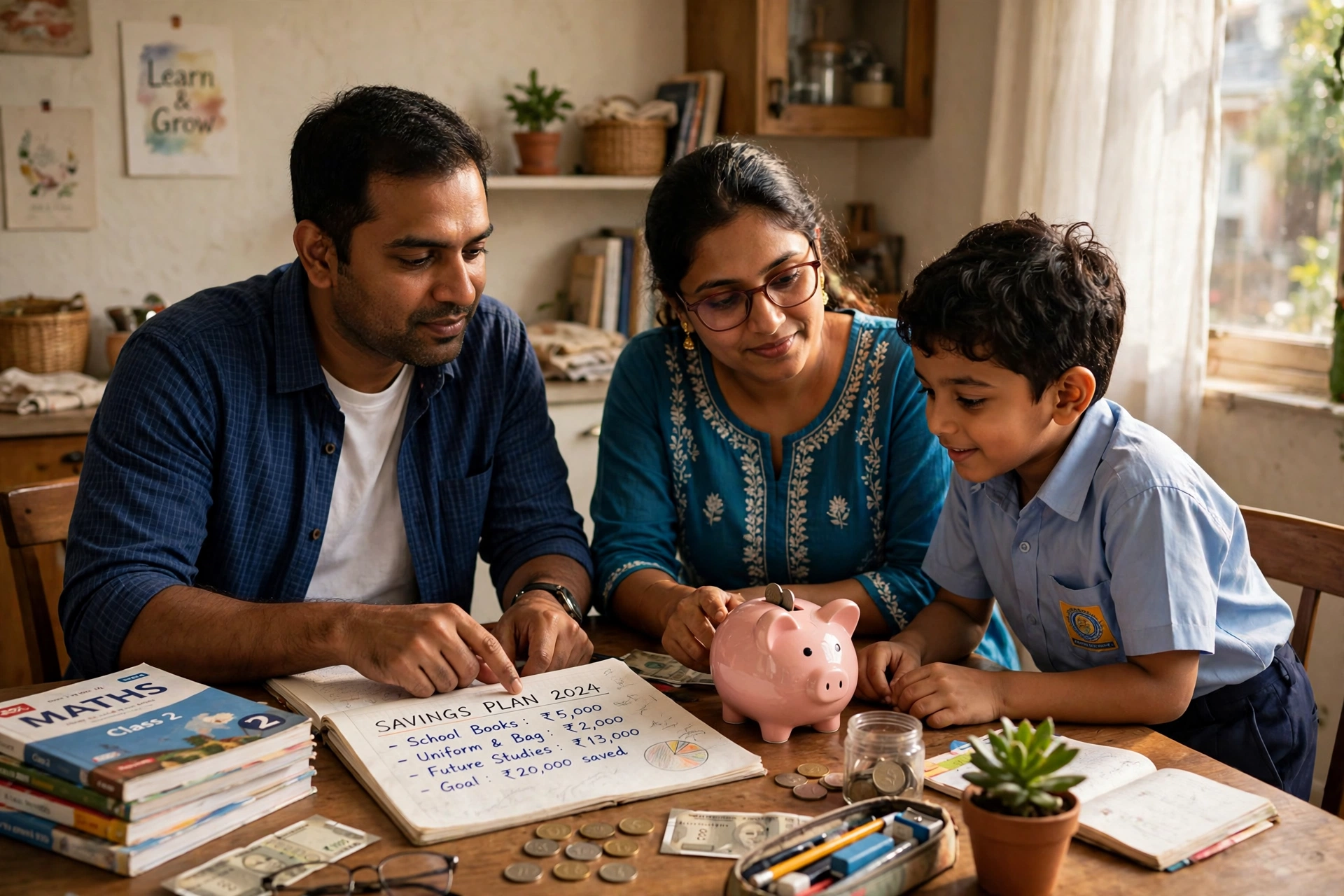
If your child is five today and you want ₹20 lakh ready for college in twelve years, you need to set aside roughly ₹6,200 every month from now, assuming an illustrative return of around 12% a year. That single number is the whole point of this article: to save for your child’s education, you work backwards from the goal, not forwards from whatever is left at the end of the month. The monthly figure changes with your child’s age, the kind of education you have in mind, and the return you actually get, but the method stays the same — pick a target, count the years you have, and turn it into a monthly habit.
Most parents know education will be expensive. What catches them off guard is how quickly the bill grows, and how late they start.
Why education costs rise faster than everything else
General inflation in India runs around 5–6% a year. Education inflation runs higher, often 8–10%. A private school charging ₹1.2 lakh a year today may charge ₹1.5 lakh in three years, not because it became dramatically better, but because teacher salaries, transport, and facilities all cost more, and schools pass that on.
Take a concrete illustration. Suppose your child is in Class 3 in a city private school charging ₹1.5 lakh a year, including transport and activities. At 8% annual growth, that fee becomes roughly ₹2.2 lakh a year by Class 8, and close to ₹3 lakh a year by Class 12. Over the remaining school years, you could spend ₹20–25 lakh on school fees alone. These are illustrations, not predictions, but they show why “we will manage when the time comes” is a risky plan.
College is where the numbers jump. An engineering degree at a decent private college in India today might cost ₹10–12 lakh in total fees over four years, before hostel and living costs. If your child is eight now and will join college in ten years, that ₹12 lakh degree, growing at 10% a year, becomes roughly ₹31 lakh. Wait fifteen years and it is closer to ₹50 lakh.
None of this means you must pay for the most expensive option. Plan for a realistic range, not a hopeful one. A family aiming for a government college still needs a buffer, because admission is never guaranteed, and a family aiming for a private college needs a much bigger one.

Work backwards: turn a big goal into a monthly number
The method is simple. First, estimate what you will need and when. Second, count the years left. Third, divide the goal into a monthly amount using a reasonable assumed return. The return is only an assumption — actual returns vary — but it lets you start, and you can adjust every year.
Here is the worked example from the introduction, in full. You want ₹20 lakh in twelve years. At an illustrative 12% a year, you need about ₹6,200 a month. If the return turns out to be 10% instead, the same monthly amount gives you roughly ₹17 lakh, so you would need to top it up. That gap is exactly why a yearly review matters.
The table below shows how the monthly figure changes with time, assuming an illustrative 12% annual return and a goal of ₹20 lakh.
| Years left | Monthly amount for ₹20 lakh |
|---|---|
| 5 years | About ₹24,250 |
| 10 years | About ₹8,600 |
| 12 years | About ₹6,200 |
| 15 years | About ₹4,000 |
The table contains the whole argument for starting now: a parent with fifteen years needs ₹4,000 a month for the same goal that costs a parent with five years ₹24,250 a month.
Adjust the goal to your situation: if you need ₹40 lakh rather than ₹20 lakh, roughly double the monthly figure. Run the calculation for your family, write the monthly figure down, and treat it like a bill paid before anything optional.

Split the goal: school years and college years are different jobs
One mistake parents make is treating “education” as a single pot of money. School fees and college fees behave differently. School fees are a yearly, ongoing expense, due every term from now until Class 12. College fees are a large lump sum, due in a few years’ time, all at once.
For school fees, build them into your monthly budget as a fixed cost, the same way you budget rent or groceries. If the annual fee is ₹1.8 lakh, you need ₹15,000 a month set aside for it. Many parents keep a separate account for school expenses, fed on salary day, so a fee notice never becomes a crisis.
For college, the lump-sum approach works better: a dedicated, long-term pot that you do not touch for anything else, built up month by month. Keeping the two pots separate also keeps you honest. If you dip into the college fund to pay this year’s school fee hike, you are borrowing from your child’s future at the worst possible time, because the money you take out loses years of growth.
Where parents commonly keep this money
There is no single right place for education savings. Different options suit different time horizons, and most families end up using a mix. What matters is matching the option to the goal, and understanding the trade-off. Everything below is general information, not a recommendation for any particular product.
For a girl child, the Sukanya Samriddhi Yojana is often the first thing parents look at. It is a government-backed scheme for a girl child below ten, with a tax-free return currently higher than most fixed deposits, and partial withdrawal is allowed at eighteen for education. Its limits are real, though: an annual deposit cap, a long lock-in, and it rarely covers the full cost of a degree on its own.
The Public Provident Fund is another long-term, government-backed option. It runs for fifteen years, offers tax-free returns, and is very safe, but the return is modest and the annual deposit limit caps how much you can build. For a goal fifteen years away it grows steadily; for a goal five years away, the lock-in makes it a poor fit.
A systematic investment plan in mutual funds is the option most parents turn to for a long horizon, because equity markets have historically beaten inflation over ten to fifteen years, even though returns are not guaranteed and values fall in bad years. If you are considering this route, a simple explainer on how to start a SIP with just ₹500 a month covers the mechanics in plain language. Keep going through market falls, because stopping during a dip locks in the worst outcome, and move money gradually into safer options as college approaches.
Fixed deposits and recurring deposits are the simplest options, and the safest. The return is known in advance and the money is protected. The trade-off is that FD and RD returns often barely beat general inflation, and fall well short of education inflation, so money kept only in FDs for fifteen years will buy less education at the end. FDs make sense for money you need within the next year or two — next year’s school fees, for example.
Keep the education fund separate from emergency money
This is a distinction that sounds obvious and gets blurred constantly. Your emergency fund is for job loss, a medical bill, or an urgent home repair. Your education fund is for fees due on a known date. When the two sit in the same account, an emergency quietly eats the education goal, and a fee notice quietly eats the emergency buffer.
Keep them in different accounts, or at least in clearly separate pots you never mix. The emergency fund should cover six months of essential expenses and be instantly accessible — a savings account or a short-term deposit, not a locked-in scheme. A separate guide on how much of an emergency fund you really need and where to keep it walks through the sizing.
The separation also protects you from yourself. A college fund that has grown to ₹8 lakh is tempting when a car needs replacing or a renovation beckons. A separate account with a clear label — your child’s name, the goal, the year — makes that withdrawal feel like what it is: taking money from a future fee bill.
What to do if you are starting late
Maybe your child is already thirteen, and this article is the first time you have run the numbers. The maths is less forgiving now, but it is not hopeless, and doing something is far better than doing nothing.
First, accept the higher number. If you need ₹20 lakh in five years, the table above says roughly ₹24,250 a month at an illustrative 12% return. If that is more than you can manage, lower the goal rather than pretending the maths will fix itself — aim for a government college, a shorter course, or a degree closer to home where hostel costs disappear. A realistic ₹12 lakh goal that you actually fund beats a ₹30 lakh goal that stays on paper.
Second, rank your goals and be prepared to cut the lower ones. For most families with a teenager, the order looks like this: emergency fund first, because a crisis without a buffer destroys every other plan; education second, because its deadline is fixed; retirement third, because it can be stretched, even though delaying it has its own cost; and lifestyle upgrades — a bigger car, a renovation, an expensive holiday — last. That ordering is painful, and it is temporary. Once the college years pass, the monthly amount frees up again.
Third, look at what can be trimmed without drama. A family that finds ₹5,000 a month by cutting subscriptions, eating out less, and renegotiating insurance premiums has just covered a fifth of the late-start monthly figure. Involve the teenager, and it becomes a shared project.
Finally, know what an education loan actually costs before you treat it as a fallback. A loan of ₹10 lakh at 9% interest over seven years means a monthly EMI of roughly ₹16,100, and total interest of about ₹3.5 lakh on top of the principal. That burden falls either on you or on your child at the start of their working life. A loan is not a failure — for many families it is the only way to afford a good degree — but it should be a last resort, taken for the gap after savings, not a substitute for saving.
Review the plan once a year, and nothing more
An education plan does not need weekly attention. It needs one honest review a year, ideally when the school fee notice arrives. Three questions cover it. Has the goal changed — a different course, a different city, a different fee structure? Is the monthly amount still on track? And is the money still in the right place for the time left, with more moving to safer options as college approaches?
That yearly check is also when you increase the monthly amount. A 10% annual increase — from ₹6,000 to ₹6,600, then to ₹7,260 — is barely noticeable if it rises with your salary, and over a decade it adds a substantial amount to the final fund. Set the monthly transfer to automatic, review once a year, and let time do its work.
Let your child into the conversation as they grow
Money conversations with children do not need to be lectures, and they should not be worries dressed up as lessons. A ten-year-old can understand that school costs money and that the family sets some aside each month. A fourteen-year-old can understand the difference between a government college and a private one, and what each means for the family budget. A sixteen-year-old choosing a course should know, in broad terms, what the options cost, so the choice is informed rather than a shock later.
This is not about burdening a child with financial anxiety. It is about giving them the practical understanding you wish you had at their age: that money is finite, that big goals need small regular steps, and that a degree is both an education and a financial decision. Start small — a piggy bank for a young child, a savings account they can watch grow for a teenager, a conversation about the cost of a course when they start thinking about college.
So, run the numbers this week. Pick a target that reflects your honest expectation, work out the monthly figure for the years you have, set up the automatic transfer, and keep the fund separate from everything else. The plan does not need to be perfect; it needs to be started, and kept going. Years from now, when the admission letter arrives and the fee notice follows, the difference between a scramble and a calm payment will come down to the monthly habit you built when your child was still small enough to think a piggy bank was a bank.