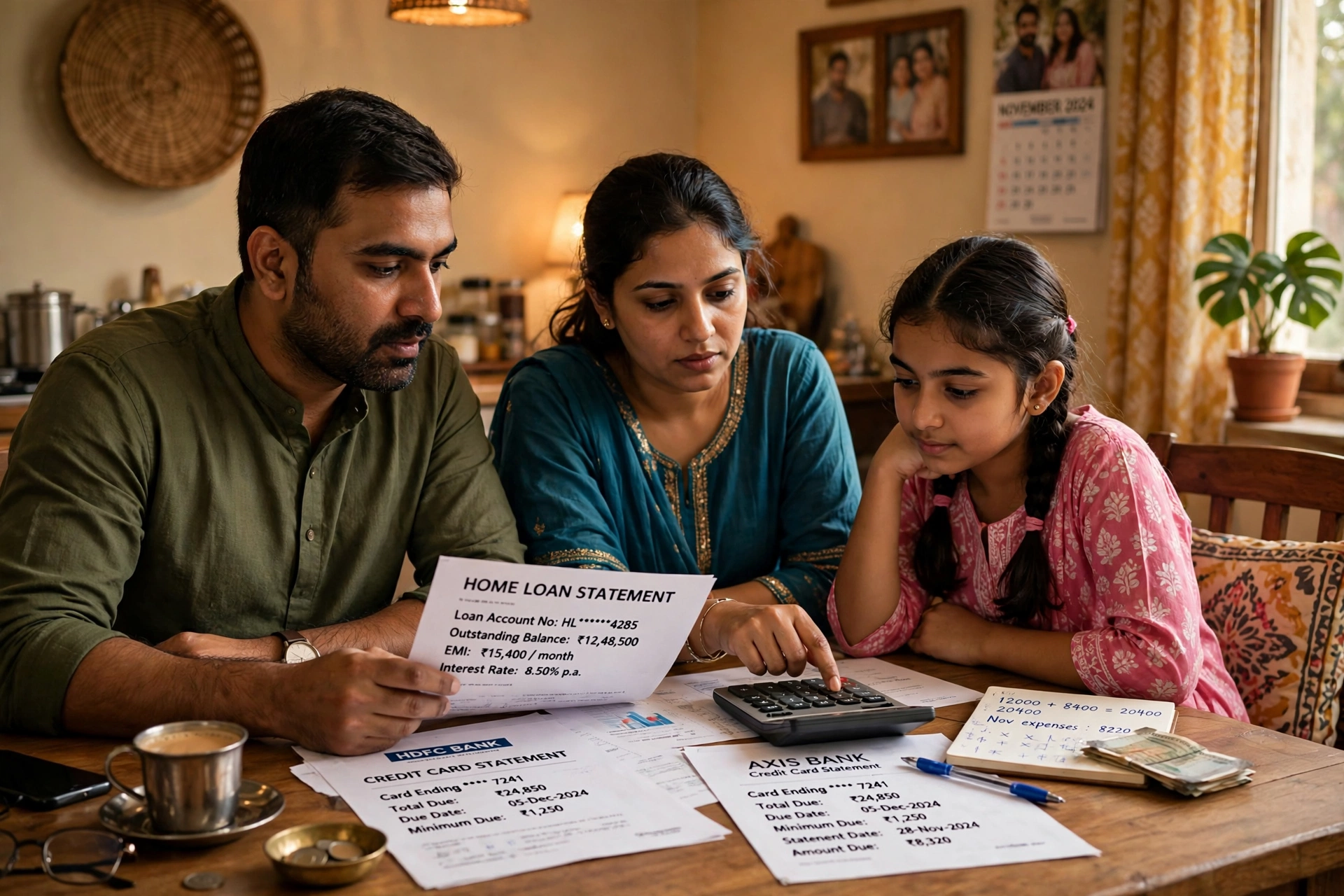
Debt rarely arrives all at once. It usually builds quietly — one credit card swipe for a phone, a personal loan for a wedding, a buy-now-pay-later instalment that felt small at checkout, and then an EMI that eats into the next month’s salary before it even lands. One morning you realise that a large part of your income is already spoken for, and the total you owe feels bigger than you expected. If that sounds familiar, you are not alone, and you are not stuck forever. Learning how to get out of debt in India is mostly about replacing panic with a clear, workable plan — and then following it month after month.
The plan in this article is simple on purpose. You will list everything you owe, stop the balance from growing, pick a repayment order that you can actually stick to, talk to your lenders where it helps, and build a small safety net so that one emergency does not push you back into borrowing. It will not clear your debt overnight. But followed steadily, it can turn a confusing pile of dues into a finish line you can see.
Step 1: See the Full Picture Before You Decide Anything
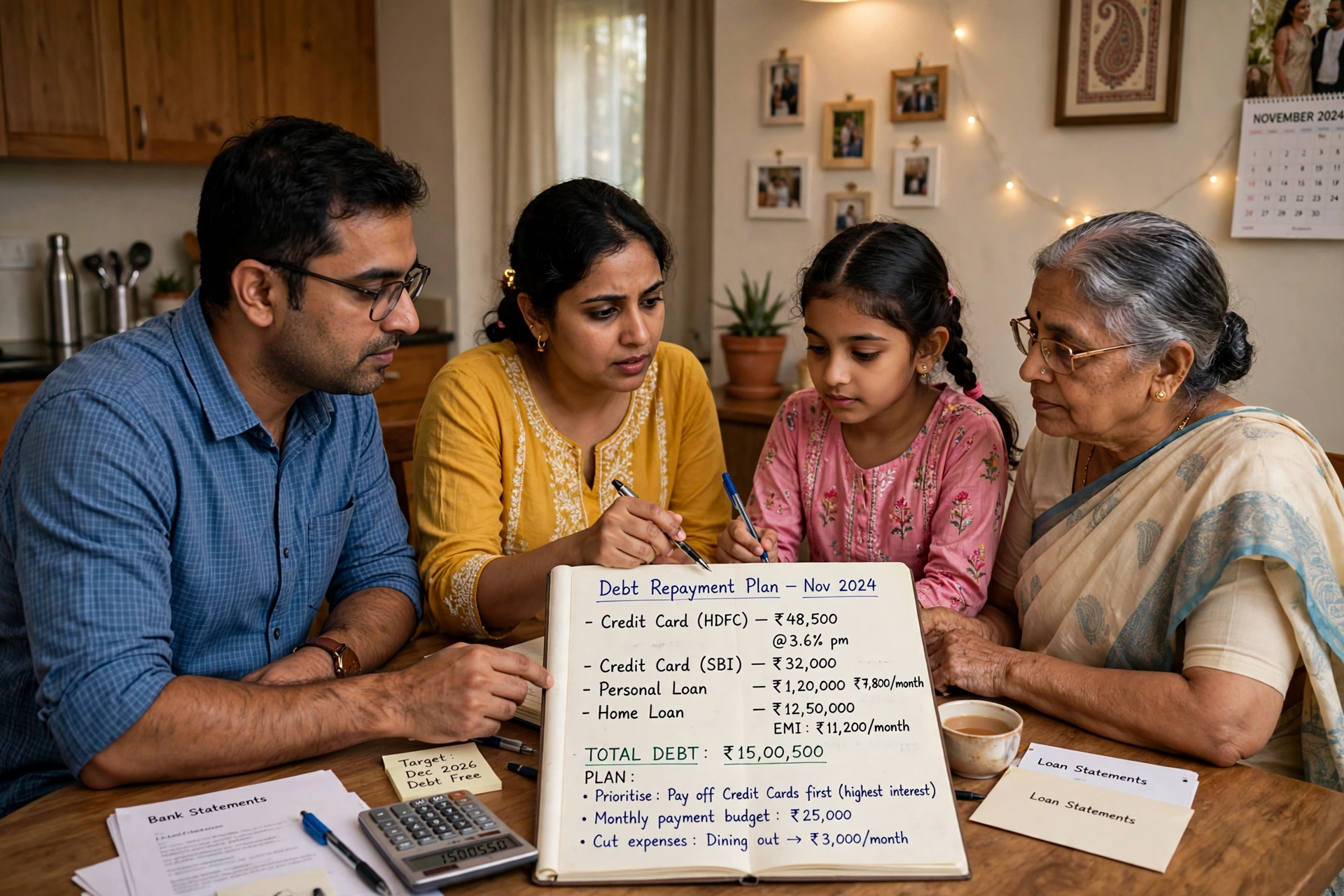
Most people in debt underestimate what they owe. Not because they are careless, but because the debt is spread across apps, cards, and bank accounts, and each statement arrives on a different date. The first job is to bring it all into one place. Take a notebook or a simple spreadsheet and write down every single debt: credit cards, personal loans, vehicle loans, education loans, gold loans, money borrowed from family, and any buy-now-pay-later balances. For each one, note the total outstanding amount, the interest rate, the minimum payment or EMI, and the due date.
This list can be uncomfortable to write. Do it anyway, preferably in one sitting, with your statements open in front of you. A vague worry — “I think I owe around two lakh” — is hard to act on. A clear list — “I owe ₹1,84,000 across four accounts, and ₹42,000 of that is on a credit card charging 40% a year” — tells you exactly where to start. You may also spot things you had forgotten: a card you stopped using that still charges interest, or a loan whose EMI is higher than you remembered.
Step 2: Stop the Debt From Growing First
Paying off debt while still adding to it is like trying to empty a bucket with a leak. Before you focus on extra payments, plug the leak. That usually means a few honest, short-term changes. Put the credit card away for daily spending and switch to UPI or debit for groceries, fuel, and eating out. Pause new buy-now-pay-later purchases, even for things that feel urgent but are really just convenient. If a big expense is coming up — a festival, a family function, a school fee — plan for it in cash rather than putting it on a card and hoping next month will be easier.
This does not mean you have to live on nothing. It means spending has to fit inside what is left after your EMIs and minimum payments, not the other way round. Take one month and track where your money actually goes. Many people find ₹3,000 to ₹5,000 a month leaking into food delivery and unused subscriptions — cutting even half of that frees up real money for repayment.
One important warning: never take a new personal loan just to pay the minimum due on a credit card, unless you have worked out the full maths and the new loan is genuinely cheaper and has a fixed end date. Borrowing to service borrowing can feel like relief for a month, and then leave you with two payments instead of one. If you are already only paying the minimum due on a card, read about how the credit card minimum due trap works — the interest on an unpaid card balance in India commonly runs at 36% to 42% a year, which is why a ₹50,000 balance can stay stuck for years on minimum payments alone.
Step 3: Keep Paying at Least the Minimum on Everything
Whatever repayment method you choose, one rule never changes: pay at least the minimum due on every debt, every month, on time. Missed payments attract late fees, penal interest, and damage to your credit score, and they can also lead to recovery calls that add stress to an already difficult situation. Set up auto-debit or calendar reminders for each due date, especially for cards, where the due date and the statement date are easy to confuse.
Step 4: Build a Tiny Emergency Buffer Alongside Repayment
This step surprises people. When you are in debt, why keep any money aside instead of throwing it all at the loan? Because without even a small buffer, the next emergency — a bike repair, a medical bill, a sudden trip home — goes straight back onto the credit card, and you are back where you started. A buffer of ₹10,000 to ₹20,000, kept in a separate savings account and touched only for genuine emergencies, breaks that cycle. Later, you can grow it into a proper fund — see how much emergency fund you really need in India and where to keep it.
Step 5: Pick Your Repayment Order — Snowball or Avalanche
Once minimums are covered and a small buffer exists, any extra money you can find goes to one debt at a time, in a chosen order, until it is gone. Then you roll that freed-up payment into the next debt. The two most popular ways to choose that order are the snowball method and the avalanche method. The best one is the one you will follow for a year or more.
With the snowball method, you attack the smallest balance first, regardless of interest rate. Clearing a small debt quickly gives you a visible win, and that momentum helps many people keep going. With the avalanche method, you attack the highest interest rate first, regardless of balance size. This saves the most money on interest over time, because expensive debt — usually credit cards — gets cleared earliest. If you are disciplined with numbers and motivated by saving interest, avalanche usually wins on paper. If you have struggled to stick to plans before and need early wins to stay motivated, snowball is often the smarter real-world choice.
Here is how the two methods look on the same three debts. Suppose Priya, who earns ₹50,000 a month in Pune, owes ₹60,000 on a credit card at 40% a year, ₹1,20,000 on a personal loan at 14%, and ₹25,000 in buy-now-pay-later balances at around 18%. She can pay all minimums, plus an extra ₹8,000 a month towards one debt.
| Debt | Balance | Interest rate | Snowball order | Avalanche order |
|---|---|---|---|---|
| Buy-now-pay-later | ₹25,000 | ~18% p.a. | 1st (smallest) | 3rd (lowest rate) |
| Credit card | ₹60,000 | 40% p.a. | 2nd | 1st (highest rate) |
| Personal loan | ₹1,20,000 | 14% p.a. | 3rd (largest) | 2nd |
In this example, snowball clears the ₹25,000 balance first, perhaps in about three months with the extra ₹8,000, and that early win frees up its monthly instalment for the card next. Avalanche puts the same ₹8,000 towards the credit card first, because at 40% a year that balance costs roughly ₹2,000 a month in interest alone, far more than the other two. Over the full repayment period, avalanche saves Priya more interest. But if clearing the small balance first is what keeps her going through a long year of tight budgets, snowball is still a good plan — the most expensive plan is the one you abandon. Pick one method, write it down, and do not keep switching every month.
Step 6: Talk to Your Lenders — They May Offer More Help Than You Expect
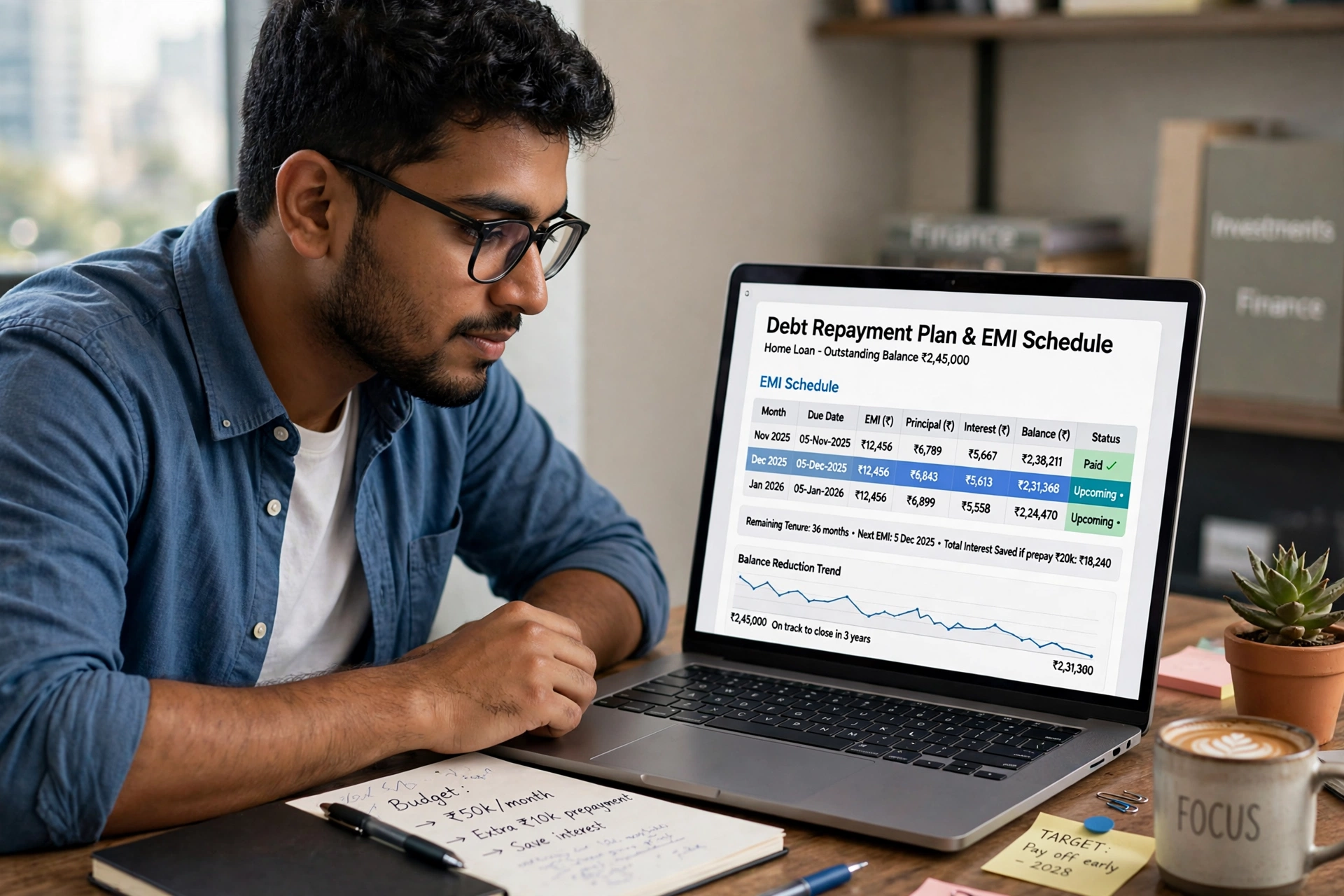
Many borrowers avoid calling their bank out of embarrassment, but lenders would usually rather agree a workable repayment plan than chase a default. If you have lost income, faced a medical emergency, or simply cannot meet the current EMI, call the bank or card issuer before you miss payments, not after. Explain the situation briefly and ask what options exist. Depending on the lender and the loan, these may include a temporary EMI reduction, a longer tenure with a lower monthly payment, a one-time settlement on a card balance, or a restructuring of the loan.
Be careful with settlements. A settled account — where the lender accepts less than the full amount — is marked as settled on your credit report, which is not as clean as a fully closed, fully paid account. It may still be the right choice if you genuinely cannot repay the full amount, but understand the trade-off before agreeing, and always get any agreement in writing before you pay. Never pay a so-called settlement agent upfront, and never share your OTP or full card details with anyone who calls claiming to help with your loan. Real bank staff will not ask for those.
Another option worth asking about is a balance transfer or a lower-interest loan used to replace high-interest card debt — but only if the maths clearly works. For example, moving a ₹60,000 card balance at 40% to a personal loan at 14% with a fixed 12-month tenure could cut the interest cost sharply, provided you do not run the card up again and you can afford the new EMI comfortably. Compare the processing fee, the tenure, and the total interest, not just the monthly figure. If the new EMI is lower only because the tenure is much longer, you may end up paying more overall.
Step 7: Make the Plan Fit Your Salary, Not the Other Way Round
A repayment plan only works if it survives contact with real life. Sit down with your actual monthly numbers. Say you earn ₹45,000 a month after tax. Rent is ₹12,000, groceries and household costs are ₹10,000, transport is ₹3,000, and your loan minimums come to ₹9,000. That leaves ₹11,000 for everything else — food delivery, clothes, outings, family support, and extra debt payments. If your plan assumes ₹10,000 a month extra towards debt, it will fail in the first month a relative needs help or a festival arrives. A plan that assumes ₹5,000 extra, and holds for twelve months, beats a heroic plan that collapses in six weeks.
Look for extra repayment money in places that do not hurt daily life too much. A yearly bonus, tax refund, or festival gift can go straight to the target debt. Selling something you no longer use — an old phone, a second vehicle, unused furniture — can clear a small balance in one stroke. If your income has room to grow, even a small side income of ₹3,000 to ₹5,000 a month, from freelancing, tutoring, or weekend work, can shorten the repayment timeline noticeably when it is directed at debt rather than absorbed into spending. The point is to find one or two realistic sources of extra money and protect them for the plan.
What to Do When Income Drops or a Payment Is Missed
Setbacks happen, and a good plan has room for them. If your income drops — a job loss, reduced hours, a business slowdown — contact your lenders early, prioritise food, housing, and essential utilities, and keep paying at least something on each debt if you possibly can. Even a partial payment, made with the lender’s knowledge, is better than silence followed by a missed EMI. Keep a simple record of every call: the date, the name of the person you spoke to, and what was agreed.
Staying Debt-Free Once the Last Payment Is Made
The month you clear your last high-interest debt deserves a pause, but not a spending spree. Keep the habit that got you there: the same monthly amount you were paying towards debt can now become your savings. Build the emergency fund up to three to six months of essential expenses, kept in a savings account or a liquid fund you can reach quickly. Then, and only then, think about longer-term goals like investing through SIPs or saving for a house deposit.
Getting out of debt in India is rarely about one clever trick. It is about a list you trust, minimums you never miss, one target debt at a time, honest conversations with lenders, and a small buffer that stops emergencies from undoing your progress. Start this week, even if the first step is only writing the list. In six months, the numbers will look different. In a year or two, for many borrowers, they look unrecognisable — not because the income suddenly doubled, but because every rupee finally had a job, and debt was no longer first in line for it.